Bebop: The Revolution of Modern Jazz
Bebop emerged in the mid-1940s as a daring departure from the commercial sounds of the Swing era. More than just a musical style, it was a movement that shifted jazz from the dance hall to the concert stage, transforming it into a sophisticated "musicians' music." Led by visionaries like alto saxophonist Charlie Parker and trumpeter Dizzy Gillespie, bebop challenged traditional harmonies and rhythms, laying the groundwork for nearly all subsequent forms of modern jazz.
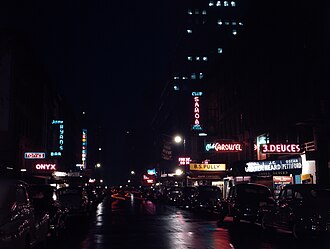
The term "bebop" itself is rooted in the playful world of scat singing—the use of nonsense syllables or vocables to improvise melodies. While the word appeared in recordings as early as 1928 with McKinney's Cotton Pickers and later in 1936 with Jack Teagarden, it didn't become synonymous with this specific genre until the mid-1940s. Thelonious Monk, a pivotal pianist of the era, suggested the name may have come from his composition "Bip Bop," later known as the "52nd Street Theme."
!["In spite of the explanations of the origins of these words, players actually did sing the words 'bebop' and 'rebop' to an early bop phrase as shown in the following example."[8] Playⓘ](/images/d0/57/d057c5eb3cfec19788ec4a712e467cea431b9fc0015f76dfc239a1beafbf70e4.png)
Key Facts
- Origin: Developed in the United States during the mid-1940s.
- Core Innovators: Charlie Parker, Dizzy Gillespie, and Thelonious Monk.
- Musical Shift: Moved the rhythmic pulse from the bass drum to the ride cymbal.
- Key Characteristics: Complex harmonies, asymmetrical phrasing, and a focus on virtuosic soloing.
- Legacy: Directly influenced hard bop, post-bop, cool jazz, and even modern hip-hop.
The Evolution from Swing to Bop
Bebop did not appear in a vacuum; it was the culmination of trends that had been simmering within swing music since the mid-1930s. The transition involved several critical technical shifts:
- Rhythm: Drummers moved away from explicit timekeeping on the bass drum, shifting the primary pulse to the ride cymbal.
- Piano: The role of the piano evolved from providing dense rhythmic support to offering strategic accents and fills.
- Arrangements: Horn sections became less ornate, favoring riffs that supported the underlying rhythm.
- Soloing: There was a newfound emphasis on the freedom and creative energy of the individual soloist.
Much of this path was blazed by the territory bands of the Southwest, with Kansas City serving as the musical capital. This style, epitomized by the Count Basie Orchestra, relied on blues and simple chord changes, valuing high-energy "cutting contests" where musicians competed in sustained, creative solos.
Innovation in New York City
As the 1940s began, the center of innovation shifted to New York. Charlie Parker, arriving with the Jay McShann Orchestra, connected with Dizzy Gillespie. Together, they began exploring upper chord intervals, pushing beyond the standard seventh chords that had defined jazz harmony for years.
Another critical influence was guitarist Charlie Christian. Christian introduced asymmetrical phrasing—emphasizing weak beats and off-beats—which became a cornerstone of the bebop aesthetic.
The Impact of the Musicians' Strike
A pivotal moment in bebop's development was the 1942-1944 musicians' strike. Because the American Federation of Musicians barred members from recording for major labels, the evolution of bebop happened largely in the shadows. Large swing bands broke apart into smaller combos, which were better suited for the experimentation the new style required.
Early recordings were often informal, such as sessions at Minton's in 1941. The first formal bebop recording occurred on February 16, 1944, when Coleman Hawkins led a session featuring Dizzy Gillespie and Max Roach, recording "Woody'n You."
The Breakout and Global Influence
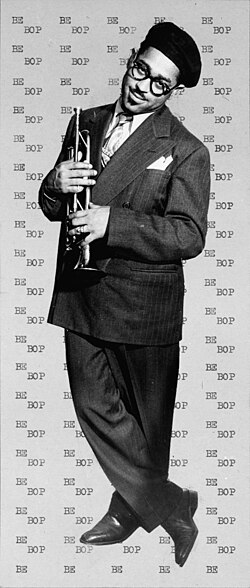
By 1946, bebop had established itself as a broad movement. In New York, musicians like Fats Navarro and J.J. Johnson adopted the style, while in Los Angeles, figures such as Charles Mingus and Dexter Gordon helped solidify the West Coast scene. Dizzy Gillespie became the public face of the movement, blending his virtuosity with a subversive sense of humor and an extroverted stage presence that challenged racial divides before the formal Civil Rights Movement.
Gillespie also integrated Afro-Cuban elements through collaborations with Chano Pozo and Sabu Martinez, sparking a Latin dance craze in the late 1940s.
Legacy and Derivative Styles
Bebop's harmonic innovations paved the way for several subsequent genres:
- Cool Jazz: A more relaxed approach led by Miles Davis.
- Hard Bop: A structural simplification of bebop led by Art Blakey and Horace Silver.
- Post-Bop: An expansion of music theory integrated into the bebop dynamic.
- Progressive Jazz: Cerebral explorations by artists like Dave Brubeck and Lennie Tristano.
Even decades later, bebop's influence persists in hip-hop. Artists like A Tribe Called Quest and Guru have cited bebop as a rhythmic influence, frequently sampling its bass lines and horn riffs.
Bebop Summary Table
| Category | Details |
|---|---|
| Primary Era | Mid-1940s to early 1950s |
| Key Figures | Charlie Parker, Dizzy Gillespie, Thelonious Monk, Max Roach |
| Core Innovations | Upper chord intervals, asymmetrical phrasing, ride cymbal pulse |
| Regional Hubs | New York City, Kansas City, Los Angeles |
| Derivative Genres | Hard bop, Cool jazz, Post-bop, Avant-garde jazz |
Frequently Asked Questions
What is the difference between Swing and Bebop?
Swing was primarily dance music characterized by large orchestras and steady rhythms. Bebop shifted the focus to small combos, complex harmonies, faster tempos, and virtuosic improvisation, making it music for listening rather than dancing.
Who were the most influential figures in Bebop?
Charlie Parker (alto sax) and Dizzy Gillespie (trumpet) were the primary architects of the style, while Thelonious Monk (piano) provided essential harmonic innovations.
How did the 1942-1944 musicians' strike affect Bebop?
The strike prevented musicians from recording for major labels, meaning the early development of bebop happened in jam sessions and small clubs, leaving much of its evolution unrecorded during those years.
What is "scat singing" and how does it relate to Bebop?
Scat singing is vocal improvisation using nonsense syllables. The term "bebop" is derived from these types of vocables, which were used by jazz singers long before the musical style was named.
Did Bebop influence modern music beyond jazz?
Yes, bebop has had a significant impact on hip-hop. Many artists use bebop samples, particularly bass lines and horn riffs, and have cited its rhythmic complexity as an influence on rapping styles.