Battle of Kadesh: The Epic Chariot Clash of Ramesses II and Muwatalli II
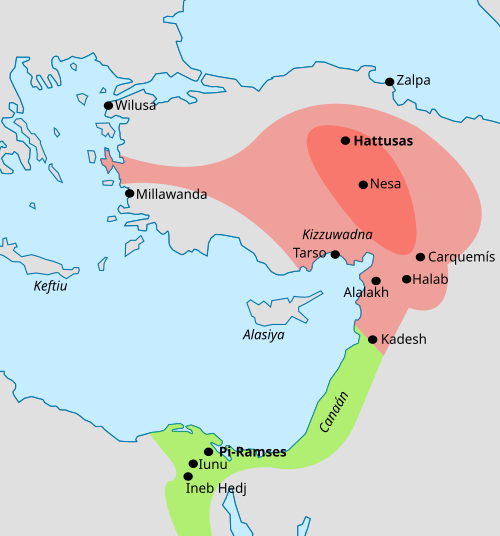
The Battle of Kadesh stands as one of the most famous military engagements of the ancient world. Fought in May 1274 BC, this massive confrontation pitted the Egyptian Empire, led by Pharaoh Ramesses II, against the Hittite Empire, commanded by King Muwatalli II. Occurring near the Orontes River on the modern-day border of Lebanon and Syria, it is recognized as the earliest pitched battle in recorded history for which specific tactical details and formations are known.
This conflict was not merely a clash of egos but a strategic struggle for dominance over the Levant. It is particularly noted for being the largest battle ever fought involving chariots—the high-tech weapon systems of the Bronze Age—with an estimated 5,000 to 6,000 vehicles deployed on the field.
Key Facts
- Date: May 1274 BC (Year 5 of Ramesses II).
- Location: Orontes River, near Kadesh (modern Lebanon-Syria border).
- Belligerents: Egyptian Empire vs. Hittite Empire.
- Scale: Largest known chariot battle in history (5,000–6,000 chariots).
- Outcome: Inconclusive/Stalemate.
- Legacy: Led to the world's earliest known written international peace treaty.
Historical Background
The roots of the conflict lay in the New Kingdom of Egypt's desire to reclaim and expand its borders. Following the expulsion of the Hyksos around 1550 BC, pharaohs like Thutmose III had pushed Egyptian influence north toward the Orontes River. However, by the late Eighteenth Dynasty, Egyptian influence had waned, with territory lost to the Mitanni in northern Syria.
The Nineteenth Dynasty sought to reverse this decline. Seti I, father of Ramesses II, began the process by reoccupying abandoned posts and capturing Kadesh and the Amurru kingdom. When Ramesses II ascended the throne, he continued this aggressive expansion. In the fourth year of his reign, he marched into Syria to test the loyalty of his vassals and scout the terrain. By the spring of his fifth year, he launched a full-scale campaign from his capital, Pi-Ramesses.
The Clash of Empires
Contending Forces
The Egyptian army was organized into four main corps: Amun, Re, Ptah, and Sutekh. While exact numbers are debated, it is estimated that the Egyptians deployed at least 2,000 chariots and 16,000 infantry. The Hittites, under Muwatalli II, mustered a formidable coalition including 19 allies, such as the king of Aleppo. Their force included approximately 2,500 chariots and a massive infantry contingent ranging from 15,000 to 40,000 men.
The Ambush at Kadesh
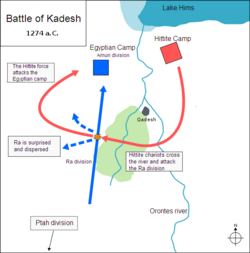
As Ramesses II approached Kadesh, he was deceived by two Shasu nomads—spies for the Hittites—who falsely claimed that the Hittite army was far to the north in Aleppo. Trusting this intelligence, Ramesses pushed forward, leaving his army divided. However, Egyptian scouts soon captured two Hittite prisoners who revealed the truth: the Hittite army was lurking nearby.
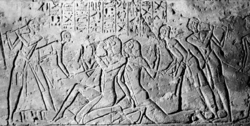
The Hittites launched a devastating surprise attack, outmaneuvering and surrounding the Egyptian forces. The Hittite chariots struck the Ra division with overwhelming force, throwing the Egyptian lines into chaos.
The Pharaoh's Counterattack
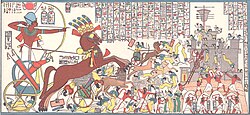
Facing potential capture or death, Ramesses II personally led a desperate charge with his elite bodyguard. Through sheer bravery and tactical aggression, the Pharaoh broke through the Hittite ranks, preventing a total collapse of the Egyptian army.
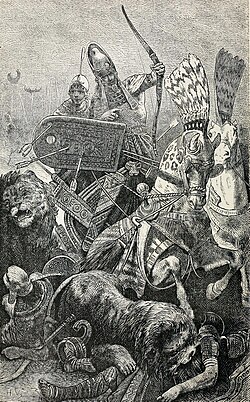
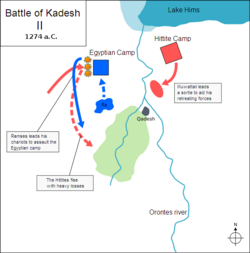
The battle entered a final, grueling phase where both sides suffered heavy losses, but neither could secure a decisive victory. The result was a tactical stalemate.
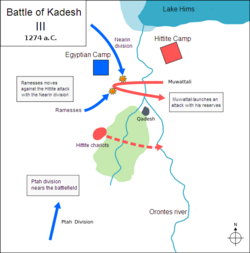
Aftermath and Diplomacy
While the battle itself was inconclusive, Ramesses II continued to campaign in the region. In the eighth and ninth years of his reign, he successfully captured the Hittite-ruled cities of Dapur and Tunip.
The prolonged conflict eventually gave way to diplomacy. Approximately 15 years after the battle, in 1258 BC, Ramesses II and the new Hittite king, Hattusili III, signed an official peace treaty. This agreement, inscribed on a silver tablet, is believed to be the earliest recorded example of a written international peace treaty.
![The Egyptian–Hittite peace treaty, on display at the Istanbul Archaeology Museum, is believed to be the earliest recorded example of a written international agreement.[3][unreliable source?]](/images/b3/82/b382be100798079bc1c4c104b8e7db1b833876cab11b594df8c1b25df4c18339.jpg)
Summary of Forces and Results
| Feature | Egyptian Empire | Hittite Empire |
|---|---|---|
| Commander | Ramesses II | Muwatalli II |
| Infantry | 16,000 | 15,000 – 40,000 |
| Chariots | ~2,000 | ~2,500 |
| Charioteers | 4,000 | 9,000 – 11,100 |
| Outcome | Inconclusive / Stalemate |
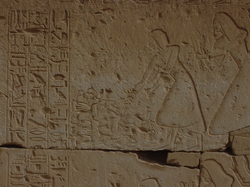
The memory of the battle was immortalized in Egyptian art, including the Great Kadesh reliefs at the Ramesseum and Abu Simbel, which depict the Pharaoh's heroism.
Frequently Asked Questions
Who won the Battle of Kadesh?
The battle is widely considered a stalemate. While Ramesses II claimed a great victory in Egyptian records, the Hittites maintained control of Kadesh and the surrounding region, meaning neither side achieved their primary strategic objective.
Why is the Battle of Kadesh historically significant?
It is significant for being the earliest pitched battle with detailed records of tactics and formations. Additionally, it involved the largest concentration of chariots in ancient history and led to the first known written international peace treaty.
How did the Hittites trick Ramesses II?
The Hittites used Shasu nomads as double agents to feed the Pharaoh false intelligence, claiming the Hittite army was 200 kilometers away in Aleppo, which lured the Egyptians into a vulnerable position for an ambush.
What was the result of the Egyptian-Hittite peace treaty?
Signed in 1258 BC between Ramesses II and Hattusili III, the treaty ended years of borderland conflicts and established a formal peace between the two superpowers of the Bronze Age.
What role did chariots play in the battle?
Chariots served as the primary shock troops of the era. The Hittites used them for a massive surprise flank attack, while the Egyptians used them for rapid counter-charges to break enemy lines.