Basil Spence: The Visionary Architect of Postwar Britain
Sir Basil Spence was a defining figure in 20th-century architecture, known for blending modernism—a style characterized by simplicity, function, and the use of industrial materials—with a deep sensitivity to context and tradition. From the ruins of war-torn cities to the political centers of the Commonwealth, Spence's work left an indelible mark on the global landscape.
Key Facts
- Major Achievement: Designed the radical new Coventry Cathedral (1956–1962).
- Professional Leadership: Served as President of the Royal Institute of British Architects (RIBA) from 1958 to 1960.
- Global Reach: Created the concept design for "The Beehive" executive wing of the New Zealand Parliament.
- Academic Contribution: Held professorships at the University of Leeds and the Royal Academy.
- Honors: Awarded an OBE in 1948 and knighted in 1960.
The Rise of Basil Spence & Partners
After a brief return to Rowand Anderson & Paul & Partners, Spence established his own practice, Basil Spence & Partners, alongside Bruce Robertson. His early versatility was evident in his exhibition design work, for which he received an OBE in 1948. This expertise culminated in the Sea and Ships Pavilion for the 1951 Festival of Britain.
By 1953, Spence had moved permanently to London, later establishing a creative hub at Canonbury in 1956. His influence extended into academia and professional governance, serving as an External Professor of Architecture at the University of Leeds (1955–1957) and as President of the Royal Institute of British Architects (1958–1960).
The University of Glasgow's Kelvin Building
One of the practice's significant early achievements was the redevelopment of the Kelvin Building at the University of Glasgow, which houses the School of Physics and Astronomy. This project unfolded in three distinct phases:
- 1947–1952: Addition of a new lecture theatre and a synchrotron (a large particle accelerator).
- 1959: Completion of teaching laboratories and a second lecture theatre.
- 1966: Addition of a museum dedicated to Lord Kelvin's experimental apparatus.
The Masterpiece: Coventry Cathedral
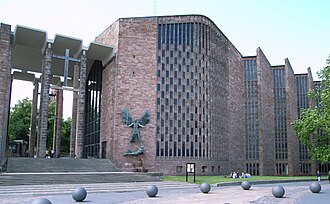
The defining moment of Spence's career came following the devastating German bombing of Coventry's Anglican Cathedral on November 14, 1940. After an initial proposal by Sir Giles Gilbert Scott was rejected by the Royal Fine Arts Commission, a competition was opened to architects across the Commonwealth of Nations in 1950.
Spence's radical design won the competition, leading to construction between 1956 and 1962. His work on the cathedral was so highly regarded that he was knighted in 1960 while the building was still under construction. The cathedral's cultural significance was further recognized in 2012 when the Royal Mail featured it in the "Britons of Distinction" stamp series.
Diverse Commissions and Later Works
In the late 1950s and 1960s, Spence's portfolio expanded into diplomatic, residential, and industrial sectors. He secured prestigious commissions for the British Embassy in Rome (completed 1971) and the Hyde Park Cavalry Barracks in London (completed 1970).
Social Housing and Urbanism
Spence attempted to tackle urban decay in Glasgow through the Hutchesontown C social housing project, designed to replace slum tenements in the Gorbals. However, due to a combination of extreme social deprivation and poor execution, the buildings suffered significant problems. They were eventually demolished by explosives in 1993, an event that tragically resulted in one accidental death.
In contrast, his Canongate Flats in Edinburgh are regarded as successful contextual modernist buildings. Located near Holyrood Palace and the Scottish Parliament, these flats were officially listed in 2008.
International and Specialized Projects
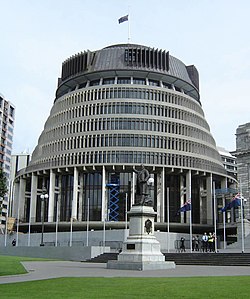
Spence's reach extended to New Zealand, where he provided the concept design for the executive wing of the Parliament Buildings in Wellington, famously known as "The Beehive." Other notable projects included the design of Abbotsinch Airport (now Glasgow Airport) and the Mortonhall Crematorium in Edinburgh, which utilized the same angled fin concept seen at Coventry Cathedral.
His versatility also led him to provide architectural treatments for the elevations of the Trawsfynydd nuclear power station in North Wales (1968) and to collaborate with Sir Richard Southern on a theatre for the University of Southampton in 1964.
Final Years and Legacy
In 1964, the practice was restructured into three entities: Sir Basil Spence OM RA (Canonbury), Spence Bonnington & Collins (London), and Spence Glover & Ferguson (Edinburgh). Spence continued to teach as a Professor of Architecture at the Royal Academy from 1961 to 1968.
Throughout the 1970s, he focused on public and private commissions, including the Aston University Library and Management Centre. His final project was a cultural centre for Bahrain, which remained unexecuted. Sir Basil Spence passed away in November 1976 in Yaxley, Suffolk. His design for the Glasgow Royal Infirmary was completed posthumously in 1981, and his practice continued until its disbandment in 1992.
| Project | Location | Completion/Period | Key Feature |
|---|---|---|---|
| Coventry Cathedral | Coventry, UK | 1962 | Radical postwar redesign |
| The Beehive | Wellington, NZ | 1960s (Concept) | Executive wing of Parliament |
| Kelvin Building | Glasgow, UK | 1947–1966 | Physics and Astronomy facilities |
| British Embassy | Rome, Italy | 1971 | Diplomatic modernist architecture |
| Canongate Flats | Edinburgh, UK | 1960s | Contextual modernist housing |
Frequently Asked Questions
Why is the New Zealand Parliament building called "The Beehive"?
The building earned the nickname "The Beehive" due to its unique circular, tiered architectural shape, which was based on a concept design by Sir Basil Spence.
What happened to the Hutchesontown C housing in Glasgow?
Due to poor execution and the high levels of social deprivation in the Gorbals area, the developments faced numerous problems and were demolished using explosives in 1993.
How did Basil Spence win the commission for Coventry Cathedral?
He won a competition launched in 1950 that was open to architects from across the Commonwealth of Nations, with his radical design being selected from over 200 entries.
What was the purpose of the Kelvin Building project?
The project involved the redevelopment and extension of the University of Glasgow's School of Physics and Astronomy, adding lecture theatres, laboratories, a synchrotron, and a museum for Lord Kelvin's apparatus.
When was Sir Basil Spence knighted?
Sir Basil Spence was knighted in 1960 in recognition of his work on the Coventry Cathedral, while the structure was still under construction.