Barney Bigard: The Virtuoso Clarinetist of the Swing Era
Albany Leon "Barney" Bigard was a cornerstone of American jazz, renowned for his lyrical mastery of the clarinet and tenor saxophone. Born into a musical lineage in New Orleans, Bigard became one of the most influential voices in the Swing and Dixieland genres, most notably through a defining 15-year partnership with the legendary Duke Ellington.
Key Facts
- Full Name: Albany Leon Bigard
- Primary Instruments: Clarinet and tenor saxophone
- Major Affiliations: Duke Ellington Orchestra and Louis Armstrong's All Stars
- Notable Composition: Co-composer of the standard "Mood Indigo"
- Career Span: Active from the 1920s through 1980
- Legacy: Led the first recording of the world-famous song "Caravan"
Early Life and Musical Foundations
Born on March 3, 1906, in New Orleans, Louisiana, Bigard was the son of Creole parents, Alexander and Emanuella Bigard. Music was a family tradition; his uncle, Emile Bigard, was a jazz violinist. Barney developed his technical skills under the tutelage of Lorenzo Tio, a respected music teacher in New Orleans.
In the early 1920s, Bigard migrated to Chicago, a hub for jazz innovation. During this era, he collaborated with King Oliver and clarinetist Johnny Dodds. Interestingly, much of his early recording work focused on the tenor saxophone, where he was praised for his lyricism, particularly on the track "Someday Sweetheart."
The Ellington Years (1927–1942)
Bigard's career reached new heights in December 1927 when he joined Duke Ellington's orchestra in New York. For the next 15 years, he served as the ensemble's featured clarinet soloist while contributing section work on the tenor saxophone. The group's early residency at the Cotton Club until 1931 established them as icons, followed by over a decade of nearly continuous touring.
During his tenure with Ellington, Bigard contributed to the creation of some of the most enduring pieces in the jazz canon, including the standard "Mood Indigo."
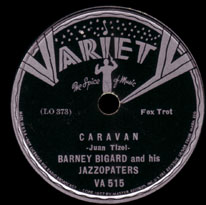
Barney Bigard and His Jazzopaters
Duke Ellington frequently formed small groups from his larger orchestra to record specialized sides. One such group was Barney Bigard and His Jazzopaters. On December 18, 1936, this ensemble recorded the first version of "Caravan," composed by Juan Tizol and later rearranged by Ellington.
The Jazzopaters consisted of Cootie Williams (trumpet), Juan Tizol (trombone), Barney Bigard (clarinet), Harry Carney (baritone sax), Duke Ellington (piano), Billy Taylor (bass), and Sonny Greer (drums). While Ellington played on the session, Bigard served as the session leader. As of 2024, "Caravan" stands as the most covered song in history, with over 500 published versions.
Hollywood and Later Career
After leaving Ellington in 1942, Bigard relocated to Los Angeles. He transitioned into film work, providing soundtracks for Hollywood studios and appearing onscreen. In 1947, he featured in the film New Orleans alongside Louis Armstrong. He later joined the touring band of trombonist Kid Ory and eventually became a member of Louis Armstrong's All Stars.
Bigard's cinematic presence continued with roles in The Strip (1951), where he played himself alongside Jack Teagarden and Earl "Fatha" Hines, and St. Louis Blues (1958), featuring Nat King Cole and Ella Fitzgerald. He also appeared in The Glenn Miller Story (1954).
Throughout the 1940s and beyond, Bigard recorded for various labels including Signature, Rex, Black & White, and Keynote. His later years saw him recording for Liberty (1957), French Vogue Records (1966), and a 1968 collaboration with Art Hodes in Chicago titled "Bucket's Got A Hole In It."
Career Summary
| Period | Primary Association | Key Contribution/Role |
|---|---|---|
| Early 1920s | King Oliver / Johnny Dodds | Tenor saxophone recordings in Chicago |
| 1927–1942 | Duke Ellington Orchestra | Featured clarinet soloist; co-composed "Mood Indigo" |
| 1936 | His Jazzopaters | Session leader for the first recording of "Caravan" |
| Late 1940s–1950s | Louis Armstrong's All Stars | Touring musician and film performer |
| 1968 | Art Hodes | Recorded "Bucket's Got A Hole In It" |
Barney Bigard passed away on June 27, 1980, at the age of 74 in Culver City, California. He left behind a detailed account of his life and collaborations in his autobiography, With Louis and The Duke.
Frequently Asked Questions
What was Barney Bigard's role in the Duke Ellington Orchestra?
Bigard served as the featured clarinet soloist for 15 years (1927–1942) and also performed section work on the tenor saxophone.
Which famous song did Barney Bigard first record as a leader?
Bigard led the group "His Jazzopaters" in the first recording of "Caravan" on December 18, 1936.
Did Barney Bigard play instruments other than the clarinet?
Yes, Bigard was also a proficient tenor saxophone player, particularly during his early years in Chicago and during his time with Duke Ellington.
What films did Barney Bigard appear in?
He appeared in New Orleans (1947), The Strip (1951), The Glenn Miller Story (1954), and St. Louis Blues (1958).
What is the title of Barney Bigard's autobiography?
His autobiography is titled With Louis and The Duke.