Barcelona Coat of Arms: History, Symbolism, and Evolution
The coat of arms of Barcelona serves as the official emblem of the City Council of Barcelona, the capital of Catalonia. With roots stretching back to the Middle Ages, these arms were first documented in 1329 and represent a complex intersection of religious devotion, royal lineage, and civic identity. In 2004, the Government of Catalonia formally conferred the coat of arms and the flag as the official symbols of the municipality.
The emblem features an escutcheon in lozenge (a diamond-shaped shield), a form commonly utilized in the municipal heraldry of Catalan cities. While the traditional arms remain the primary symbol, the City Council also employs a modern isotype based on these historic heraldic elements.
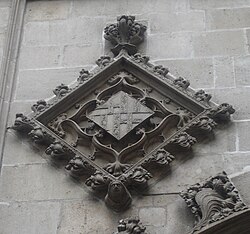
Key Facts
- First Documented: 1329.
- Primary Symbols: The Saint George's Cross and the Royal Bars of Aragon.
- Shield Shape: Lozenge (diamond).
- Current Crest: The modern Spanish Royal Crown.
- Official Status: Formally recognized by the Government of Catalonia in 2004.
Heraldic Composition and Meaning
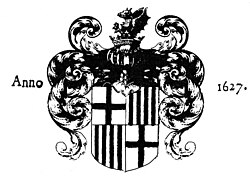
The blazon—the formal technical description of the arms—defines the shield as quarterly. This means the shield is divided into four sections. The first and fourth quarters feature the Saint George's Cross (a red cross on a silver/white field), while the second and third quarters display the Royal Bars of Aragon (four red vertical stripes on a gold background).
The Saint George's Cross
The cross of Saint George, the patron saint of the House of Barcelona and the Archdiocese of Barcelona, is one of the oldest elements of the city's identity. Evidence of its use appears in a seal from 1288 and 13th-century murals in the Tinell Hall. By 1395, city ordinances explicitly identified the red cross on a white field as the "badge of the city." Because the representatives of the citizens traditionally held significant negotiating power with the monarchy, the city's arms were placed in the most honorable positions—the first and fourth quarters.
The Royal Bars of Aragon
The four red paletts on a gold background represent the Kings of Aragon and the Counts of Barcelona. This symbol emerged following the dynastic union in 1137 between Raymond Berengar IV of Barcelona and Petronila of Aragon. These "Four Bars" are a shared heritage across several territories of the former Crown of Aragon, including Catalonia, Aragon, Valencia, and the Balearic Islands.
Historical Evolution and Controversies
The design of the Barcelona arms has not remained static, evolving through various political eras and artistic trends.
The Debate Over the Bars
While the royal grant of 1345 established four pallets, earlier periods saw variations with two or three bars. This led to recurring debates over the "proper" version of the city's arms. In 1996, the city adopted a monochrome logotype featuring a lozenge with a cross and two bars. However, this version sparked controversy for failing to adhere to traditional heraldic rules and the Law of Local Symbols of Catalonia. Following a successful appeal by the Catalan Society of Genealogy, Heraldry, Sigillography, Vexillology and Nobility, the current quartered version with four bars was adopted in 2004.
Evolution of the Crest
The crest atop the shield has changed significantly over the centuries:
- 15th Century: An open royal crown (without arches) was standard.
- 17th Century: The Aragonese royal crest, a winged dragon, was introduced.
- 19th Century: The dragon evolved into a bat (Rat penat), a common symbol in the heraldry of former Crown of Aragon capitals like Valencia and Palma.
- Post-Civil War: The bat was removed, and a royal crown without a crest was used.
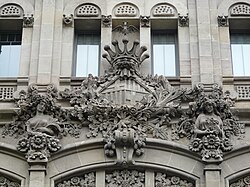
- Current: The modern Spanish Royal Crown, featuring a gold circlet with precious stones, eight rosettes of oyster plant leaves, and eight half-arches surmounted by a cross on a globe.
The Arms of the Province of Barcelona
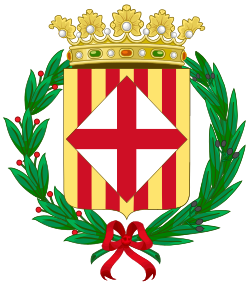
Distinct from the city's emblem, the Provincial Council of Barcelona uses a separate coat of arms created by Royal Ordinance on March 1, 1871. This version combines the city's elements in a different arrangement: the four red pallets of Aragon are debruised (overlaid) by a silver lozenge containing the Saint George's Cross.
The provincial shield is further adorned with a laurel branch on the left (dexter) symbolizing victory and honor, and an olive branch on the right (sinister) representing peace. It is topped with an open royal crown.
Summary of Heraldic Elements
| Element | City Coat of Arms | Provincial Coat of Arms |
|---|---|---|
| Shield Layout | Quarterly (1 & 4 Cross, 2 & 3 Bars) | Bars debruised by a lozenge with Cross |
| Primary Symbols | St. George's Cross & Royal Bars | St. George's Cross & Royal Bars |
| Crest | Modern Spanish Royal Crown | Former Royal Crown (Open) |
| Additional Ornaments | None | Laurel and Olive branches |
| Official Adoption | 2004 (Current version) | 1871 / 1874 |
Frequently Asked Questions
What do the four red stripes on the gold background represent?
These are the Royal Bars of Aragon, representing the Kings of Aragon and the Counts of Barcelona. They symbolize the dynastic union that occurred in 1137.
Why is the Saint George's Cross placed in the first and fourth quarters?
In heraldry, these are the most honorable positions. Their placement reflects the historical role of the city's representatives, who traditionally influenced and negotiated policies with the king.
What is the significance of the bat in older versions of the arms?
The bat (Rat penat) evolved from the Aragonese royal dragon. It was a shared symbol among the capitals of the former Crown of Aragon, including Valencia and Palma.
How does the provincial coat of arms differ from the city's?
While both use the cross and the bars, the provincial arms place the cross inside a lozenge overlaid on the bars, and include laurel and olive branches to symbolize honor and peace.
Why was the 1996 version of the emblem rejected?
The 1996 version was criticized for not following traditional heraldic rules and the Law of Local Symbols of Catalonia, leading to a legal appeal and the eventual adoption of the current version in 2004.