Avis de Réception: The History and Function of Postal Return Receipts
In the world of postal communications, ensuring that a critical document has reached its destination is often as important as the delivery itself. This is where the avis de réception—French for "advice or acknowledgment of receipt"—comes into play. This specialized postal service provides the sender with a signed form or card from the recipient, serving as tangible evidence that the correspondence was successfully delivered.
Because these forms provide a verifiable paper trail, they are frequently utilized for documents requiring legal endorsements, where proof of delivery is a mandatory requirement.
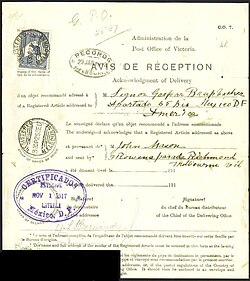
The Evolution of Postal Acknowledgments
While the formalized international system is well-documented, the concept of return receipts existed under various names in certain postal entities as early as the late 18th century. As global trade and diplomacy expanded, the need for a standardized system became apparent.
The service was officially adopted by the General Postal Union (GPU) in 1875. Shortly thereafter, in 1879, the system was maintained and integrated by the GPU's successor, the Universal Postal Union (UPU), the body responsible for the standardization of postal policies worldwide.
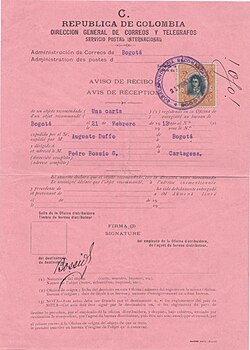
Global Terminology and Variations
Depending on the country and language, the avis de réception is known by many different names. While the standard abbreviations used globally are AR and AD, the full terminology varies by region:
- United Kingdom and Commonwealth: Often referred to as "advice of delivery."
- United States: Commonly termed as "return receipt requested," "required," "wanted," or "demanded."
- Canada: Known as "acknowledgment of receipt."
- Germany: Referred to as Rückschein.
- Italy: Known as ricevuta di ritorno.
- Poland: Called zwrotne potwierdzenie odbioru.
- Spanish-speaking regions: Termed aviso de recibo or aviso de recepción (as seen on Salvadoran stamps from 1897).
It is worth noting that while the term accusé de réception is sometimes used, it is considered inaccurate in a formal postal context.
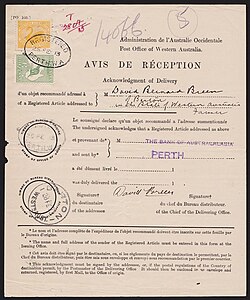
Key Facts
- Purpose: Provides the sender with a signed card proving the recipient received the mail.
- Legal Use: Frequently used for documents requiring legal endorsements.
- Standardization: Adopted by the General Postal Union in 1875 and the Universal Postal Union in 1879.
- Common Abbreviations: AR and AD.
- Origins: Existed in some forms as early as the late 18th century.
Summary of Regional Terms
| Region/Country | Term Used |
|---|---|
| International (French) | Avis de réception |
| United States | Return receipt (requested/required) |
| United Kingdom | Advice of delivery |
| Germany | Rückschein |
| Italy | Ricevuta di ritorno |
| Canada | Acknowledgment of receipt |
Frequently Asked Questions
What exactly is an avis de réception?
It is a postal service where a form or card is signed by the recipient upon delivery and then returned to the sender as proof of receipt.
When was the system standardized internationally?
The service was adopted by the General Postal Union in 1875 and subsequently by the Universal Postal Union in 1879.
Is "accusé de réception" the correct term for this service?
No, although it is sometimes seen, the term accusé de réception is considered inaccurate for this specific postal service.
What are the most common abbreviations for this service?
The standard abbreviations used are AR and AD.
Why are these forms often used in legal matters?
Because they provide a signed acknowledgment from the recipient, they serve as reliable evidence that a specific letter or document was delivered.