Post Offices: History, Evolution, and Global Functions
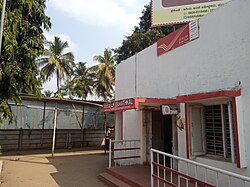
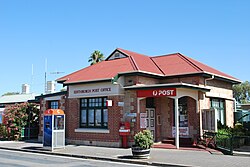
A post office is a public facility and retail hub dedicated to mail services. While most people recognize them as places to send letters and parcels, these institutions provide a wide array of essential services, including the sale of postage stamps, packaging, and stationery, as well as the provision of post office boxes. Depending on the country, post offices often act as government service centers, processing passport applications, road taxes, and postal savings or bank fees.
The administration of these facilities is led by a postmaster. In the 19th century, the delivery process was less centralized; mail was frequently delivered to public hubs like general stores or bars, often arriving alongside newspapers. Residents would travel into town to collect their correspondence and run other errands.
Key Facts
- Core Services: Accepting mail/parcels, selling stamps, and providing PO boxes.
- Administrative Lead: The chief administrator is known as the postmaster.
- Terminology: "GPO" stands for General Post Office, while "LPO" refers to a Licensed Post Office.
- Ancient Roots: Evidence of royal courier systems exists as far back as 2400 BCE in Egypt.
- Modernization: The transition from horse-drawn coaches to railways, aircraft, and automobiles phased out the use of "post houses."
Terminology and Types of Facilities
The term "post-office" has been used since the 1650s, following the legalization of private mail services in England in 1635. Historically, post riders (mounted couriers) were "posted" at intervals along post roads at posting houses to ensure urgent correspondence traveled without delay. In early America, these were often called stations.
Today, different terms describe different types of postal infrastructure:
- General Post Office (GPO): Typically the national headquarters of a postal service.
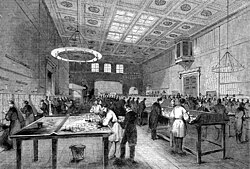
- Sorting Office / Delivery Office: Facilities used exclusively for processing mail, often featuring a large postal hall.
- Mail Exchange: Integrated facilities that combine mail processing with airports or railway stations.
The Evolution of Postal Systems
Ancient and Classical Networks
Organized courier systems are among humanity's oldest administrative tools. Ancient Egypt utilized royal couriers as early as 2400 BCE. The Persian Empire developed the Chapar Khaneh system along the Royal Road, while the Mauryan and Han dynasties established similar systems in India and China by the 2nd century BCE.
The Roman Empire refined this through the Cursus Publicus, a network regularized by Augustus. This system relied on stationes (locally maintained post houses) and mansiones (privately owned rest houses). Emperor Diocletian later split the system into two: one for urgent correspondence using horses or mules, and another for bulk shipments using oxen.
Modern Development and Specialization
In the 16th century, the House of Thurn and Taxis initiated regular mail service from Brussels for the Holy Roman Empire. In Scotland, the post office on High Street in Sanquhar has functioned continuously since 1712, making it one of the oldest in the world.
Different regions developed unique solutions for rural access. In 19th-century Canada, the way office system allowed villagers to drop off and pick up mail at local points before it was moved to a primary post office. Conversely, some European nations established cabinets noirs—special censorship offices used to intercept and read mail.
The Shift to Unstaffed Facilities
To increase accessibility, many jurisdictions have moved toward automated services. While mailboxes and PO boxes have long existed, newer technologies have expanded these options. Germany's Deutsche Post introduced the Pack-Station in 2001 for package pickup and drop-off. Similarly, the United States Postal Service implemented Automated Postal Centers (APCs), which allow customers to print postage and send mail even when the physical office is closed.

Notable Post Offices Around the World
| Name | Location | Significance |
|---|---|---|
| James Farley Post Office | New York City, USA | America's largest operating post office. |
| General Post Office | Dublin, Ireland | Headquarters of An Post; site of the 1916 Easter Uprising. |
| Mumbai GPO | Mumbai, India | One of the world's largest (120,000 sq ft). |
| Sanquhar Post Office | Sanquhar, Scotland | Continuous operation since 1712. |
| The Fullerton | Singapore | Former post office, now a 5-star hotel. |
| Magna Plaza | Amsterdam, Netherlands | Former post office, now a shopping center. |
Frequently Asked Questions
What is the difference between a post office and a sorting office?
A post office is a customer-facing retail facility that provides services like selling stamps and accepting parcels. A sorting office is a processing facility used exclusively for organizing mail for delivery and does not typically provide retail customer service.
What was the Cursus Publicus?
The Cursus Publicus was the state-run transportation and courier network of the Roman Empire, which used a system of post houses and relay couriers to move official messages across the empire.
What is a General Post Office (GPO)?
A General Post Office usually refers to the national headquarters of a country's postal service. While some GPOs provide customer services, others serve primarily as administrative hubs.
How did postal systems work before postal codes?
Before the invention of postal codes, items were routed to specific post offices for receipt or delivery. In the 19th-century United States, this often led to small communities being renamed to avoid duplication of post office names within a single state.
What are Automated Postal Centers (APCs)?
APCs are self-service kiosks installed by the USPS that allow customers to print postage and accept mail and small packages without the need for a staff member.