Automixis: Mechanisms of Self-Fusion and Genetic Diversity
In the diverse world of biological reproduction, automixis stands as a fascinating middle ground between sexual and asexual processes. Automixis occurs when nuclei or gametes derived from a single individual fuse together. While this process often results in parthenogenesis—the development of an embryo from an unfertilized egg—it is a complex mechanism that can significantly alter the genetic makeup of the offspring.
How Diploidy is Restored
For an offspring to develop normally, it typically needs to be diploid (containing two complete sets of chromosomes). In automixis, since there is no second parent to provide a set of chromosomes, the organism must restore its ploidy through specific cellular mechanisms.
Endomitotic Cycles
One method of restoration is the endomitotic cycle, where chromosomes double without the cell actually dividing. This can happen either before meiosis begins or after it is completed. In some species, ploidy is restored more simply through the fusion of the first two blastomeres (early embryonic cells).
Restitutional Meiosis and Nuclear Fusion
Other species restore ploidy by fusing meiotic products. This can occur via restitutional meiosis, where chromosomes fail to separate during one of the two anaphases (the stage of cell division where chromosomes move to opposite poles). Alternatively, the nuclei produced during meiosis may fuse, or a polar body (a small cell produced during oogenesis) may fuse with the egg cell during maturation.
The Debate: Sexual or Asexual?
Biologists are divided on how to classify automixis. Some argue that all forms are sexual because they involve recombination—the shuffling of genetic material. Others classify endomitotic variants as asexual, viewing the resulting embryos as purely parthenogenetic.
For those who distinguish between the two, the threshold for "sexuality" often depends on when the products of anaphase I or II join. Depending on the scientific criterion used, automixis may be viewed as sexual if it involves restitutional meiosis, nuclear fusion, or if the gametes are fully mature at the time of fusion. In these cases, the process is genetically similar to self-fertilization.
Genetic Outcomes: Central vs. Terminal Fusion
The genetic identity of the offspring depends entirely on the type of apomixis (asexual reproduction) that occurs. The primary distinction lies between central and terminal fusion.
Central Fusion and Heterozygosity
Central fusion occurs during restitutional meiosis of anaphase I or through the fusion of its products. In this scenario, offspring retain most or all of the mother's genetic material. Because homologous chromosomes are separated during anaphase I, heterozygosity—the presence of different alleles at a specific locus—is mostly preserved. However, if crossing over occurs, some heterozygosity may be lost. In pre-meiotic doubling, any recombination happens between identical sister chromatids.
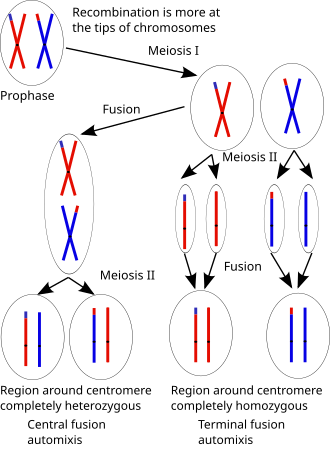
Terminal Fusion and Homozygosity
Terminal fusion occurs during restitutional meiosis of anaphase II or the fusion of its products. Here, offspring possess slightly more than half of the mother's genetic material and are mostly homozygous (possessing identical alleles). This happens because sister chromatids are separated during anaphase II; any remaining heterozygosity is the result of crossing over. If endomitosis occurs after meiosis, the offspring becomes completely homozygous with only half of the mother's genetic material.
Because of these varied mechanisms, parthenogenetic offspring can be genetically unique from both their siblings and their mother.
Key Facts
- Automixis is the fusion of gametes or nuclei from the same individual.
- Central fusion generally preserves the mother's heterozygosity.
- Terminal fusion typically leads to high levels of homozygosity in offspring.
- Endomitosis restores ploidy by doubling chromosomes without cell division.
- Automixis allows for the repair of DNA damage through retained meiotic processes.
Summary of Automictic Mechanisms
| Mechanism | Timing/Type | Genetic Result | Ploidy Status |
|---|---|---|---|
| Central Fusion | Anaphase I / Pre-meiotic | Mostly Heterozygous | High retention of maternal DNA |
| Terminal Fusion | Anaphase II | Mostly Homozygous | ~50% maternal DNA |
| Post-meiotic Endomitosis | After Meiosis | Completely Homozygous | 50% maternal DNA |
Adaptive Benefit of Meiosis in Automixis
Even when reproduction is effectively asexual, certain elements of meiosis are retained in both plants and animals. These include the pairing of homologous chromosomes, the formation of DNA double-strand breaks, and homologous recombinational repair during prophase I. Scientists believe these specific features are maintained as adaptations to facilitate the repair of DNA damage.
Frequently Asked Questions
What is the main difference between central and terminal fusion?
Central fusion occurs during or after anaphase I and tends to preserve the mother's genetic heterozygosity. Terminal fusion occurs during or after anaphase II, typically resulting in offspring that are mostly homozygous.
Is automixis considered sexual or asexual reproduction?
It depends on the definition used. Some scientists classify it as sexual because it involves genetic recombination, while others view endomitotic variants as asexual parthenogenesis.
How does endomitosis restore diploidy?
Endomitosis restores the necessary number of chromosomes by doubling the DNA content without undergoing the actual process of cell division.
Why do some automictic organisms still undergo parts of meiosis?
Certain stages of meiosis, such as homologous recombinational repair in prophase I, are retained because they serve as a critical mechanism for repairing damaged DNA.
Can automictic offspring be different from their mother?
Yes. Depending on the type of fusion and whether crossing over occurs, the offspring can be genetically unique from both the mother and other offspring produced by the same individual.