Athena: The Greek Goddess of Wisdom, Warfare, and Handicraft
In the pantheon of ancient Greek religion, few figures are as multifaceted as Athena. A prominent member of the Twelve Olympians, she embodies the intersection of strategic intellect and martial prowess. Unlike Ares, who represents the bloodlust and chaos of war, Athena governs the disciplined, tactical side of combat, while simultaneously serving as the patron of wisdom and the skilled arts of handicraft.
From her unusual birth to her role as the protector of the city of Athens, Athena's influence extends from the heights of Mount Olympus to the everyday lives of ancient artisans and soldiers.
Key Facts
![Fragment of a fresco from the Cult Center at Mycenae dating the late thirteenth century BC depicting a warrior goddess, possibly Athena, wearing a boar's tusk helmet and clutching a griffin.[11]](/images/e9/a7/e9a702dc9211beaa05dee8532754461b2c4e1306143b08f0eaca539ebb887620.jpg)
- Domains: Wisdom, strategic warfare, and handicraft.
- Family: Daughter of Zeus (and sometimes Metis).
- Symbols: The Aegis (protective shield/breastplate), helmet, spear, and the olive tree.
- Sacred Animals: The owl, serpent, and horse.
- Roman Equivalent: Minerva.
- Egyptian Equivalent: Neith.
Origins and Divine Nature
![Ancient Akkadian cylinder seal (dating c. 2334–2154 BC) depicting Inanna, the goddess of war, armoured and carrying weapons, resting her foot on the back of a lion[27]](/images/d8/c5/d8c5a3c6ccbe4b6e8acb1ad97b35668a94c8eb584e064d30304dd2a993a47d36.jpg)
The Miraculous Birth
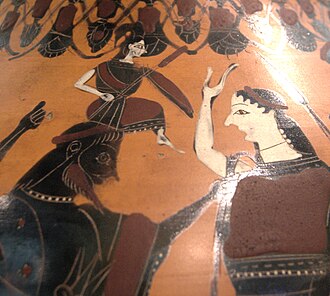
One of the most enduring myths regarding Athena is her parthenogenetic birth—meaning she was born without a mother. According to tradition, Zeus swallowed the goddess Metis to prevent a prophecy. Later, Athena emerged fully grown and armored directly from Zeus's forehead.
Attributes and Epithets
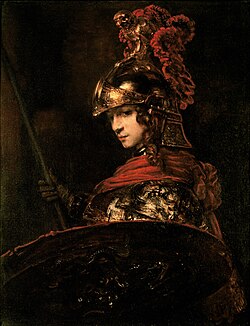
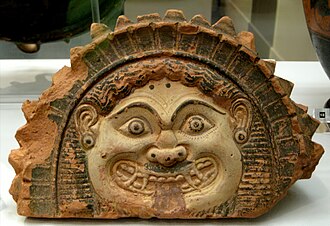
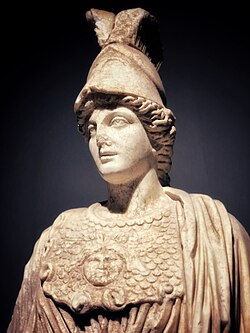
Athena is often identified by several key attributes. She is frequently depicted wearing a Corinthian helmet and carrying a spear. Her most famous accessory is the Aegis, a formidable shield or breastplate often adorned with a gorgoneion (the head of a Gorgon, such as Medusa), which served to terrify her enemies.
![The Athena Giustiniani, a Roman copy of a Greek statue of Pallas Athena. The guardian serpent of the Athenian Acropolis sits coiled at her feet.[137]](/images/c2/37/c2375a04f4363f9e2bf21abf1aee509c3bfa8c7821fc4321164364f8c5851345.jpg)
She is also known by various epithets that highlight her different roles, such as Pallas Athena and Glaukopis (bright-eyed). Her association with the owl symbolizes her wisdom, while the olive tree represents her gift of peace and prosperity to humanity.
Cults and Patronage
The Lady of Athens
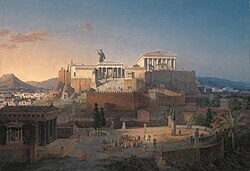
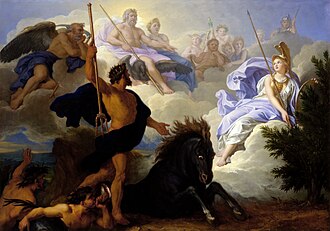
Athena's most significant connection is to the city of Athens, of which she is the patron deity. Legend tells of a contest between Athena and Poseidon for the city's patronage; Athena won by gifting the citizens the first olive tree, a symbol of wealth and food.
![The Parthenon on the Athenian Acropolis, which is dedicated to Athena Parthenos[89]](/images/8c/00/8c00538bc43e272235baa1fdcdf152eb897bba3ac930ab7c603d3a10f90f06bf.jpg)
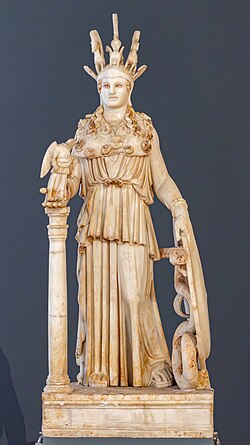
The city honored her through the construction of the Parthenon on the Acropolis, a temple dedicated to Athena Parthenos (Athena the Virgin). A central feature of this temple was a massive 11.5-meter (38 ft) gold and ivory statue created by the sculptor Phidias, depicting her holding Nike, the goddess of victory.
Regional and Panhellenic Influence
Beyond Athens, Athena was worshipped across the Greek world. Her influence was felt in regional cults and through her role as a patron of heroes, guiding figures like Heracles and Jason in their legendary quests.
![Attic red-figure kylix painting from c. 480-470 BC showing Athena observing as the Colchian dragon disgorges the hero Jason[152]](/images/6f/0c/6f0caa719bd3f18da77657115c7a2604f4199dd0fe93e27ca4e51d0ccba7c408.jpg)
Athena in Art and Symbolism
Classical Depictions
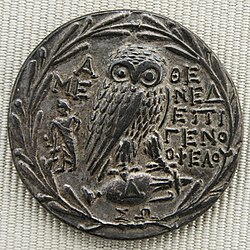
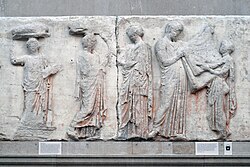
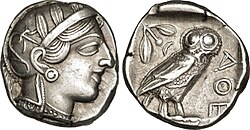
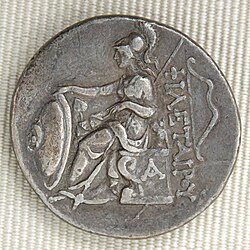
In classical art, Athena is portrayed as a figure of strength and composure. From the "Mourning Athena" relief to the detailed imagery on ancient coins, her image has always conveyed authority. The Athenian silver tetradrachm, for example, frequently featured her profile and her sacred owl.
Post-Classical and Modern Legacy
The legacy of Athena transitioned into the Roman era as Minerva, who retained most of Athena's attributes but was integrated into the Capitoline Triad. In the modern era, Athena continues to serve as a global symbol of freedom, democracy, and intellectual strength.
![Statue of Pallas Athena in front of the Austrian Parliament Building. Athena has been used throughout Western history as a symbol of freedom and democracy.[223]](/images/9b/3b/9b3b74e94640c1b9bb4e2bb0036fa2f6aec33907f85b2c6c57e26ee1b028c3f3.jpg)
Her influence can be seen in the architecture of the Austrian Parliament Building in Vienna and has inspired symbols of national identity, such as Britannia and the Statue of Liberty. Even in the United States, the Great Seal of California features Athena kneeling beside a grizzly bear.
Summary of Athena's Divine Profile
| Category | Details |
|---|---|
| Primary Roles | Wisdom, Strategic War, Handicrafts |
| Parents | Zeus (and Metis) |
| Key Symbols | Aegis, Owl, Olive Tree, Spear |
| Major Temple | The Parthenon (Athens) |
| Roman Name | Minerva |
Frequently Asked Questions
How is Athena different from Ares?
While both are deities of war, Ares represents the raw, violent, and chaotic aspects of battle. Athena represents the strategic, disciplined, and intellectual side of warfare, focusing on tactics and victory through wisdom.
What is the significance of the owl in Athena's imagery?
The owl is the symbol of wisdom and vigilance. Because owls can see in the dark, they represent the ability to see what others cannot, mirroring Athena's role as the goddess of insight and strategic planning.
Who is Pallas Athena?
Pallas is a common epithet used for Athena. While the exact origin is debated, it is often associated with a childhood friend or a giant whom she slew, subsequently adopting the name as a title.
What was the Athena Parthenos?
The Athena Parthenos was a colossal gold and ivory statue created by Phidias for the Parthenon. It stood approximately 11.5 meters tall and depicted the goddess holding the winged goddess Nike in her hand.
Does Athena have any children?
Athena is traditionally a virgin goddess. However, mythology mentions Erichthonius, whom she adopted as her son after his unusual birth from the earth.