Armenians in Israel and Palestine: A History of Faith, Art, and Resilience
The Armenian community in Israel and Palestine is a small but culturally rich minority, numbering between 5,000 and 6,000 people. With a presence in the Levant that spans millennia, this community has evolved from early pilgrims and ecclesiastical leaders into a vibrant residential population known for its contributions to art, photography, and spirituality.
Today, significant Armenian populations reside in Jerusalem, Haifa, Holon, Nazareth, and Bethlehem. While the community is most visible in the historic heart of Jerusalem, its influence extends across the region through a legacy of craftsmanship and a deep-rooted connection to the Holy Land.
Key Facts
- Population: Approximately 5,000–6,000 people across Israel and Palestine.
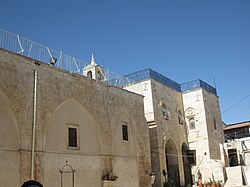
- Primary Hub: The Armenian Quarter, the smallest of the four quarters in Jerusalem's Old City.
- Religious Affiliation: Predominantly Armenian Apostolic, with smaller Catholic and Evangelical communities.
- Cultural Legacy: Pioneers in early Palestinian photography and traditional hand-painted ceramics.
- Historical Roots: Presence dates back to the 1st century BCE under King Tigranes the Great.
Ancient Roots and the Armenian Patriarchate
The Armenian connection to the region began long before the common era. In the 1st century BCE, King Tigranes the Great made much of Judea a vassal of the Kingdom of Armenia. However, the community's spiritual identity solidified in the early 4th century AD following the Christianization of Armenia. This era saw the first recorded Armenian pilgrimages to the Holy Land, including a delegation of priests visiting Patriarch Macarius of Jerusalem.
A pivotal moment occurred in 638 with the establishment of the Armenian Patriarchate of Jerusalem. The Patriarchate is centered in the Armenian Quarter of the Old City, which serves as the spiritual and administrative heart of the community.
Artistic Contributions: Photography and Ceramics
Armenians played a transformative role in the visual history of the region. Starting in the 1850s, they became the dominant photographers in Palestine. This movement was led by Esayee Garabedian, who established a photography workshop and school within the St. James monastic compound. His students, including Garabed Krikorian, further expanded the craft; Krikorian eventually taught Khalil Raad, recognized as the first Arab photographer in Palestine.
In the 20th century, refugees of the Armenian genocide continued this legacy. Elia Kahvedjian became a leading photographer in Jerusalem, while Kegham Djeghalian opened the first photography studio in Gaza in 1944.
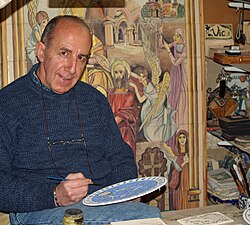
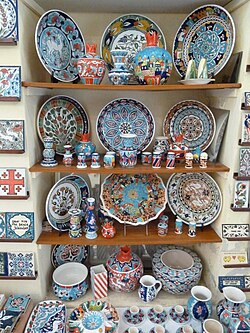
Parallel to photography, Armenians introduced a distinct ceramic tradition. In 1919, master craftsmen from Kütahya, Turkey, were brought to Jerusalem to renovate the tiles of the Dome of the Rock. These artisans remained in the city, establishing a renowned tradition of hand-painted Armenian ceramics.
The Impact of the Armenian Genocide
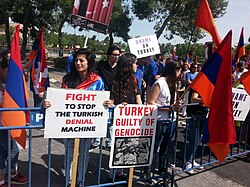
The modern Armenian community was fundamentally reshaped by the Armenian Genocide (1915–1917) under the Young Turk government. Approximately 10,000 refugees sought sanctuary around the St. James monastic compound, transforming the Armenian Quarter from a monastic center into a residential neighborhood.
The tragedy also led to the creation of orphanages. In 1922, the Armenian Patriarchate converted the former Armenian Theological Seminary—which had ceased operations during WWI—into a refuge for 616 boys who had survived the genocide.
Beyond Jerusalem, refugees reached the coast of Haifa in 1922. Despite initial British restrictions, local Arab notables protested on their behalf, leading to the establishment of the village of Athlit. During this period, the Nili intelligence network—a pro-British Jewish espionage group—also documented the persecution of Armenians to alert British authorities.
Demographics and Modern Challenges
The community's demographics have shifted significantly due to geopolitical conflicts. Following the 1948 Arab-Israeli War, the community split between those holding Israeli citizenship and those with Jordanian nationality in the West Bank and East Jerusalem. After the 1967 Six-Day War, emigration led to a population decline. As of 2023, roughly 2,000 Armenians in Israeli-controlled territory remain stateless residents.
In recent years, the community in the Old City has faced existential threats. Activists have warned that a controversial land deal could result in the loss of control over 25% of the Armenian Quarter, further shrinking an already dwindling population.
| Category | Details |
|---|---|
| Estimated Population | 5,000–6,000 |
| Major Cities | Jerusalem, Haifa, Holon, Nazareth, Bethlehem |
| Primary Languages | Armenian, Modern Hebrew, Levantine Arabic |
| Key Religious Institutions | Armenian Patriarchate of Jerusalem, St. James Cathedral |
| Cultural Institutions | Edward and Helen Mardigian Armenian Museum |
Faith and Cultural Preservation
The majority of the community belongs to the Armenian Apostolic Church, though Armenian Catholic and Evangelical communities also exist. A unique aspect of their faith is the adherence to the ancient Julian calendar by the Patriarchate of Jerusalem, meaning they celebrate Christmas and Epiphany on January 19, unlike the Gregorian calendar used by the global Armenian Apostolic Church (January 6) or Catholics (December 25).
Cultural preservation is further supported by the Hebrew University of Jerusalem, which hosts a chair of Armenian Studies. This program fosters Armenian-Jewish cultural exchange, highlighting the shared history of persecution and identity between the two peoples.
Frequently Asked Questions
Where is the Armenian community primarily located in Jerusalem?
The community is centered in the Armenian Quarter, which is the smallest of the four quarters in the Old City of Jerusalem and houses the Armenian Patriarchate.
How did the Armenian Genocide affect the community in Israel and Palestine?
The genocide led to a massive influx of refugees in the early 20th century, transforming the Armenian Quarter into a residential area and leading to the establishment of orphanages and new settlements like Athlit near Haifa.
What is the significance of Armenian ceramics in Jerusalem?
Armenian ceramics were introduced in 1919 by craftsmen from Kütahya, Turkey, who were originally hired to renovate the Dome of the Rock. They subsequently established a lasting tradition of hand-painted pottery in the city.
Why do Armenians in Jerusalem celebrate Christmas on a different date?
The Armenian Patriarchate of Jerusalem follows the Julian calendar, resulting in the celebration of Christmas and Epiphany on January 19, whereas other Armenian and Christian communities follow the Gregorian calendar.
What is the current status of Armenia-Israel diplomatic relations?
Armenia and Israel maintain diplomatic relations and trade, though neither maintains a resident embassy in the other's capital. The Israeli ambassador to Armenia is based in Tbilisi, Georgia.