Republic of ArmeniaArmenian historyYerevanArmenian cultureCaucasus geography

Armenia: A Journey Through Ancient History and Modern Resilience

Exploring the Republic of Armenia: A Journey Through History, Culture, and Resilience Nestled in the South Caucasus, the Republic of Armenia is a land defined by its profound historical d...

Exploring the Republic of Armenia: A Journey Through History, Culture, and Resilience

Nestled in the South Caucasus, the Republic of Armenia is a land defined by its profound historical depth, rugged mountainous landscapes, and a resilient spirit that has endured through millennia. From ancient prehistoric sites to its modern status as a unitary parliamentary republic, Armenia offers a unique window into the evolution of human civilization.

Key Facts
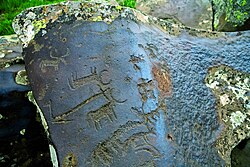
Petroglyphs with images of various animals on Mount Ughtasar
  • Capital: Yerevan
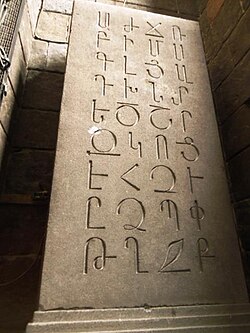
  • Official Language: Armenian (using the Armenian alphabet)
  • Government Type: Unitary parliamentary republic
  • Primary Religion: Christianity (96.8%, with 95.2% belonging to the Armenian Apostolic Church)
  • Total Area: 29,743 km²
  • Currency: Armenian Dram (AMD)

A Legacy Written in Stone: Ancient and Medieval History
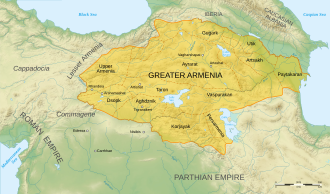
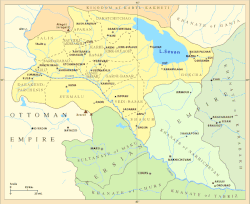
Historical Armenia, 150 BC

Armenia's history stretches back to the very dawn of human technology. Archaeological findings, such as 325,000-year-old Stone Age sites, suggest the region has been a focal point of human activity for eons. Moving into the Bronze Age, sites like Zorats Karer (also known as Karahunj) serve as testament to early complex societies.
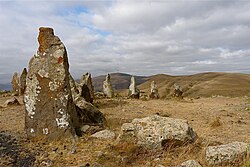
Bronze Age burial site Zorats Karer (also known as Karahunj)
: Bronze Age burial site Zorats Karer (also known as Karahunj)

The formal political history of the region includes the Urartu period (860 BC–547/90 BC) and the subsequent Kingdom of Armenia (331 BC–428 AD). Throughout the centuries, various dynasties and kingdoms shaped the nation, including Bagratid Armenia, the Armenian Kingdom of Cilicia, and Zakarid Armenia. Historical records, such as the 6th-century BC Behistun Inscription of Darius I, provide early evidence of Armenia's presence in the ancient world.
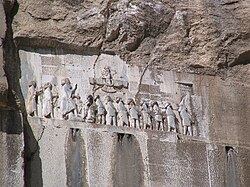
Behistun Inscription of Darius I mentioning Armenia. 6th century BC.
: Behistun Inscription of Darius I mentioning Armenia. 6th century BC.

The medieval era saw the rise of significant architectural and religious landmarks. The Etchmiadzin Cathedral, traditionally dated to 303 AD, is considered the oldest cathedral in the world, serving as the Mother Church of the Armenian Apostolic Church.

The Etchmiadzin Cathedral, Armenia's Mother Church traditionally dated 303 AD, is considered the oldest cathedral in the world.[74][75][76]
: The Etchmiadzin Cathedral, Armenia's Mother Church traditionally dated 303 AD, is considered the oldest cathedral in the world.[74][75][76]
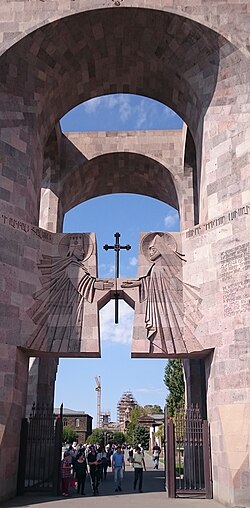
Portal to the Holy City at Echmiazin, the seat of the Catholicos
: Portal to the Holy City at Echmiazin, the seat of the Catholicos

Architectural Marvels

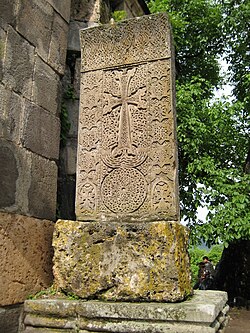
Armenian architecture is renowned for its unique styles, ranging from the Greco-Roman influence seen in the Garni Temple—the only such colonnaded building in the post-Soviet space—to the intricate stone carvings of Khachkars (cross-stones).

The pagan Garni Temple, probably built in the first century, is the only "Greco-Roman colonnaded building" in the post-Soviet space.[65]
: The pagan Garni Temple, probably built in the first century, is the only "Greco-Roman colonnaded building" in the post-Soviet space.[65]
Ancient Armenian Khachkars (cross-stones)
: Ancient Armenian Khachkars (cross-stones)

Modern Transitions: From Empires to Independence
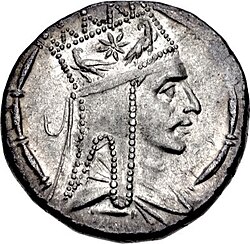
Coin of Tigranes the Great

The modern history of Armenia is marked by significant shifts in sovereignty. Following periods of rule by the Safavid dynasty of Iran and later the Russian Empire, the First Republic of Armenia was established on May 28, 1918. This era was tragically interrupted by the Armenian Genocide of 1915, a defining and somber chapter in the nation's history.
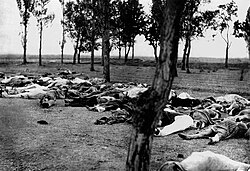
Armenian genocide victims in 1915
: Armenian genocide victims in 1915

Following the First Republic, Armenia became part of the Soviet Union as the Armenian Soviet Socialist Republic. After the collapse of the USSR, Armenia regained its independence on September 23, 1991, and subsequently joined the United Nations in 1992.
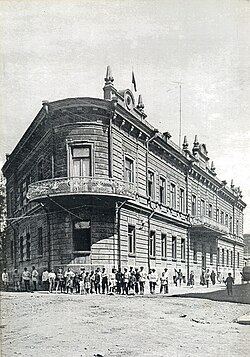
The Government house of the First Republic of Armenia (1918–1920)
: The Government house of the First Republic of Armenia (1918–1920)
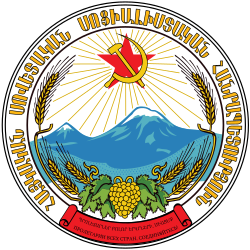
The state emblem of Soviet Armenia depicting Mount Ararat
: The state emblem of Soviet Armenia depicting Mount Ararat

Contemporary Governance and Politics

Today, Armenia operates as a parliamentary republic. The government is led by the President, Vahagn Khachaturyan, and the Prime Minister, Nikol Pashinyan. The legislative power is held by the National Assembly.
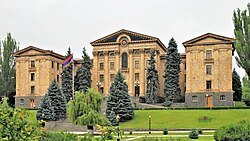
The National Assembly in Yerevan
: The National Assembly in Yerevan

The political landscape has seen significant movements, including the 2018 nationwide protest movement that led to a change in regime. In recent years, the nation has navigated complex foreign relations and regional conflicts, including the 2023 Azerbaijani offensive in Nagorno-Karabakh.
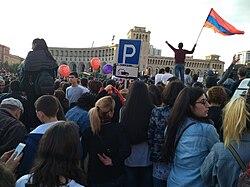
In April 2018, a quasi-authoritarian regime collapsed as a result of a nationwide protest movement in Armenia.
: In April 2018, a quasi-authoritarian regime collapsed as a result of a nationwide protest movement in Armenia.

Geography and Demographics

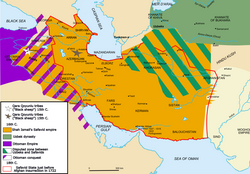
In 1501–02, most of the Eastern Armenian territories, including Yerevan, were conquered by the emerging Safavid dynasty of Iran led by Shah Ismail I.

Armenia is characterized by its mountainous and volcanic topography. The climate varies across the region, as detailed in the Köppen-Geiger classification. The landscape is dominated by high altitudes, providing both challenges and breathtaking natural beauty.
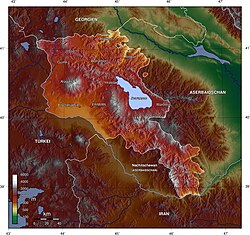
Armenia's mountainous and volcanic topography
: Armenia's mountainous and volcanic topography

The population is highly homogeneous, with Armenians making up 98.1% of the ethnic groups. While the majority reside within the borders of the Republic, there is a vast Armenian Diaspora spread across the globe.
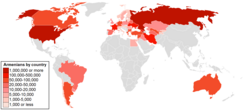
The Armenian population around the world
: The Armenian population around the world

Urban Centers and Provinces

Yerevan serves as the economic, cultural, and political heart of the country. Beyond the capital, various provinces (marzes) such as Aragatsotn, Shirak, and Syunik contribute to the nation's diverse regional identities.
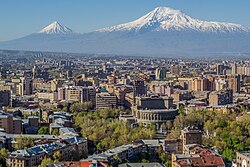
Yerevan is the economic and cultural centre of Armenia.
: Yerevan is the economic and cultural centre of Armenia.
Summary of Armenian Administrative Divisions (Selected)
Province (Marz) Capital Population (2022 Census)
Yerevan Yerevan 1,086,677
Shirak Gyumri 235,484
Lori Vanadzor 222,805
Ararat Artashat 248,982
Kotayk Hrazdan 269,883

Culture, Science, and Innovation

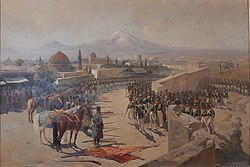
Capture of Erivan fortress by Russian troops in 1827 during the Russo-Persian War (1826–28) by Franz Roubaud

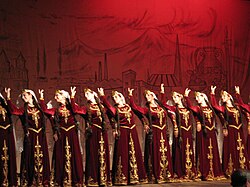
Armenian culture is a rich tapestry of traditional music, dance, and art. The nation also places a high value on science and technology, with strategic goals focused on modernizing scientific infrastructure and promoting research in fields like advanced technologies, life sciences, and renewable energy.
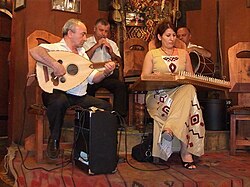
Armenian folk musicians
: Armenian folk musicians
Traditional Armenian dance
: Traditional Armenian dance

Intellectual and Sporting Achievements

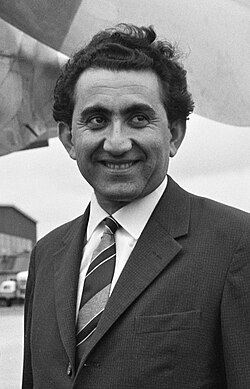
Armenia has produced world-class intellectuals and athletes. In the realm of sports, the nation has a strong tradition in chess, boasting grandmasters such as Levon Aronian and former World Champion Tigran Petrosyan.
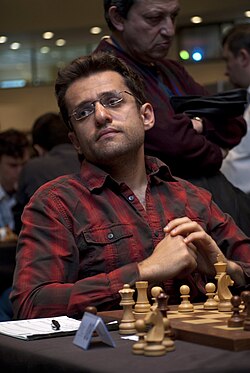
Chess Grandmaster Levon Aronian is a former FIDE No. 2 rated player and the fourth-highest rated player in history.
: Chess Grandmaster Levon Aronian is a former FIDE No. 2 rated player and the fourth-highest rated player in history.
Tigran Petrosyan, 9th World Chess Champion
: Tigran Petrosyan, 9th World Chess Champion

Frequently Asked Questions

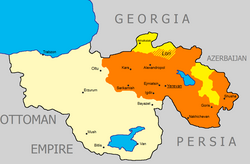
The Armenian Oblast (1828–1840) included the territory of the former Erivan (marked in yellow) and Nakhichevan (marked in light green) khanates.
ภาพประกอบบทความ
ภาพประกอบจากบทความต้นฉบับ
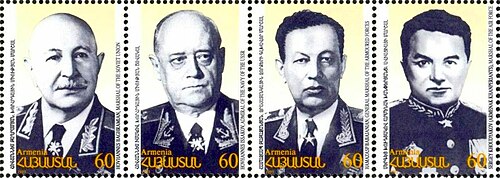
Armenian Marshals and Admiral of World War II on stamps: Bagramyan, Isakov, Babadzhanian, Khudyakov
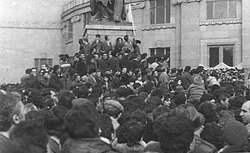
Armenians gather at Theater Square in central Yerevan to claim unification of Nagorno-Karabakh Autonomous Oblast with the Armenian SSR, 1988.
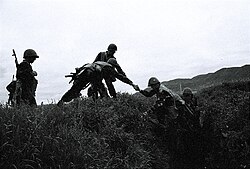
Armenian soldiers in 2008, during Nagorno-Karabakh conflict
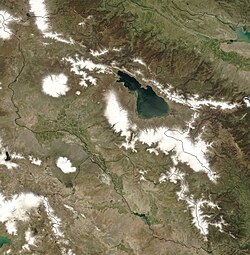
Satellite image of the territory of Armenia (2003)
Köppen-Geiger climate classification map for Armenia[182]
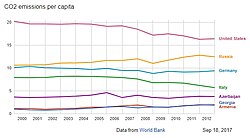
Carbon dioxide emissions in metric tons per capita in Armenia, Azerbaijan, Georgia, Russia, Germany, Italy, USA in 2000–2012. World Bank data.
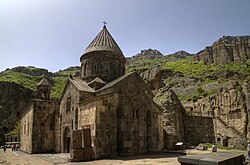
Geghard monastery, Kotayk Province
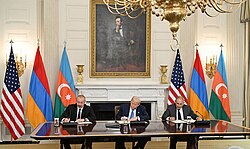
Joint Declaration signed on meeting between Armenian Prime Minister Nikol Pashinyan and Azerbaijani President Ilham Aliyev held in Washington, D.C., 8 August 2025
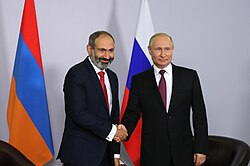
Russian president Vladimir Putin shakes hands with Armenian prime minister Nikol Pashinyan, 2018
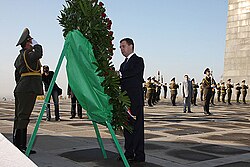
Russian President Dmitry Medvedev at the Armenian Genocide memorial in Yerevan
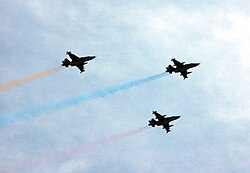
Armenian Air Force Su-25s during a military parade
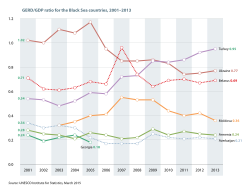
Gross domestic expenditure on R&D (GERD) to GDP ratio for the Black Sea countries, 2001–2013. Source: UNESCO Science Report: towards 2030 (2015), Figure 12.3.
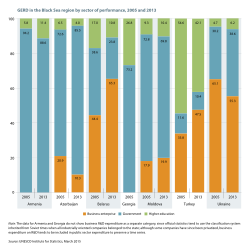
GERD in the Black Sea region by sector of performance, 2005 and 2013. Source: UNESCO Science Report: towards 2030 (2015), Figure 12.5.
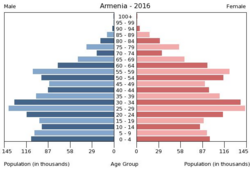
Population pyramid 2016
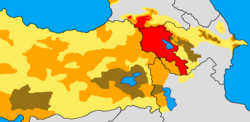
Historical and modern distribution of Armenians.Settlement area of Armenians in early 20th century: >50% 25–50% <25% Armenian settlement area today
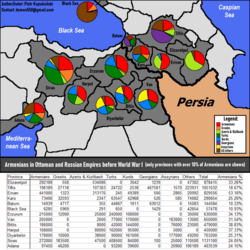
Armenians in the Ottoman Empire and the Russian Empire before World War I.
Armenian-language writing
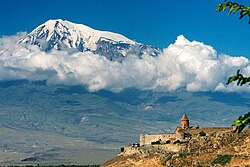
The 7th-century Khor Virap monastery in the shadow of Mount Ararat, the peak on which Noah's Ark is said to have landed during the biblical flood.
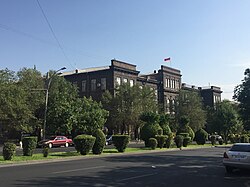
Yerevan State University building
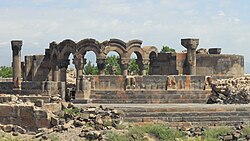
Zvartnots Cathedral, 643–652, UNESCO World Heritage Site
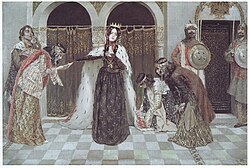
Queen Zabel's Return to the Palace, Vardges Sureniants (1909)
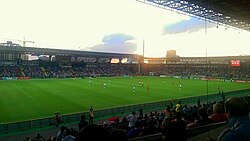
The Vazgen Sargsyan Republican Stadium in Yerevan
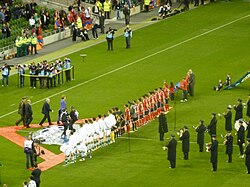
The Armenia national football team in Dublin, Ireland

What is the official language of Armenia?

The official language is Armenian, which uses its own unique alphabet.

What is the capital of Armenia?

The capital and largest city of Armenia is Yerevan.

What is the main religion practiced in Armenia?

The vast majority of the population (96.8%) identifies as Christian, with 95.2% belonging to the Armenian Apostolic Church.

What is the currency used in Armenia?

The official currency is the Armenian Dram (AMD).

How is the Armenian population distributed?

While the majority of Armenians live within the Republic of Armenia, there is a significant global diaspora living in various parts of the world.