Argentine Peso: History, Evolution, and Economic Impact
The Argentine Peso (ISO code: ARS) is the official currency of Argentina, issued by the Central Bank of the Argentine Republic. While it serves as the primary medium of exchange for the nation, its history is a complex narrative of economic volatility, characterized by severe inflation and periodic currency resets.
Since the mid-20th century, Argentina has faced periods of hyperinflation—a term describing rapid, excessive, and out-of-control price increases. This has led the government to repeatedly introduce new versions of the peso, often dropping multiple zeros from the valuation at rates ranging from 100:1 to 10,000:1 to maintain manageable accounting.
Key Facts
- ISO Code: ARS (Numeric: 032)
- Current Issuing Authority: Central Bank of the Argentine Republic (BCRA)
- Subunit: 100 centavos = 1 peso
- Highest Recent Inflation: 289.4% year-on-year as of April 2024
- Current High-Value Notes: 1,000, 2,000, 10,000, and 20,000 pesos
The Evolution of Argentine Currency
Early Currency and the 19th Century
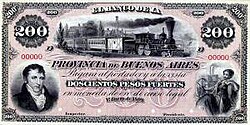
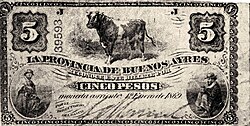
Before the modern era, Argentina utilized various forms of the peso. In 1826, the peso fuerte was introduced as a convertible currency tied to gold (17 pesos fuerte equaled one Spanish ounce of 0.916 fine gold). Simultaneously, the peso moneda corriente was used, though it eventually depreciated significantly.
The Peso Moneda Nacional and Peso Ley
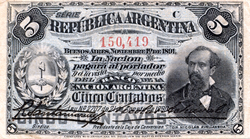
In 1881, the peso moneda nacional replaced the depreciated moneda corriente at a rate of 25:1. This currency remained in use until 1970. Initially convertible to gold, this link was abandoned in 1929. It was subsequently replaced by the peso ley in 1970 at a rate of 1:100.
The Path to the Modern Peso
The 1980s saw rapid currency turnover. The peso argentino (1983–1985) replaced the peso ley at a rate of 1:10,000, only to be replaced by the austral in June 1985. Finally, in 1992, the current peso (originally the peso convertible) was introduced, replacing the austral at a rate of 1:10,000.
To put this in perspective, one 1992 peso convertible was equivalent to 10 trillion pesos moneda nacional from 1970.
Currency Valuation and Exchange Rates
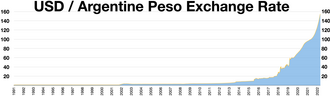
The 1992 peso was initially pegged 1:1 to the US dollar, a stability that lasted until early 2002. Following this, the exchange rate shifted dramatically, moving from 3:1 in 2003 to 178:1 by early 2023. By August 14, 2023, the official rate was fixed at ARS$350 per USD, while the unregulated (informal) rate reached ARS$665.
As of April 14, 2025, under an agreement with the International Monetary Fund, the official peso became freely floating within a currency band of 1,000 to 1,400 pesos per dollar. This liberalization has brought official and unofficial rates closer together, though interventions by the Argentine central bank and the US Treasury occurred in late 2025 to maintain the band limits.
Banknotes and Coinage
Modern Banknotes
The Central Bank has issued several series of banknotes to keep pace with inflation. The most recent, the "Heroines and heroes of our history" series (2023), features figures such as José de San Martín and Juan Bautista Alberdi, with denominations reaching up to 20,000 pesos.
Coins and Legal Tender
While centavo coins (1, 5, 10, 25, 50) and low-value peso coins (1, 2, 5, 10) exist and remain legal tender, many are rarely used in stores due to their negligible purchasing power.
| Series Name | Introduction Year | Key Themes/Features | Notable Denominations |
|---|---|---|---|
| Convertibles | 1992 | Fixed USD value | $1 to $100 |
| Nuevo Diseño | 1997 | National figures | $10 to $100 |
| Tenemos Patria | 2013 | National identity | $50, $100 |
| Native Fauna | 2016 | Argentine wildlife | $20 to $1,000 |
| Heroínas y héroes | 2023 | Historical figures | $1,000 to $20,000 |
Frequently Asked Questions
What is the difference between the official and unofficial exchange rate?
The official rate is the value set by the government and central bank, while the unofficial (or "blue") rate is the market value determined by unregulated trading. Historically, these have differed significantly, though they have converged more recently due to market liberalization.
Why does Argentina change its currency so often?
Frequent currency changes and the removal of zeros are used to combat the effects of hyperinflation, making prices and accounting more manageable for the public and the government.
Is the 1992 peso still in use?
Yes, the peso introduced in 1992 (ARS) is the current currency, although its valuation has changed drastically from its original 1:1 peg with the US dollar.
Are the old centavo coins still legal tender?
Yes, they remain legal tender, but because their value is so low, they are rarely accepted in retail stores or bank branches.
What is a "crawling peg"?
A crawling peg is a exchange rate regime where a currency is allowed to fluctuate within a small range or is adjusted gradually over time to maintain competitiveness against another currency, such as the US dollar.