Argentine Defense Industry: Evolution of Domestic Military Production
The Argentine defense industry has undergone a complex evolution, characterized by periods of ambitious self-sufficiency and phases of significant contraction. From the early industrial pushes during the Second World War to the strategic responses following the 1970s arms embargoes, Argentina has sought to maintain a domestic capability to equip its armed forces. While privatization in the 1990s nearly dismantled this infrastructure, recent years have seen a resurgence in local production and import substitution.
Key Facts
- Fabricaciones Militares is the primary state-owned complex supplying the Army.
- The Pulqui I was the first jet combat aircraft developed in Latin America.
- INVAP is a leader in high-tech development, producing satellites and indigenous radars.
- Argentina possesses advanced nuclear technology, including the ability to build commercial reactors.
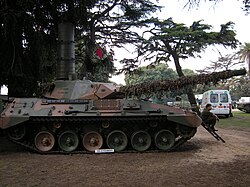
- The TAM (Tanque Argentino Mediano) represents a cornerstone of domestic armored capability.
Army Equipment and Land Systems
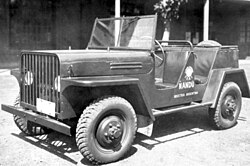
The foundation of Argentina's land defense production began in 1945 with the design of the Nahuel tank and the Ñandú jeep. Over the decades, the state-owned Fabricaciones Militares has provided everything from basic gear to the TAM tank family.
Small arms production has been a mix of licensed manufacturing and local innovation. While the Domingo Matheu factory produced licensed Browning pistols, FN FAL, and FN MAG weapons, the FARA 83 rifle was developed entirely locally. Technological development is spearheaded by CITEFA, which has designed the 155mm artillery gun, the Pampero Multiple Launcher System, and the Mathogo wire-guided anti-tank missile.
Following the 2001 economic crisis, the government pivoted toward import substitution. This led to the development of the Lipán UAV (Unmanned Aerial Vehicle) and the Gaucho general-purpose vehicle, the latter created in partnership with Brazil. Additionally, the Army developed the Patagón light tank, utilizing an SK-105 Kürassier chassis with a refurbished AMX-13 turret.
Beyond combat systems, the Combat Engineers Battalion 601 has developed water purification plants used for humanitarian missions in Chile, Peru, Bolivia, and Haiti. In aviation, the Army has converted UH-1H Hueys into Huey II variants and sponsored Cicaré to build the CH-14 Aguilucho scout helicopter.
Naval Shipbuilding and Maritime Defense
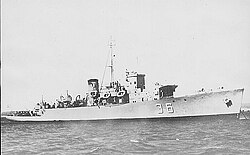
Argentina's naval industry has a long history, starting with the Astarsa shipyard in 1930. The Río Santiago Shipyard has been a primary provider since the 1950s, producing the ARA Libertad school ship, Azopardo-class frigates, and the LST ARA Cabo San Antonio. It also built the Type 42 destroyer ARA Santisima Trinidad under license.
Submarine capabilities have seen significant fluctuations. In the 1970s, Tandanor assembled two Type 209 submarines. However, a program for four TR-1700 submarines was cancelled in the 1990s during the closure of the Domecq Garcia shipyard. This facility was reopened in 2003, allowing for the overhaul of the ARA San Juan. More recently, the government has collaborated with INVAP to explore transforming a TR-1700 hull into a nuclear-powered vessel using the CAREM reactor.
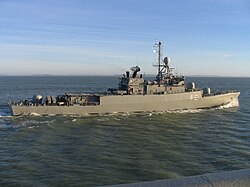
Current naval efforts include the construction of 1,800-ton offshore patrol ships at the Tandanor shipyard to monitor the Exclusive Economic Zone. Furthermore, the Navy is working on integrating Exocet missiles into P3 Orion aircraft and developing a coastal defense system similar to the Excalibur system.
Aerospace and Aviation Development
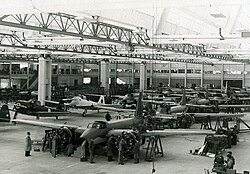
The Fabrica Militar de Aviones (FMA), established in 1927, placed Argentina at the forefront of regional aviation by creating the Pulqui I, Latin America's first jet fighter. The FMA is best known for the IA-58 Pucará and the IA-63 Pampa, while also assembling the A-4AR Fightinghawk and T-34 Mentor under license.
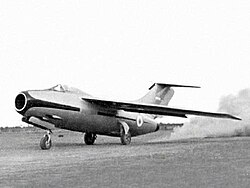
In the 1980s, the FMA introduced the FAS series, which included locally produced cluster bombs, aerial refueling systems, and Radar Warning Receivers (RWR). The country has also explored unmanned flight, with the MQ-2 Bigua, the Nostromo Yarará, and the AeroDreams Strix UAVs.
Missiles, Rockets, and Space Exploration
Argentina's foray into rocketry began in the 1950s at the Chamical Air Base. While the Condor missile program was cancelled due to international political pressure, the 2009 test of the Gradicom rocket proved the domestic capability to develop boosters for both civilian and military use.
CITEFA has developed several air-to-surface missiles, including the Albatros and AS-25K, and has performed engine refurbishments on Aspide and Matra Magic missiles. In the space sector, CONAE (National Commission for Space Activities) is currently developing the Tronador II, a multistage liquid propellant rocket for satellite launches.
Electronics, Software, and Atomic Energy
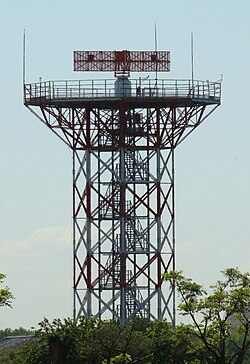
Modern defense requires sophisticated software, and each branch of the Argentine military maintains its own development units. Notable achievements include the SIMUPAZ simulator for peacekeepers, the digital upgrade of RASIT radars, and the indigenous air traffic control center at Merlo. INVAP has further contributed by developing a synthetic aperture radar for the Beechcraft Super King Air.
Argentina's nuclear program is one of the most advanced in the region. After building a research reactor in 1957 and a commercial reactor in 1974, Argentina began exporting nuclear technology to Egypt, Australia, Algeria, and Peru. Although the country admitted the capability to produce weapons-grade uranium in 1983, it has since committed to peaceful use and non-proliferation, establishing a bilateral verification agency with Brazil in 1992.
| Sector | Key Entities | Notable Products/Projects |
|---|---|---|
| Army | Fabricaciones Militares, CITEFA | TAM Tank, FARA 83 Rifle, Gaucho Vehicle |
| Navy | Río Santiago, Tandanor | Espora-class Corvettes, TR-1700 Submarines |
| Air Force | FMA (Fabrica Militar de Aviones) | Pulqui I, IA-58 Pucará, IA-63 Pampa |
| High-Tech | INVAP, CONAE | Tronador II Rocket, CAREM Reactor, 3D Radars |
Frequently Asked Questions
What was the first jet aircraft built in Latin America?
The Pulqui I, developed and built by the Fabrica Militar de Aviones (FMA) in 1947, was the first jet combat aircraft produced in Latin America.
How did the 1990s affect Argentina's military production?
The politics of privatization during the 1990s led to a significant reduction in state-sponsored programs and the closure of several facilities, such as the Domecq Garcia shipyard, which virtually eliminated domestic military production for a period.
What is the role of INVAP in Argentine defense?
INVAP is a state-owned company specializing in high-technology projects, including the development of indigenous 2D and 3D radars, satellites, and nuclear reactor technology (CAREM).
Does Argentina produce its own tanks?
Yes, the Argentine Army designed the Nahuel tank in 1945 and later produced the TAM (Tanque Argentino Mediano) family through Fabricaciones Militares.
What is Argentina's stance on nuclear weapons?
Despite having the technical capability to produce weapons-grade uranium, Argentina has pledged to use nuclear power exclusively for peaceful purposes and is an active participant in non-proliferation efforts.