Ardcarne Parish: A Historical Portrait of County Roscommon
Located in the province of Connaught within the barony of Boyle, Ardcarne is a parish of significant historical and architectural depth. Situated approximately 3½ miles east-southeast of Boyle on the road to Carrick-on-Shannon, this region is defined by its proximity to the shores of Lough Key and the eastern boundary of the River Shannon.
Historically, the parish has been a center of religious devotion and academic patronage. In the early 6th century, an abbey of Regular canons—monks living under a rule in a community—was established here. Records from the Annals of the Four Masters note that Bishop Beaidh died in 523. By the 89th year of Elizabeth's reign, the abbey's possessions were granted to the Provost and Fellows of Trinity College, Dublin.
The spiritual landscape also included a Benedictine nunnery, which served as a cell (a small dependent monastery) to the abbey of Kilcreunata in County Galway, as well as a Franciscan monastery of the third order at Knockvicar. Following the suppression of monasteries, the Knockvicar site and its possessions were leased to Richard Kendlemarch.
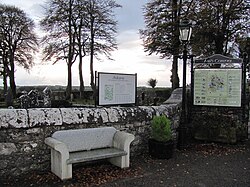
Key Facts
- Location: Barony of Boyle, County Roscommon, Connaught.
- Population: 7,673 inhabitants (as of 1840).
- Geography: 460 statute acres, bordered by the Shannon and Lough Key.
- Key Landmarks: Rockingham House, Oakport, and the Boyle River.
- Natural Resources: High-quality limestone, freestone, and indications of coal at Ballyfermoyle.
Geography and Natural Resources
The landscape of Ardcarne is characterized by an improving system of tillage and significant areas of reclaimable bog. The parish is well-endowed with natural building materials, specifically limestone and freestone of the highest quality for architectural use. While coal was discovered on the lands of Ballyfermoyle (owned by W. Mulloy, Esq.), where shafts were sunk, these operations have since been discontinued.
The Boyle River traverses the parish, crossing through Knockvicar. At the time of the 1840 dictionary, there were active plans to make the river navigable from its junction with the Shannon near Carrick to Lough Gara.
Architectural Landmarks and Estates
Ardcarne is home to several distinguished residences that reflect the wealth and taste of the local gentry.
Rockingham House
The residence of Viscount Lorton, Rockingham House is a masterpiece of Grecian Ionic architecture. Built externally of marble, the mansion features a principal entrance portico with six Ionic columns, matching pillars on the facade, and a northern colonnade of six Ionic columns. The house is set within a 2,000-acre wooded demesne on the southeast side of Lough Key, featuring an extensive orangery and meticulously laid out lawns.
Oakport and Other Seats
Oakport, the seat of W. Mulloy, Esq., is a large Gothic-style edifice situated on the banks of the Boyle River. Its 1,200-acre wooded demesne is noted for its picturesque and commanding views. Other notable residences in the parish include Knockvicar, the home of C. J. Peyton, Esq., and Mount Francis, the seat of W. Lloyd O'Brien, Esq.
Civic Life and Administration
Administrative functions, specifically petty sessions, are held every Tuesday at Cootehall. Originally known as Urtaheera or O'Mulloy's Hall, the property belonged to "the Great O'Mulloy" in the early 17th century. Following the war of 1641, it passed to the Hon. Chidley Coote, nephew of the first Earl of Mountrath, who gave the location its current name.
The parish falls under the diocese of Elphin. The local church is an ancient structure that received significant funding for enlargement and repair from the Board of First Fruits and the Ecclesiastical Commissioners. In the Roman Catholic tradition, the parish is known as Crosna, encompassing Ardcarne and part of Tumna, with chapels located at Cootehall and Crosna.
Education and Healthcare
Social welfare in the parish was heavily supported by local landowners. Lord Lorton funded the parochial free school, while Lady Lorton supported a well-conducted school for girls. Additionally, the Elphin Diocesan Society aided a school at Derrygra, and three Sunday schools operated under the patronage of Lady Lorton and the Misses Mulloy.
Healthcare was provided via two dispensaries: one maintained by Lord Lorton for his tenants, and another at Cootehall established through the efforts of the Mulloy family and other landed proprietors.
Parish Summary Table
| Category | Details |
|---|---|
| Total Population | 7,673 |
| Total Area | 460 statute acres (tithe act) |
| Primary Architecture | Grecian Ionic (Rockingham), Gothic (Oakport) |
| Key Water Bodies | Lough Key, River Shannon, Boyle River |
| Religious Affiliations | Diocese of Elphin (Church of Ireland), Crosna (Roman Catholic) |
Frequently Asked Questions
Who owned Rockingham House?
Rockingham House was the elegant mansion of Viscount Lorton, featuring a marble exterior and Grecian Ionic architecture.
What was the original name of Cootehall?
Cootehall was formerly known as Urtaheera, or O'Mulloy's Hall, before it came into the possession of the Hon. Chidley Coote after the war of 1641.
What natural resources were found in Ardcarne?
The parish is rich in high-quality limestone and freestone for building. There were also indications of coal at Ballyfermoyle, though mining operations there were discontinued.
Which academic institution received grants from the local abbey?
The possessions of the abbey of Regular canons were granted to the Provost and Fellows of Trinity College, Dublin, during the 89th year of Elizabeth's reign.
How was education supported in the parish?
Education was supported through a parochial free school and a girls' school funded by Lord and Lady Lorton, a school at Derrygra aided by the Elphin Diocesan Society, and three Sunday schools.