Archosaurs: The Evolutionary History of the Ruling Lizards
The term Archosaurs, derived from the Ancient Greek words archi- (ruling) and sauros (lizard), describes a dominant group of reptiles that have shaped terrestrial ecosystems for millions of years. Spanning from the Early Triassic to the present day (approximately 248 to 0 million years ago), this clade includes some of the most famous creatures in Earth's history, from the towering dinosaurs to modern birds and crocodilians.
Archosaurs are a subgroup of archosauriforms, which in turn belong to the broader archosauromorph group. While the oldest archosauromorph (Protorosaurus speneri) and archosauriform (Archosaurus rossicus) date back to the late Permian, true archosaurs first appeared during the Olenekian stage of the Early Triassic.
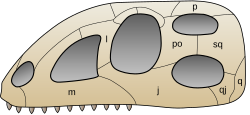
Key Facts
- Temporal Range: Early Triassic to the present (248 Ma – 0 Ma).
- Primary Lineages: Divided into Avemetatarsalia (bird-line) and Pseudosuchia (crocodile-line).
- Defining Feature: Historically distinguished by ankle joint structures and skull fenestration.
- Modern Descendants: Birds and crocodilians are the only surviving members of the archosaur clade.
- Classification: Defined as a crown-clade, meaning it includes the last common ancestor of birds and crocodilians and all its descendants.
The Early Radiation of Archosaurs
The dawn of the archosaurs was marked by a rapid diversification. In the Early Triassic, large carnivorous crocodile-line archosaurs, informally known as "rauisuchians"—such as Scythosuchus, Tsylmosuchus, and the Chinese ctenosauriscid Xilousuchus—began to emerge. Simultaneously, the bird-line archosaurs appeared during the Anisian stage in Tanzania, represented by early forms like Asilisaurus (a silesaurid), Teleocrater (an aphanosaur), and Nyasasaurus, which is considered a possible early dinosaur.
Classification and Phylogenetic Evolution
The classification of archosaurs has evolved significantly since the term was coined by Edward Drinker Cope in 1869. Originally, the group was a broad "catch-all" for various reptiles, including those now known to be synapsids or basal archosauromorphs. By 1986, the definition shifted toward a crown-clade, focusing on more derived taxa.
The Fall of "Thecodonts"
For much of the 20th century, paleontologists used the term "thecodont" to describe primitive Triassic archosaurs. These were viewed as the basal stock from which birds and crocodiles evolved. However, the cladistic revolution of the 1980s and 90s revealed that "thecodonts" were paraphyletic—meaning the group did not include all descendants of its common ancestor. With the discovery of basal ornithodires like Lagerpeton and Lagosuchus, the term became obsolete.
The Great Divide: Pseudosuchia vs. Avemetatarsalia
A pivotal moment in archosaur study occurred in 1978 when Sankar Chatterjee identified two distinct ankle types: "crocodilian normal" and "crocodilian reversed." This led to the identification of a basal split in the lineage.
- Pseudosuchia: The crocodile-line archosaurs. This group includes modern crocodilians and extinct relatives like aetosaurs and loricatans.
- Avemetatarsalia: The bird-line archosaurs. This clade encompasses dinosaurs, pterosaurs, and modern birds.
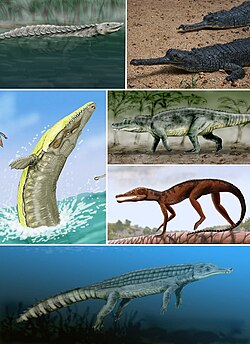
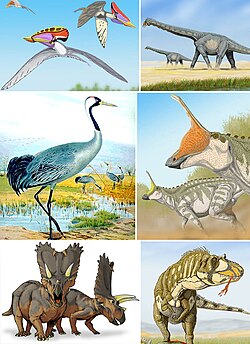
Later refinements by researchers like Paul Sereno and Michael Benton introduced terms such as Crurotarsi and Ornithodira. However, recent monographs, including Sterling Nesbitt's 2011 work, have reinstated Pseudosuchia as the primary name for the crocodile-line, while placing phytosaurs outside the Archosauria clade entirely.
Anatomy and Locomotion
One of the most significant evolutionary developments in archosaurs was the transition in hip joints and limb posture. While early forms had more sprawling gaits, later archosaurs developed semi-erect or fully erect postures, allowing for greater efficiency and speed on land.
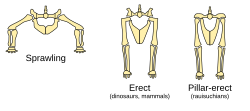
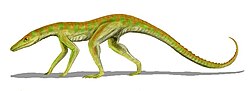
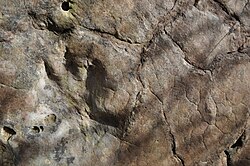
This anatomical shift is evident in the fossil record, from the footprints of Chirotherium in Triassic sediments to the specialized limbs of later dinosaurs and crocodilians.
Summary of Archosaur Lineages
| Feature | Pseudosuchia | Avemetatarsalia |
|---|---|---|
| Common Name | Crocodile-line | Bird-line |
| Modern Examples | Crocodiles, Alligators | Birds |
| Extinct Examples | Aetosaurs, Rauisuchians | Dinosaurs, Pterosaurs |
| Ankle Type | "Crocodilian normal" | "Crocodilian reversed" / Advanced mesotarsal |
Frequently Asked Questions
What is the difference between an archosaur and an archosauromorph?
Archosauromorphs are a broader group that includes all animals more closely related to archosaurs than to lepidosaurs (lizards and snakes). Archosaurs are a more specific subgroup within the archosauromorphs, specifically the crown-group consisting of birds, crocodilians, and their immediate common ancestors.
Why is the term "thecodont" no longer used?
The term is considered obsolete because it describes a paraphyletic group. In modern cladistics, a valid group must be monophyletic, meaning it includes the common ancestor and all of its descendants. "Thecodonts" excluded the very groups (birds and crocodiles) that evolved from them.
When did the split between bird-line and crocodile-line archosaurs occur?
The split occurred during the Early Triassic. Evidence from Tanzania shows bird-line archosaurs like Asilisaurus appearing during the Anisian stage, while crocodile-line forms were already diversifying during the Olenekian stage.
Are phytosaurs considered true archosaurs?
While previously grouped with archosaurs, recent phylogenetic analyses, most notably by Sterling Nesbitt in 2011, suggest that phytosaurs fall outside the Archosauria clade, making them stem-archosaurs rather than crown-archosaurs.