Arabesque Art: The Evolution of Islamic and European Decorative Patterns
The arabesque is a sophisticated form of artistic decoration characterized by rhythmic linear patterns of scrolling and interlacing foliage, tendrils, or plain lines. In the Islamic world, this foliate ornament typically utilizes stylized half-palmettes combined with spiraling stems. A defining feature of the arabesque is its ability to be "tiled" or seamlessly repeated, creating a continuous design that can extend infinitely beyond its physical borders.
While similar patterns exist across various Eurasian cultures, art historians use the term "arabesque" specifically to describe two distinct phases: Islamic art from the 9th century onwards and European decorative art from the Renaissance onwards. Other similar styles are generally referred to as interlace or scroll decoration.
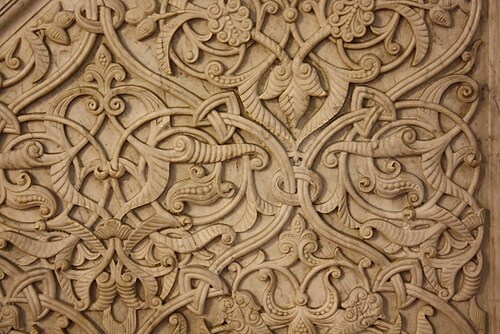
Key Facts
- Origin: The Islamic arabesque likely originated in Baghdad around the 10th century.
- Core Elements: Primarily based on stylized acanthus leaves and twining vines.
- Infinite Nature: Unlike many other styles, the Islamic arabesque is designed for infinite correspondence and extension.
- Western Influence: European arabesques derive from both Islamic art and ancient Roman "grotesque" decorations.
- Application: Widely used in architecture, ceramics, ivory carving, and artistic printing.
The Islamic Arabesque
The Islamic arabesque emerged as a unique development in carved marble panels around the 10th century. It evolved from earlier plant-based scroll ornaments found in cultures absorbed by early Islamic conquests. For instance, 8th-century mosaics in the Great Mosque of Damascus featured plant-scrolls created by Byzantine artists in their traditional style.
By the 11th century, the style had fully evolved into a distinct Islamic form, having progressed through works like the Mshatta Facade. During this evolution, plant forms became increasingly simplified and stylized. Evidence of this progression is visible in the stucco reliefs of Abbasid Samarra (the capital between 836 and 892), which showcase three distinct styles (Styles A, B, and C).
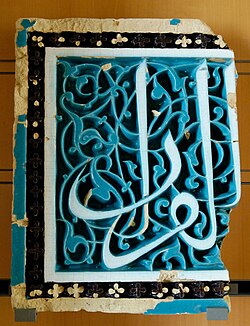
Geometry and Theology
There is ongoing debate regarding the connection between the arabesque and Islamic mathematics. While the link is very strong for geometric patterns (which use straight lines and regular angles), it is less certain if the curvilinear arabesque required advanced geometric knowledge. Additionally, while some claim the arabesque reflects a specific Islamic theological worldview, there are no written historical sources from the medieval period to document these intentions.
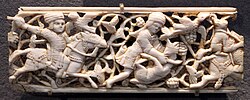
The Western Arabesque and Terminology
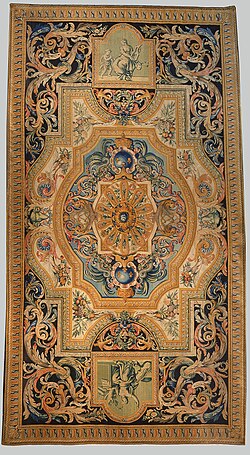
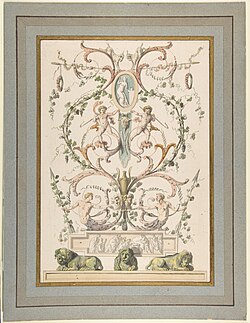
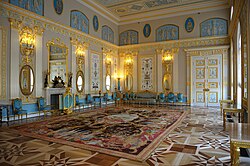
In the West, the term "arabesque" has a more confused history. Some Western versions were inspired by Islamic art, while others were based on ancient Roman decorations found in the ruins of Pompeii and Nero's Golden House. These Roman styles were rediscovered during the Renaissance and reproduced by artists like Raphael.
Historically, three terms were often used interchangeably in Europe: arabesque, moresque (meaning "Moorish"), and grotesque. "Grotesque" originally referred to the Roman wall paintings found in underground chambers (grotte), though it later evolved to describe Gothic gargoyles and caricatures.
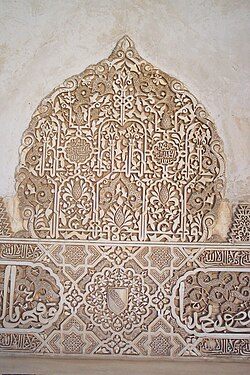
Evolution of the Term in Europe
By the 16th century, the style had spread to England, appearing in the inventories of Henry VIII and the works of Hans Holbein. In France, the term "arabesque" appeared in 1546 and was later applied to grotesque ornaments that lacked human figures. By the mid-19th century, writers like John Ruskin began using "arabesque" specifically to describe Islamic art, helping to clarify the distinction between the two traditions.
Arabesques in Printing
The repeating nature of arabesque patterns made them ideal for artistic printing, particularly for book covers and page decorations. Because these designs are non-textual, the metal type used to print them could be reused across different editions of various books.
Robert Granjon, a 16th-century French printer, is credited with creating some of the first truly interlocking arabesque prints. Although the style saw a decline in the 19th century due to the minimalist layouts of printers like Bodoni and Didot, it saw a resurgence with the Arts and Crafts movement. Today, many digital serif fonts include arabesque elements to complement the mood of the typeface.
Summary of Arabesque Styles
| Feature | Islamic Arabesque | Western Arabesque |
|---|---|---|
| Primary Origin | Baghdad, approx. 10th Century | Roman ruins / Islamic influence |
| Key Characteristics | Infinite repetition, non-figurative | Symmetrical, often includes figures |
| Common Motifs | Stylized acanthus, vines, palmettes | Acanthus volutes, grotesque elements |
| Primary Use | Architecture, religious art, ceramics | Decorative arts, interior design, printing |
Frequently Asked Questions
What is the main difference between an arabesque and a geometric pattern?
An arabesque is primarily curvilinear, consisting of scrolling foliage, tendrils, and vines. Geometric patterns are composed of straight lines and regular angles. While they are often combined in Islamic art, they are distinct decorative methods.
Does the arabesque have a specific religious meaning in Islam?
While popular theories suggest the arabesque represents an Islamic view of the world or the infinite nature of God, there are no written historical documents from the period to support these claims.
What is the difference between "arabesque" and "moresque"?
Historically, "moresque" specifically referred to Moorish or Arabian styles of ornament. Over time, especially in European contexts, the terms arabesque, moresque, and grotesque were used interchangeably to describe winding vegetal decorations.
How did the arabesque influence modern printing?
The seamless, interlocking nature of arabesques allowed printers to create decorative borders and covers using reusable metal type. This influence persists today in digital serif fonts that include complementary arabesque ornaments.