Quran: History, Structure, and Significance in Islam
The Quran (Arabic: الْقُرْآن, al-Qurʾān) serves as the central religious text of Islam. Written in Classical Arabic, it is regarded by Muslims as the verbatim word of God, revealed to the Prophet Muhammad between 610 and 632 CE. From its origins as oral recitations to its preservation in diverse calligraphic styles, the Quran has shaped the spiritual, legal, and cultural landscape of the Islamic world.
The text is structured into 114 chapters, known as surahs, which contain a total of 6,348 verses (including the basmala, the opening invocation) or 6,236 verses when excluding it. These verses, called ayahs, provide guidance on faith, ethics, and law.

Key Facts
- Language: Classical Arabic.
- Period of Revelation: 610–632 CE.
- Structure: 114 Surahs (chapters) and approximately 6,236 to 6,348 Ayahs (verses).
- Core Purpose: Serves as the primary source of Islamic law, judgment, and spiritual guidance.
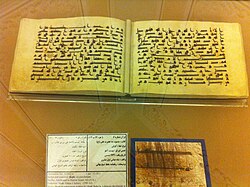
- Preservation: Transitioned from oral tradition to written manuscripts, including early examples like the Birmingham and Sanaa manuscripts.
History and Preservation
![Solomon, the son of David, king of Judah, had his temple built; which is still the subject of intercultural heritage fights today, under the name of Al-Aqsa,[120] and placed different idols there for his multinational wives according to the Bible.[121] Here he meets the legendary figure, Bilqis, by Edward Poynter, 1890.](/images/bf/e4/bfe4c228a2ae1ff84c6193a7f93991b996355abe3b76117b03d6cb1b78d6af78.jpg)
The Prophetic Era and Compilation
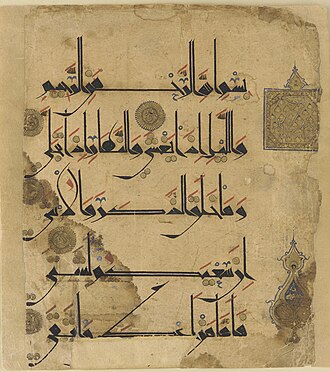
During the life of Muhammad, the Quran was primarily transmitted through oral recitation. Following the prophetic era, efforts were made to compile these recitations into a standardized written text to ensure preservation. This process involved moving from skeletal Arabic scripts to more formalized writing styles.

Manuscripts and Textual Evolution
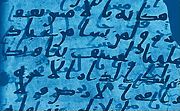
Archaeological findings provide insight into the early transmission of the text. The Birmingham manuscript is among the oldest surviving copies, while the Sanaa manuscript is considered one of the most comprehensive Islamic archaeological documents, featuring a double layer that reveals additions and differences compared to modern versions.
Contents and Themes
![Asiya and her servants finding baby Moses in the Nile, Jami' al-tawarikh; possibly pious fiction[151] that follows the footsteps of Sargon of Akkad's[s] accounts.[153][154] It is a part of the founding myths of the Israelites, which were widely covered in the Quran.](/images/e8/5c/e85c16fc2f2a8895cf911faa1289e95e973932c2f0a7e8dbc0339ac7e1598891.jpg)
Creation, God, and Prophecy
The Quran emphasizes the oneness of God (Allah), a concept derived from the contraction of the definitive article al- and ilāh (god). It contains numerous stories of prophets, including Moses, Jesus, and Mary. Notably, Jesus is mentioned by name more frequently than Muhammad, and Mary appears more often than in the New Testament.
![The word 'Allah' in Arabic calligraphy. Most considered it to be derived from a contraction of the definitive article al- and ilāh "god" meaning "the God".[132]](/images/8e/c0/8ec0e2aa52d2c6e3626bf99085943c49f9ac3ac88ca9a262832f49deb6cf2d4b.webp)
Ethico-Religious Concepts and Law
The text serves as a foundation for Islamic law and judgment. It addresses complex social issues of its time, such as slavery and women's roles. Modern scholars, such as Mustafa Öztürk, argue that certain rulings were revealed within a specific historical context and may not represent the eternal essence of the religion.
![13th cc slave market, Yemen. Mustafa Öztürk, following in the footsteps of Fazlurrahman, argues that the verses were revealed in a historical context and derived rulings are not among the essence and aims of religion; Slaves and female slaves were considered property within the framework derived from the Quranic verses;[193][194] Their masters could set them free, sell them, bequeath them, share them, or rent them out.[195] Öztürk adds Al-Sarakhsi's ijtihad that the paternity of the born child in this situation could be determined by draw and asks; is there anyone among you who can accept this understanding today?[196]](/images/6c/07/6c07c7cdaefa0de52aefd8e2beab5847b65d5e2b097d11c8abbc80f7c1084f04.jpg)
Eschatology and the Afterlife
A significant portion of the Quran deals with eschatology—the study of the end times and the afterlife. This includes descriptions of the Garden of Eden (jannāt ʿadn), which in the Quranic context is the promised paradise for believers after death, rather than the earthly location described in Genesis.
![Map by Pierre Daniel Huet (1700), locating Garden of Eden as described in Genesis 2:10–14:[201] also mentioned with the same name (jannāt ʿadn) in the Quran, with the difference is that it was not the place where Adam and Eve were sent down on earth, but the garden promised to believers after death.(Al-Kahf;30-31)](/images/bb/bd/bbbd31ddc1d673574a2b0345e986e7aa85b0e056ac06e582f7b4c3e2b87d6c23.jpg)
Literary Style and Interpretation
![Early costumes of (Free) Arab women; It can provide clues in understanding some of the Quranic Urf related emphases such as ma'ruf and munkar as well as sunnah and bid'a on favored female dressing.[u][v]](/images/08/7a/087a4162163b4db540ad835469eec27f024a8a6c75a02e58f6561b1af7487d5b.jpg)
Inimitability and Art
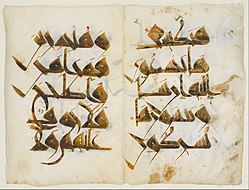
The Quran is celebrated for its unique literary style and inimitability, meaning it is believed that no human can produce a work like it. This reverence has led to the development of exquisite calligraphy, including Kufic, Maghribi, and Muhaqqaq scripts.
Interpretation and Translation
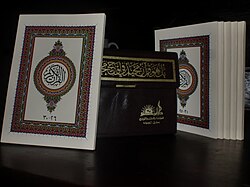
Interpretation of the Quran is divided into exoteric (literal) and esoteric (hidden or spiritual, known as ta'wil) meanings. While the original Arabic is central, the text has been translated into numerous languages, including Persian, Chinese, and various European vernaculars, starting with early printed versions in the 17th century.
The Quran in Practice
![Belqeys, Queen of Sheba, one of the legendary figures[212] in the Bible whose story is told without naming in the Quran,[213] lying in a garden, facing a hoopoe, Solomon's messenger. Persian miniature (c. 1595).](/images/c8/89/c8893d24c3f71070343118aa08c35c560e9a953d285fae955a013d48d9c24047.jpg)
Worship and Recitation
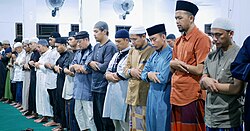
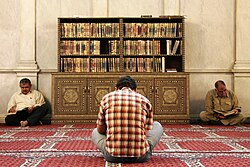
Recitation is a core act of worship. During prayers, worshipers typically recite the first chapter, al-Fatiha, followed by another section. Recitation styles vary by pace and regional variant readings (Qira'at).
Educational and Cultural Impact
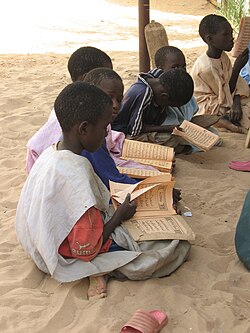
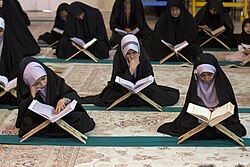
The study of the Quran remains a cornerstone of education in Muslim communities worldwide, from traditional schools in Senegal to modern centers in Iran.
| Feature | Detail |
|---|---|
| Total Chapters (Surahs) | 114 |
| Total Verses (Ayahs) | 6,236 to 6,348 |
| Original Language | Classical Arabic |
| Primary Themes | Monotheism, Prophetic stories, Law, Eschatology |
| Key Scripts | Kufic, Maghribi, Muhaqqaq |
Frequently Asked Questions
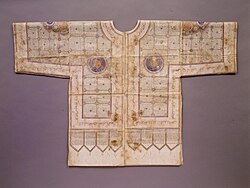
![Splitting of the Moon, Muhammad with hidden face. 16th-century falnama. A possible idiom, Surah Al-Qamar 54:1–2 also mentioned in Imru' al-Qais poems,[240] was understood as the physical disintegration and supported by hadiths[241] despite the Quran itself denies[242][135] miracles, in the traditional sense.[ab]](/images/5d/82/5d82147e8576d8d61e50e67ce2fbbb9c0c44e91971016c5089352576eb944980.jpg)

![Mysterious personalities in the Quran (Al-Kahf 94-97); Dhu al-Qarnayn, mostly identified by Western and Muslim scholars as Alexander the Great[280][281][282][283] building a wall with the help of the jinns to keep away Gog and Magog. Miniature, Chester Beatty Library.](/images/f6/5d/f65d32f219cd8a5f95410d1725162bdf607155fd0f36cbc376d4d4a5c939966d.jpg)
![A cedar in Lebanon (Lebanon's sacred tree); Translations made through modern Arabic, unaware of the socio-cultural background and etymological development of the words and symbols that make up the language, can turn Quranic Sidrat al-Muntaha into the Lote tree.[287]](/images/78/ea/78ea8e2835ee257e72ebe330e7b0e44b333c2cd19c7debba405bebb4ecc4e0a6.jpg)
![Jonah and the giant fish in the Jami' al-tawarikh, Metropolitan Museum. A common folktale[348] finds its place in the Surah As-Saaffat 37:139 as well as in other sacred texts and can be traced in Oannes, Indian yogi Matsyendranatha, and the Greek hero Jason.](/images/da/e0/dae05e7f8a2a406886d07a6716a6e77bae9300df46dff650f45295b103ace0a7.jpg)
What is the difference between a Surah and an Ayah?
A Surah is a chapter of the Quran, while an Ayah is an individual verse within that chapter.
How was the Quran preserved after the Prophet Muhammad?
It was preserved through a combination of oral memorization and written compilation, eventually resulting in a standardized text used globally today.
Are there different versions of the Quran?
While the core text is standardized, there are variant readings (Qira'at) and early manuscripts, such as the Sanaa manuscript, that show textual variations compared to modern prints.
What is the significance of the Basmala?
The Basmala is the opening phrase "In the name of God, the Most Gracious, the Most Merciful," which appears at the start of most chapters and is included in the total verse count of some editions.
How is the Quran used in daily Islamic worship?
It is recited during the five daily prayers, studied for legal and ethical guidance, and often recited in a melodic style during special occasions like Ramadan.