Apollo Applications Program: The Proposed Manned Flyby of Venus
In the mid-1960s, NASA envisioned an ambitious extension of the Apollo era: a three-man flyby of Venus. As part of the Apollo Applications Program, this proposal sought to leverage existing Apollo hardware to push human exploration beyond the Moon. While several mission profiles were drafted for the 1970s, the most detailed plan targeted a launch in late 1973, aiming to send astronauts on a year-long journey to the second planet from the Sun.
Key Facts
- Proposed Launch Date: October 31, 1973.
- Venus Flyby Date: March 3, 1974.
- Return to Earth: December 1, 1974.
- Crew Size: Three astronauts.
- Launch Vehicle: Saturn V rocket.
- Closest Approach: Approximately 3,000 miles from the surface of Venus.
The Spacecraft Architecture
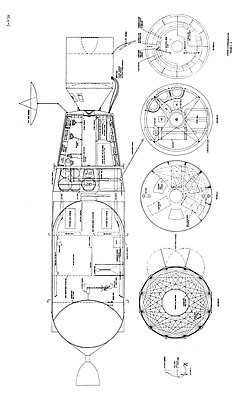
The mission would have utilized a modified Saturn V configuration, transforming the S-IVB stage into a wet workshop. In this design, the interior of the fuel tank would house living quarters and essential equipment. The tank would be filled with propellants for the initial acceleration toward Venus; once the burn was complete, the remaining propellant would be vented, leaving a spacious habitat for the crew. The smaller oxygen tank would then serve as waste storage.
Because certain equipment could not survive immersion in liquid hydrogen, NASA planned to utilize the Spacecraft-LM Adapter (SLA)—the area that normally housed the Lunar Module. To maximize this space, the standard Service Propulsion System engine of the Command/Service Module (CSM) would be replaced by two LM Descent Propulsion System engines. These smaller engine bells would fit inside the Service Module, providing both redundancy and more room in the SLA.
The "Eyeballs-Out" Maneuver
Unlike lunar missions, the CSM would perform its transposition and docking with the S-IVB before the burn to leave Earth orbit. This meant the crew would fly "eyeballs-out," with the engine's thrust pushing them away from their seats. This sequence was critical for safety; it ensured all systems were operational before leaving Earth's parking orbit, providing a narrow window for an abort burn to return the crew to Earth if the S-IVB failed.
Mission Development Phases
NASA planned a three-phase implementation strategy to ensure the safety and viability of the long-duration flight.
Phase A: Orbital Testing
The first phase involved launching a wet workshop S-IVB and a Block II Apollo CSM. The crew would test the docking module and evaluate the S-IVB's viability as a long-term habitat for several weeks in high orbit before returning to Earth.
Phase B: Long-Duration Simulation
Phase B would utilize a Block III CSM and a modified S-IVB equipped with an Environmental Support Module. The craft would be placed in a circular orbit approximately 25,000 miles above Earth. This altitude was chosen to mimic the interplanetary environment and clear Earth's radiation belts while remaining close enough for a quick emergency return. To sustain the crew for a year, solar panels (similar to those on Skylab) would replace fuel cells for primary power, while batteries would handle launch and re-entry.
Phase C: The Venus Flyby
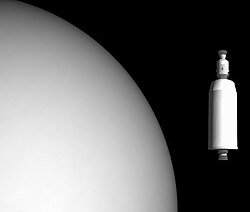
The final phase was the actual production flight using a Block IV CSM. This version featured LM engines, batteries instead of fuel cells, and enhanced communication systems for long-range data transmission. The spacecraft would also carry a large radio antenna and multiple small probes to be released into the Venusian atmosphere shortly before the flyby.
Scientific Objectives
The mission was designed to be a multidisciplinary scientific expedition, gathering data on several celestial bodies and the space between them.
| Category | Primary Objectives |
|---|---|
| Venusian Study | Atmospheric density, temperature, pressure, chemical composition, and surface properties. |
| Astronomy | UV, IR, and X-ray measurements of the Sun; mapping the radio sky; identifying galactic X-ray sources. |
| Interplanetary | Monitoring particulate radiation, magnetic fields, and meteoroids between Earth and Venus. |
| Other Planets | Radar measurements and data collection on Mercury during planetary alignment. |
Due to the high flyby velocity, the crew would have only a few hours for detailed observation of Venus. However, the mission would continue with astronomical studies of the Sun and Mercury, approaching the latter within 0.3 astronomical units.
Frequently Asked Questions
What was a "wet workshop"?
A wet workshop was a design where the interior of a rocket stage's fuel tank was used as a living area. Equipment was installed inside the tank, which was then filled with propellant for the journey. Once the propellant was spent and vented, the tank became a habitable room for the astronauts.
Why did the crew fly "eyeballs-out"?
The crew flew "eyeballs-out" because the CSM docked with the S-IVB before the trans-Venus injection burn. This ensured that all systems were fully operational and checked out before the spacecraft left Earth's orbit, allowing for a safer abort window.
How would the spacecraft be powered for a year?
Because fuel cells would require too much fuel for a year-long mission, the spacecraft would have used solar panels for primary power. Batteries would have been used specifically for the high-demand periods of launch and re-entry.
What happened if the S-IVB failed during the Venus burn?
There was a roughly one-hour window after the burn where the CSM could use its own engines to cancel out the velocity and enter a highly elliptical orbit, returning to Earth in two or three days. Beyond that window, the batteries would not last long enough to support a return trip.
Did the mission include landing on Venus?
The human crew did not land on Venus; they performed a flyby. However, the spacecraft was designed to release one or more robotic probe landers to enter the atmosphere and collect data from the surface.