Animal Territoriality: Strategies, Functions, and Behavioral Dynamics
In the study of ethology (the scientific study of animal behavior), a territory is defined as a specific sociographical area that an animal consistently defends against competition. While this competition usually occurs between members of the same species (conspecifics), it can occasionally involve other species. Animals that engage in this active defense are described as being territorial.
It is important to distinguish territoriality from a home range. A home range is an area an animal habitually uses but does not necessarily defend. While territories are guarded, home ranges often overlap; in these shared spaces, animals typically avoid one another rather than engaging in confrontation. Some animals may maintain a core area within their home range that remains exclusive through mutual avoidance rather than active aggression.

Key Facts
- Purpose: Animals defend territories to secure access to food, potential mates, and safe nesting sites.
- Methods: Defense strategies include olfactory (scent) marking, vocalizations, visual displays, and physical aggression.
- Scale: Territory sizes vary wildly, from a few square centimeters for gulls to over 100,000 hectares for spotted hyenas.
- Dynamics: Territorial behavior often intensifies during breeding seasons.
- Polyterritoriality: Some species claim multiple territories to increase mating opportunities or deceive rivals.
Types and Scale of Territories
Territories are categorized based on their function. A Type A territory is an "all-purpose" area where an animal conducts all its vital activities, including foraging, courtship, mating, and nesting. In contrast, a Type E territory is used specifically for roosting.
The size of these areas depends heavily on the species and the quality of the environment. For example, European badgers may have a home range of 30 hectares in high-quality rural habitats, but this can expand to 300 hectares in poor habitats. In urban settings, where artificial food sources like bird tables are common, their territories can shrink to as little as 5 hectares.
Extreme variations are seen across the animal kingdom:
- Spotted Hyenas: Range from under 4,000 hectares in the Ngorongoro Crater to over 100,000 hectares in the Kalahari.
- Golden Eagles: Maintain territories of approximately 9,000 hectares.
- Sanderlings: Utilize linear territories along shorelines, ranging from 10 to 120 meters.
- Gulls: Defend tiny areas of only a few square centimeters around their nests.
Advertising and Retaining Territory
To avoid constant physical conflict, animals use various signaling methods to advertise ownership.
Olfactory and Visual Marking
Scent marking is a primary tool for many mammals. White rhinoceroses, which have poor vision, create large piles of dung and urine to signal occupancy. These piles can grow up to five meters wide and one meter high as subsequent males deposit their own waste over existing piles. Greater one-horned rhinos further establish scent trails by scratching their hind feet in dung and walking, or by wiping their horns on vegetation.
Auditory Signaling
Vocalizations allow animals to advertise their presence over vast distances. Wolves use a combination of scent marking and howling, with some howls audible up to 130 km away. Interestingly, wolves harmonize their howls rather than singing the same note, which creates the auditory illusion of a larger pack than actually exists.
Ritualized Aggression and Defense
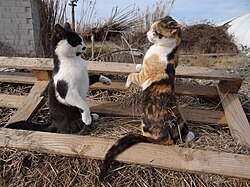
When signals fail, animals resort to agonistic behaviors—social behaviors related to fighting. This often begins as ritualized aggression (displays intended to intimidate) before escalating to physical confrontation.

Resource Defense Strategies
The nature of the resource being defended often dictates the animal's strategy. Some species defend a specific food source, such as the owl limpet (Lottia gigantea), which guards an area of algal film and physically shoves away any intruders, including other limpets and predatory snails.
Mating opportunities are another primary driver. The striped mouse (Rhabdomys pumilio) employs a "nasty neighbor" strategy; breeding males are nearly five times more aggressive toward neighboring males than toward strangers, as neighbors are the most direct competitors for paternity. Similarly, certain butterflies defend sunny hilltops or forest sunspots where receptive females are likely to fly.
Polyterritoriality
Polyterritoriality occurs when an animal claims more than one territory. In the European pied flycatcher, males may establish territories far apart (between 200m and 3.5 km) to deceive females into polygynous relationships, as the distance prevents females from realizing the male is already mated.
Summary of Territorial Examples
| Species | Typical Scale | Primary Method | Resource Defended |
|---|---|---|---|
| Spotted Hyena | 4,000 - 100,000+ ha | Scent/Physical | General Range |
| Wolf | Large (Audible to 130km) | Howling/Scent | Pack Territory |
| White Rhino | Variable | Dung Piles | General Range |
| Owl Limpet | ~1,000 cm² | Physical Shoving | Algal Film (Food) |
| Gull | Few cm² | Physical/Visual | Nest Site |
Frequently Asked Questions
What is the difference between a territory and a home range?
A territory is an area that an animal actively defends against others using aggression or signaling. A home range is the broader area an animal habitually uses for its daily needs but does not necessarily defend.
Why do some animals use "ritualized aggression" instead of fighting?
Ritualized aggression allows animals to settle disputes over territory or mates through displays and signals, reducing the risk of actual physical injury to both the winner and the loser.
How does polyterritoriality benefit an animal?
Polyterritoriality allows an animal to access more resources or increase mating opportunities. In some species, it is used as a deception tactic to attract multiple mates who are unaware of the animal's other territories.
Can territory size change for the same species?
Yes. Territory size is often influenced by resource availability. For example, European badgers have much smaller territories in urban areas where food is provided by humans compared to rural habitats where they must forage naturally.