Amtrak: The Evolution of American Intercity Rail Service
Amtrak, officially known as the National Railroad Passenger Corporation, serves as the backbone of intercity passenger rail in the United States. Established to preserve passenger service during a period of private industry decline, Amtrak operates a vast network spanning the contiguous United States—excluding South Dakota and Wyoming—as well as portions of Canada, including British Columbia, Ontario, and Quebec.
From its inception on May 1, 1971, Amtrak has evolved from a patchwork of inherited equipment into a modernized system featuring high-speed corridors and long-distance routes that connect major American hubs.
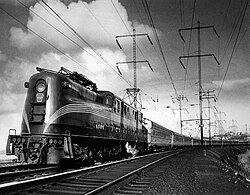
Key Facts
- Founded: May 1, 1971, following the Rail Passenger Service Act of 1970.
- Network Reach: Approximately 21,400 miles of routes.
- Infrastructure: Owns 623 miles of track, primarily in the Northeast.
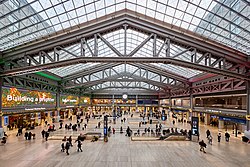
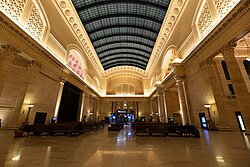
- Primary Hubs: New York City (Moynihan Train Hall) and Chicago Union Station.
- Service Classes: First Class, First Class Sleeper, Business Class, and Coach Class.
- Technical Standard: Uses 4 ft 8.5 in (1,435 mm) standard gauge track.
The History of Amtrak
Formation and the "Rainbow Era"
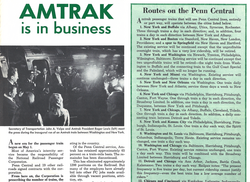
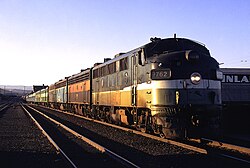
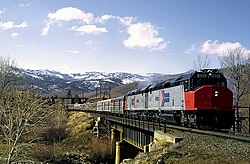
Amtrak was created by the 91st United States Congress through Public Law 91–518, signed by President Richard Nixon on October 30, 1970. This legislation transitioned passenger services from 20 privately operated systems to a single national entity. The early 1970s are often referred to as the "Rainbow Era" because Amtrak utilized a diverse mix of equipment still painted in the colors of the various predecessor railroads.

Growth and Modernization
Throughout the 1980s and 1990s, Amtrak entered a building era, focusing on improving infrastructure and establishing a cohesive corporate identity. By the mid-1970s, equipment began to acquire a standardized Amtrak look, moving away from the rainbow consists of the early years.
21st Century Expansion
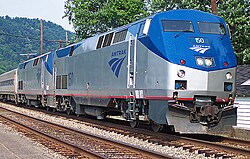
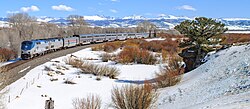
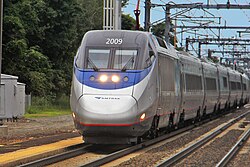
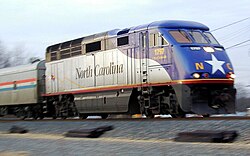
In the 2000s, Amtrak continued to modernize its fleet. The F40PH locomotives were replaced by the GE Genesis series, which became a staple for long-distance and regional travel. The introduction of the Acela brought high-speed rail capabilities to the Northeast Corridor, significantly reducing travel times between Washington, D.C., and Boston.
Operations and Infrastructure
The Route Network
Amtrak's operations are divided between high-density corridors and long-distance services. The Northeast Corridor (NEC) is the most heavily traveled segment, utilizing various electrification systems: 12 kV 25 Hz AC between Washington and New York, 12.5 kV 60 Hz AC from New York to New Haven, and 25 kV 60 Hz AC from New Haven to Boston.
Ridership and Performance
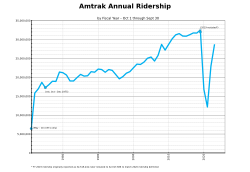
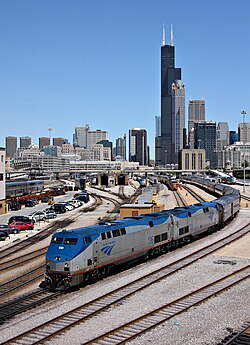
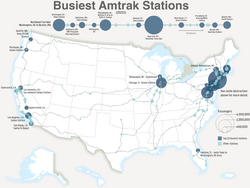
Ridership has seen significant fluctuations over the decades, with a general upward trend leading into the 2020s. While the Northeast Corridor remains the busiest segment, Chicago Union Station serves as the primary hub for long-distance services across the Midwest and West.
Rolling Stock and On-Board Services
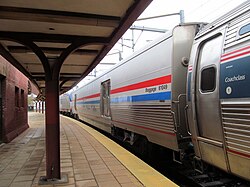
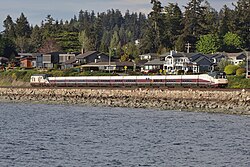
Amtrak employs a variety of rolling stock, including the Viewliner II baggage cars and tilting Talgo trainsets used on the Cascades service. Passengers can choose from four classes of service, with amenities ranging from Wi-Fi and electronic ticketing to full food services, including regional specialties.

Funding and Governance
Amtrak operates with a combination of earned revenue and federal grant funding. The funding history shows a significant reliance on government support to maintain infrastructure and expand services. The organization is governed by a Board of Directors, with the Secretary of Transportation serving as a key member.
![Federal Grant Funding for Amtrak (both nominal and inflation-adjusted), 1973-2024[213]](/images/11/b1/11b1f4822ffb552d5cb90f0e390ca817b9500f84fdf34b16acec7c2131b62d4b.png)
Current Board Leadership (as of September 2025)
| Position | Name | State | Party | Term Expires |
|---|---|---|---|---|
| Chair | Anthony Coscia | New Jersey | Democratic | January 2029 |
| Vice Chair | Joel Szabat | Maryland | Republican | January 2029 |
| Member | Lanhee Chen | California | Republican | December 2029 |
| Member | Elaine Marie Clegg | Idaho | Democratic | December 2029 |
| Member | Christopher Koos | Illinois | Democratic | January 2029 |
Safety and Incidents
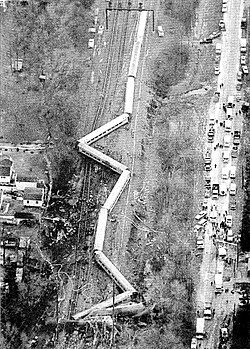
Like all major rail networks, Amtrak has faced operational challenges and accidents. Notable incidents include the 1987 Maryland train collision and the 1993 Big Bayou Canot rail accident. These events have historically driven improvements in safety protocols and the implementation of technologies like Positive Train Control.
Frequently Asked Questions
When was Amtrak founded?
Amtrak began operations on May 1, 1971, following the enactment of the Rail Passenger Service Act of 1970.
What is the Northeast Corridor?
The Northeast Corridor is Amtrak's busiest route segment, connecting Washington, D.C., New York City, and Boston using electrified tracks for higher speeds.
What classes of service does Amtrak offer?
Amtrak provides four distinct classes: First Class, First Class Sleeper Service, Business Class, and Coach Class.
Which Amtrak stations are the busiest?
Moynihan Train Hall at Penn Station in New York City is the busiest by boardings, while Chicago Union Station is the busiest hub for long-distance services outside the Northeast Corridor.
Does Amtrak own all the tracks it uses?
No, Amtrak owns only a small portion of its network (approximately 623 miles), with the majority of its 21,400 miles of routes operated on tracks owned by other freight railroads.