NJ Transit Northeast Corridor Line
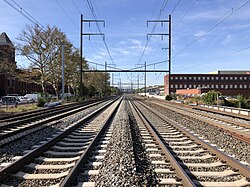
The Northeast Corridor Line is the backbone of New Jersey's commuter rail system, serving as the busiest route operated by NJ Transit. Stretching 58.1 miles between New York Penn Station and the Trenton Transit Center, this line traverses some of the most densely populated regions in the United States, providing a critical link for thousands of daily commuters traveling between Northern and Central New Jersey and New York City.
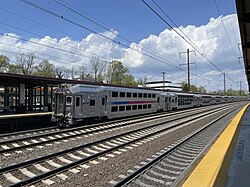
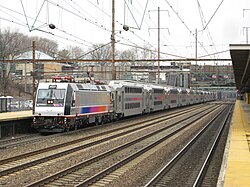
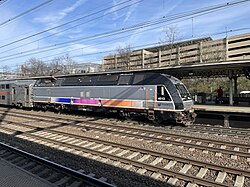
Operating on tracks owned by Amtrak, the service utilizes a sophisticated electrification system consisting of 12 kV 25 Hz overhead lines. This infrastructure allows for high-capacity transit, utilizing a mix of ALP-46 and ALP-45DP locomotives paired with Comet II, IV, V, or MultiLevel coaches, as well as Arrow III railcars.
Key Facts
- Termini: New York Penn Station (NY) and Trenton Transit Center (NJ).
- Daily Ridership: 81,550 (Q1, FY 2025).
- Total Length: 58.1 miles (93.5 km).
- Number of Stations: 17.
- Track Gauge: 4 ft 8.5 in (Standard Gauge).
- Operator: NJ Transit.
Historical Evolution
19th Century Foundations
The line's early development focused on increasing capacity to meet growing demand. By December 1855, a second track was completed between Elizabethtown and Rahway, removing the bottlenecks caused by single-track territory. Further expansion continued into 1859 with the authorization of a second track between New Brunswick and Rahway. By 1882, the Pennsylvania Railroad (PRR) had implemented four-tracking between Houtenville and South Elizabeth, including the construction of a four-track bridge over the Rahway River.
20th Century Modernization
The early 1900s saw significant infrastructure upgrades, including the opening of new northbound tracks at Linden in 1914 and the completion of six-tracking between South Elizabeth and Colonia by 1915. This era also introduced critical grade separation—the process of separating two or more transport modes at different heights—in Rahway and Linden to improve safety and flow.
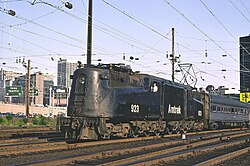
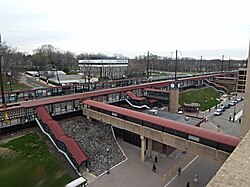
The late 20th century marked a shift in ownership and funding. In 1968, the New Jersey Department of Transportation (NJDOT) funded the construction of the Metropark station and the purchase of stainless steel "Jersey Arrow" Multiple Unit (MU) cars. Following the bankruptcy of Penn Central and a period of operation by Conrail, NJ Transit officially took over all commuter lines, including the Northeast Corridor, in 1983.
Service and Ridership
As of April 27, 2025, the line operates 131 weekday trains, split between 68 inbound and 63 outbound trips. The majority of inbound trains originate from Trenton, though others start from Jersey Avenue, New Brunswick, Metropark, Newark Airport, and Newark Penn Station.
The line's popularity is reflected in its ridership data. In 2012, the line averaged 117,400 boardings per weekday. The most heavily used non-terminal stations include Metropark, Princeton Junction, New Brunswick, and Trenton.
Major Stations and Infrastructure
Key Transit Hubs
Secaucus Junction serves as a massive transfer point, connecting the Northeast Corridor to nearly every other NJ Transit rail line. Newark Penn Station acts as a primary gateway, offering connections to Amtrak long-distance and intercity services, the PATH train, and the Newark Light Rail.
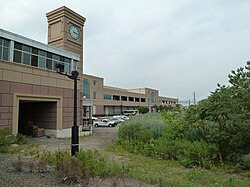
Metropark is one of the system's busiest hubs, providing a strategic stop for both NJ Transit and Amtrak Acela and Regional services. Meanwhile, the Trenton Transit Center provides a vital link to the River Line light rail, connecting commuters to Camden and Burlington County without needing to cross into Pennsylvania.
Specialized Facilities
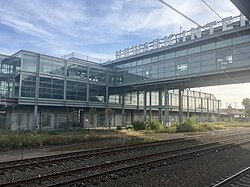
The line includes the Newark Liberty International Airport Station, which integrates rail travel with the AirTrain Newark system, allowing seamless transit for air travelers.
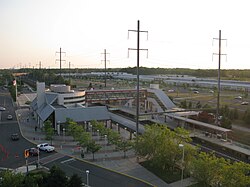
Other notable stops include the Hamilton station, known for its distinct building architecture, and various community stops such as Edison and Metuchen.
Line Summary Table
| Feature | Detail |
|---|---|
| Owner (Tracks) | Amtrak |
| Operator | NJ Transit |
| Electrification | 12 kV 25 Hz Overhead Line |
| Rolling Stock | ALP-46/ALP-45DP Locomotives, Comet/MultiLevel Coaches, Arrow III |
| Primary Termini | New York Penn Station & Trenton Transit Center |
| Total Stations | 17 |
Frequently Asked Questions
Who owns the tracks used by the NJ Transit Northeast Corridor Line?
The tracks are owned by Amtrak, while the commuter service is operated by NJ Transit.
What are the busiest stations on the line?
The busiest non-terminal stations are Metropark, Princeton Junction, New Brunswick, and Trenton.
How many trains run on the line during a typical weekday?
As of April 2025, the line operates 131 trains on weekdays, consisting of 68 inbound and 63 outbound trips.
What types of trains are used on this route?
The service uses ALP-46 or ALP-45DP locomotives with Comet II, IV, V, or MultiLevel coaches, as well as Arrow III railcars.
Where can passengers transfer to other NJ Transit rail lines?
Secaucus Junction is the primary transfer hub, providing connections to the Bergen County, Gladstone, Main, Meadowlands, Montclair-Boonton, Morristown, Pascack Valley, Raritan Valley, and North Jersey Coast lines.