Northeast Corridor: The Backbone of American Rail Travel
The Northeast Corridor (NEC) is the most heavily traveled passenger rail line in the United States, serving as the primary artery for the Northeast megalopolis. Stretching 457 miles (735 km) between Boston, Massachusetts, and Washington, D.C., the corridor integrates high-speed, inter-city, and commuter rail services to move millions of passengers annually across several states.
The system is a complex patchwork of ownership and operation, involving Amtrak, various state departments of transportation, and regional commuter agencies. This infrastructure supports a diverse range of services, from the premium Acela high-speed trains to essential commuter lines that fuel the region's economy.
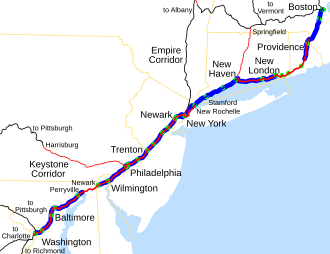
Key Facts
- Total Length: 457 miles (735 km).
- Termini: Boston, MA and Washington, D.C.
- Stations: 108 total (30 Amtrak stations and 78 commuter-only stations).
- Ridership: 15,173,228 Amtrak passengers in FY 2025.
- Track Gauge: Standard gauge (4 ft 8.5 in).
- Electrification: Utilizes three different AC voltage systems across its length.
Historical Development
The NEC did not begin as a single entity but evolved from various rail projects. The first sections opened in 1834, with the final connecting sections completed by 1917. Much of the corridor's foundational infrastructure was the result of ambitious projects by the Pennsylvania Railroad and the New Haven Railroad between 1903 and 1917.
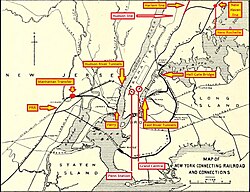
Key early milestones included the opening of the Manhattan Transfer station and the New York Tunnel Extension in 1910, as well as the completion of the Hell Gate Bridge in 1917, which effectively linked the various lines into a cohesive corridor.
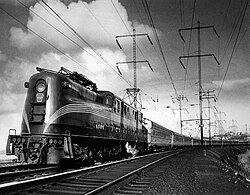
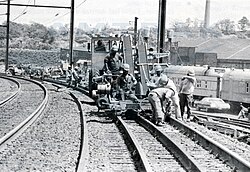
Over the decades, the line underwent significant modernization, including a massive electrification effort between 1905 and 1938 and the later Northeast Corridor Improvement Project in the late 1970s. In the 1990s, the corridor transitioned toward high-speed rail with the introduction of the Acela service.
Infrastructure and Technical Specifications
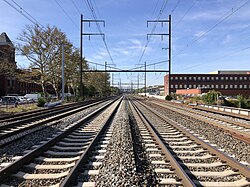
The NEC is characterized by its varying track counts, ranging from 2 to 6 tracks depending on the density of the area. One of its most complex technical features is its electrification, which is split into three distinct zones to accommodate legacy systems and modern requirements:
- Boston to New Haven: 25 kV AC at 60 Hz.
- New Haven to New York: 12.5 kV AC at 60 Hz.
- New York to Washington: 12 kV AC at 25 Hz.
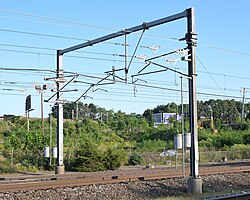
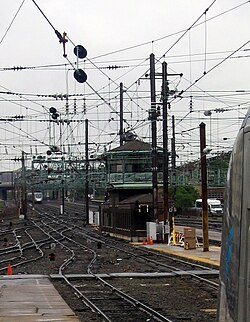
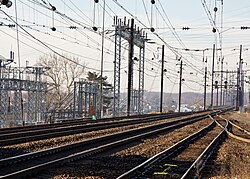
The corridor relies on a mix of catenary (overhead line) systems. Modern sections use constant-tension catenary, while older sections, such as those in Perryville, Maryland, still utilize variable-tension systems from the Pennsylvania Railroad era.
Bridges and Tunnels
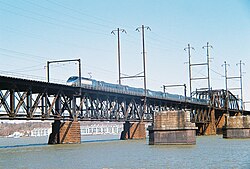
To navigate the geography of the East Coast, the NEC employs numerous critical crossings. Major bridges include the Thames River Bridge, the Hell Gate Bridge, and the Susquehanna River Bridge. Tunnels are equally vital, particularly the North River Tunnels and East River Tunnels in New York City, and the Baltimore and Potomac Tunnel.
Current Rail Services
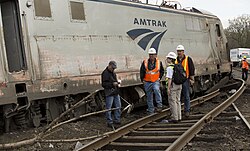
The NEC is a shared resource used by a variety of operators. While Amtrak manages the primary inter-city services, several commuter agencies utilize the tracks to provide regional transit.
Inter-city Services
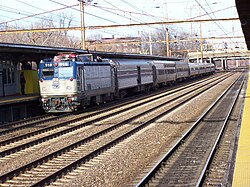
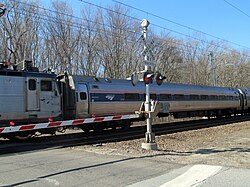
Amtrak operates several long-distance and regional trains on the NEC, including the Northeast Regional and the high-speed Acela. Other long-distance trains, such as the Crescent (New York to New Orleans) and the Silver Meteor (New York to Miami), also utilize portions of the corridor.
Commuter Rail Operators
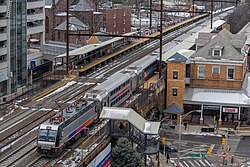
The corridor supports a massive commuter network, including:
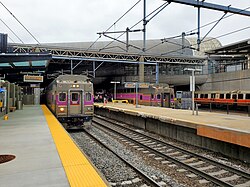
- MBTA: Serving the Boston area.
- CT Rail and Metro-North: Serving Connecticut and the New York suburbs.
- NJ Transit: Providing critical links between New Jersey and New York.
- SEPTA: Serving the Philadelphia region.
- MARC: Connecting Maryland suburbs to Washington, D.C.
Freight Operations
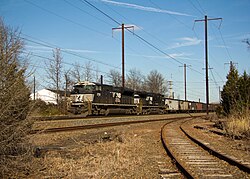
Although primarily a passenger line, freight services also operate on the NEC. Companies such as Norfolk Southern and CSX Transportation utilize the tracks for strategic freight movements.
Ridership Trends
Passenger volume on the NEC has shown significant growth over the last two decades, despite a sharp decline during the 2020-2021 period. By FY 2025, Amtrak ridership reached over 15 million passengers, reflecting a strong recovery and continued demand for rail travel in the Northeast.
| Fiscal Year | Northeast Regional | Acela | Total Ridership | % Change |
|---|---|---|---|---|
| 2015 | 8,215,523 | 3,473,644 | 11,707,079 | +0.7% |
| 2019 | 8,940,745 | 3,577,455 | 12,525,602 | +3.3% |
| 2021 | 3,508,766 | 897,639 | 4,408,825 | - |
| 2023 | 9,163,082 | 2,959,384 | 12,122,466 | +31.3% |
| 2025 | 12,018,536 | 3,153,621 | 15,173,228 | +8.1% |
Future Developments
To address aging infrastructure and increase capacity, several major projects are underway. These include the Gateway Program, the Frederick Douglass Tunnel, and the replacement of several aging bridges over the Housatonic, Hutchinson, and Mianus rivers.
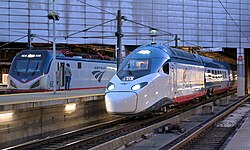
Technological upgrades are also a priority, with the introduction of new Avelia Liberty trainsets for the Acela service, the first of which departed Boston South Station on August 28, 2025.
Frequently Asked Questions
Who owns the Northeast Corridor?
Ownership is split among several entities: the Massachusetts Department of Transportation (Boston to the MA/RI border), Amtrak (MA/RI border to New Haven and New Rochelle to Washington), the Connecticut Department of Transportation (New Haven to the CT/NY border), and Metro-North Railroad (CT/NY border to New Rochelle).
What is the difference between the Northeast Regional and Acela?
The Northeast Regional is a standard inter-city service that stops at more stations, while the Acela is a higher-speed service designed for faster travel between major city centers with fewer stops.
Why does the NEC have different electrification voltages?
The different voltages are a result of the corridor being assembled from various railroad companies (like the Pennsylvania and New Haven Railroads) that implemented their own electrification standards at different times.
How many stations are on the Northeast Corridor?
There are 108 stations in total, consisting of 30 Amtrak stations and 78 stations used exclusively by commuter rail services.
What are some of the major upcoming projects for the NEC?
Key future projects include the Gateway Program, the Frederick Douglass Tunnel, high-speed upgrades between New Brunswick and Trenton, and the replacement of several critical bridges in Connecticut.