Ampullariidae Apple Snails: Biology, Taxonomy, and Global Impact
The Ampullariidae, commonly known as apple snails, are a family of large freshwater gastropods renowned for their unique biological adaptations and significant ecological roles. Ranging from beloved aquarium pets to devastating agricultural pests, these snails have a temporal range extending back 160 million years. Their ability to thrive in diverse tropical environments makes them a subject of great interest for biologists and ecologists alike.
Key Facts
- Respiratory Versatility: Possess both a gill and a lung, allowing them to be amphibious.
- Reproduction: They are gonochoristic, meaning individuals are either male or female.
- Diversity: The family comprises between 105 and 170 species.
- Defense: Use an operculum (a hard trapdoor) to seal their shells during dry periods.
- Origin: Likely Gondwanan, diversifying after the separation of Africa and South America.
Biological Adaptations and Ecology
Apple snails are exceptionally well-suited for tropical regions where heavy rainfall alternates with severe drought. Their most striking feature is their dual respiratory system. They possess a gill on the right side of the body for underwater breathing and a lung on the left for breathing air. This combination allows them to expand their foraging range and survive in varying oxygen levels.
To survive dry seasons, apple snails use an operculum to seal the shell entrance, preventing desiccation while they remain buried in the mud. Additionally, some genera, such as Pomacea and Pila, utilize a tubular siphon to breathe air while remaining submerged, which helps them avoid predators like the snail kite and limpkin.
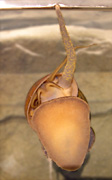
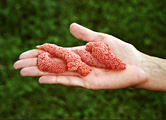
Feeding habits vary across the family; many species are filter feeders that employ a specialized mucus net to capture detritus and phytoplankton from the water. Their reproductive strategy is equally specialized, with several genera depositing light pink, calcareous egg clutches above the waterline to protect offspring from aquatic predators.
Systematics and Taxonomy
Taxonomically, Ampullariidae is the type family of the superfamily Ampullarioidea. According to the World Register of Marine Species (WoRMS), the family is divided into two primary subfamilies: Ampullariinae (containing 5 genera) and Pomaceinae (containing 4 genera). There are also six extinct genera classified as incertae sedis, meaning their exact placement within the family remains uncertain.
| Subfamily | Key Genera | Primary Distribution |
|---|---|---|
| Ampullariinae | Pila, Lanistes, Saulea, Afropomus, Forbesopomus | Africa and Asia |
| Pomaceinae | Pomacea, Marisa, Asolene, Felipponea | Americas and West Indies |
Human Interaction and Use
The Aquarium Trade
Due to their size and vibrant colors, apple snails are popular in the pet trade. Species like Pomacea bridgesii and Pomacea diffusa (mystery snails) are prized for colors ranging from gold and blue to purple and jade. While some can reach 15 cm in diameter, the Pomacea canaliculata is often less desirable for hobbyists because it tends to consume aquatic plants.
For those keeping these snails, the optimal water temperature is between 18 and 28 °C (64–82 °F). Higher temperatures generally increase their activity, growth, and feeding rates.
Agricultural Pests and Health Risks
Not all interactions are positive. In the 1980s, Pomacea canaliculata was introduced to Taiwan and later spread across Southeast Asia and Hawaii for the escargot industry. Instead of becoming a food source, they became invasive pests that devastated rice and taro crops. Furthermore, these snails can carry Angiostrongylus cantonensis (rat lungworm), a parasite that can infect humans if the snails are consumed undercooked.
Biological Control and Food
Interestingly, some species are used as bio-control agents. Marisa cornuarietis has been introduced to Africa and Asia to compete with and prey upon Planorbidae snails, which serve as intermediate hosts for parasites causing schistosomiasis.
In certain regions, apple snails remain a culinary delicacy. In Veracruz, Mexico, the subspecies Pomacea patula catemacensis (known as "tegogolo") is prized for its high protein content (approximately 12g per 100g of flesh) and low fat.
Frequently Asked Questions
Are apple snails hermaphroditic?
No, unlike many other snail families, apple snails are gonochoristic, meaning they have separate male and female individuals.
How do apple snails breathe both air and water?
They possess a dual system consisting of a gill for aquatic respiration and a lung for aerial respiration, separated by a division of the mantle cavity.
Why are some apple snails considered pests?
Certain species, particularly Pomacea canaliculata, are invasive and consume large amounts of agricultural crops like rice and taro, disrupting local ecosystems.
Can you eat apple snails from an aquarium?
No. Only wild or specifically cultured apple snails intended for food are fit for human consumption; those from domestic aquaria may be unsuitable.
What is the purpose of the operculum?
The operculum is a hard lid that allows the snail to seal itself inside its shell, preventing it from drying out during periods of drought.