Amino Acids: The Molecular Building Blocks of Life
Amino acids are organic compounds that serve as the fundamental units of proteins. Chemically, they are defined by the presence of both amino (—NH₂) and carboxylic acid (—COOH) functional groups. While nature contains over 500 different amino acids, a select group of 22 proteinogenic amino acids are the primary components incorporated into proteins and are encoded within the genetic code of life.
Beyond their structural role in proteins—which, along with water, make up the bulk of human muscle and tissue—amino acids are vital to various biological processes. They act as precursors for neurotransmitters and are essential for biosynthesis. Many scientists believe these molecules played a pivotal role in the emergence of life on Earth.

Key Facts
- Proteinogenic Count: 22 amino acids are typically used to build proteins in eukaryotes.
- Core Structure: Most protein-forming amino acids are α-amino acids, meaning the amino and carboxyl groups are attached to the same central carbon.
- Diversity: Amino acids are categorized by their side-chain properties: polar, nonpolar, acidic, or basic.
- Biological Role: They are the second-largest component of human muscle and tissue after water.
- Metabolic Paths: They are catabolized into glucogenic, ketogenic, or both types of products.
Structural Classification
Amino acids are primarily classified by the position of their amino group relative to the carboxylic acid group. The most common are α-amino acids, but β- and γ-amino acids also exist in nature.
The Role of Side Chains
What distinguishes one amino acid from another is the side chain (or R-group). These side chains determine the chemical personality of the amino acid, influencing how proteins fold and function. They are generally grouped into several categories:
- Nonpolar (Hydrophobic): These avoid water and often cluster in the interior of proteins (e.g., Leucine, Valine).
- Polar Uncharged: These are hydrophilic but carry no net charge at physiological pH (e.g., Serine, Threonine).
- Polar Charged: These carry a positive charge (Basic: Lysine, Arginine) or a negative charge (Acidic: Aspartate, Glutamate).
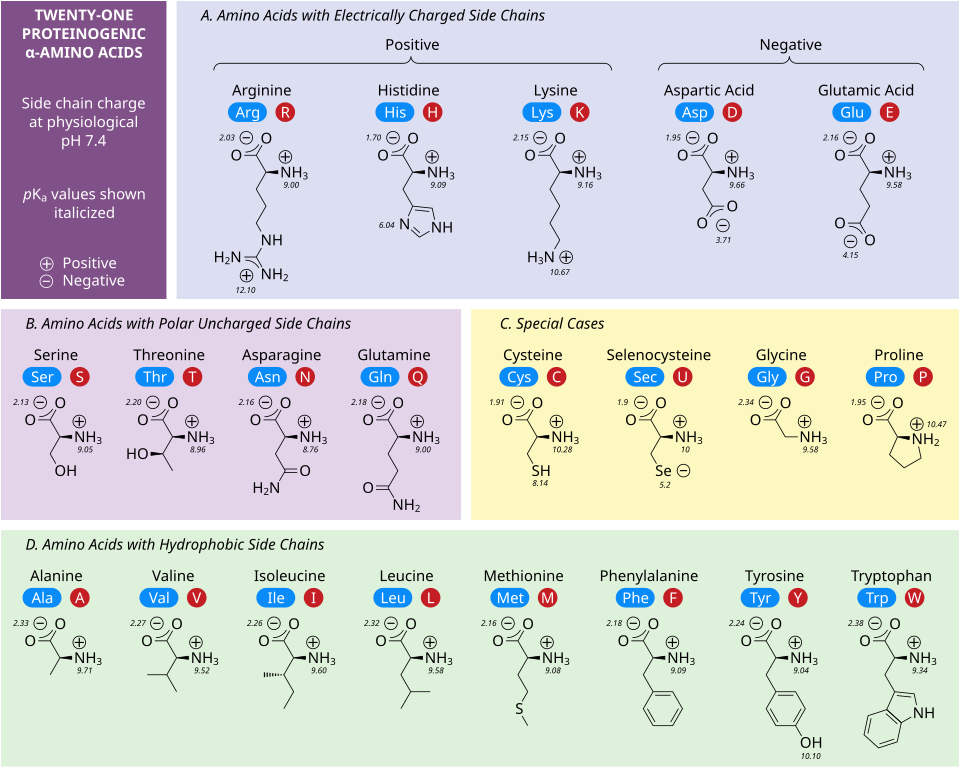
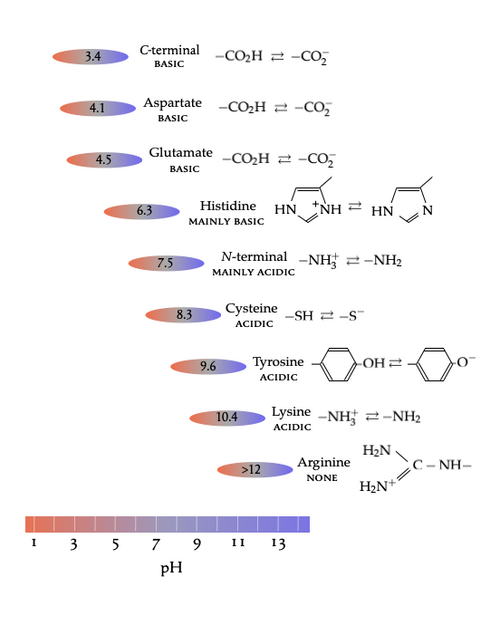
Certain amino acids have specialized functional groups. For example, Histidine, Lysine, and Arginine possess groups that can change charge based on the environment.

Physicochemical Properties
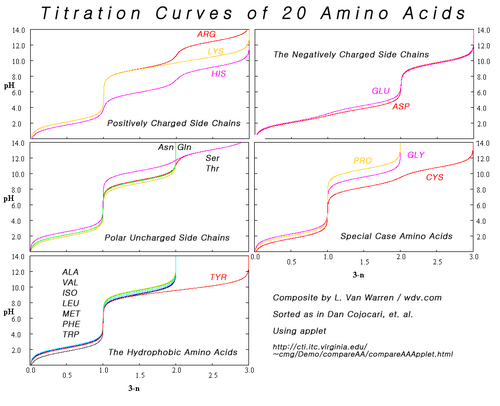
The behavior of amino acids is heavily influenced by their acid-base character. Because they contain both an acidic carboxyl group and a basic amino group, they can exist as zwitterions—molecules that contain an equal number of positively and negatively charged functional groups, resulting in a net charge of zero.
The isoelectric point (pI) is the specific pH at which an amino acid carries no net electrical charge. This property is crucial for techniques used to separate proteins in laboratory settings.
Biological Roles and Occurrence
Protein Synthesis and Peptide Bonds
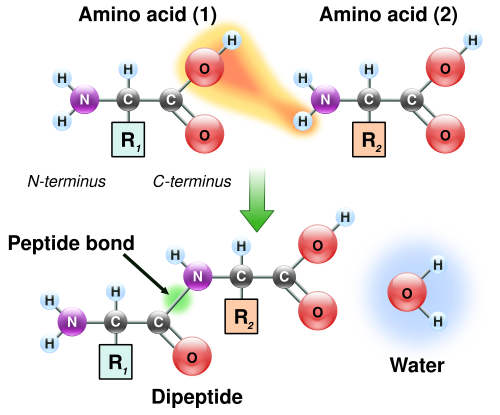
Amino acids link together through a process called condensation. When two amino acids join, they form a peptide bond, creating a dipeptide. Long chains of these residues fold into complex three-dimensional shapes to become functional proteins.
Nutrition and Blood Chemistry
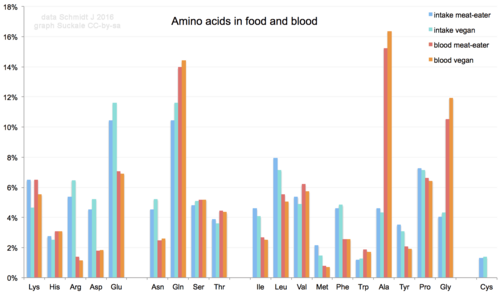
In the human body, the distribution of amino acids varies between diet and blood. While glutamate and glutamine are highly frequent in food, alanine, glutamine, and glycine are the most common in human blood serum.
Catabolism and Energy
When the body breaks down amino acids (catabolism), the resulting products are classified based on how they are used for energy:
- Glucogenic: Products can be converted into glucose via gluconeogenesis.
- Ketogenic: Products are used for ketogenesis or lipid synthesis and cannot form glucose.
- Both: Some amino acids can follow either pathway.
![Catabolism of proteinogenic amino acids. Amino acids can be classified according to the properties of their main degradation products:[181] * Glucogenic, with the products having the ability to form glucose by gluconeogenesis * Ketogenic, with the products not having the ability to form glucose. These products may still be used for ketogenesis or lipid synthesis. * Amino acids catabolized into both glucogenic and ketogenic products.](/images/4d/3c/4d3cea355f0a153c01921e03a174d94a4817456f518572f6c09ace6875a198b3.png)
Synthesis and Industrial Use
Amino acids can be produced through chemical synthesis, such as the Strecker synthesis, or through biological biosynthesis. Beyond the human body, they are used industrially in animal feed, food additives, and as chemical building blocks for biodegradable plastics and fertilizers.

Amino Acid Property Summary
| Amino Acid | 1-Letter Code | Chemical Polarity | Net Charge (pH 7.4) | Molecular Mass (Da) |
|---|---|---|---|---|
| Alanine | A | Nonpolar | Neutral | 89.094 |
| Arginine | R | Basic polar | Positive | 174.203 |
| Aspartate | D | Brønsted base | Negative | 133.104 |
| Glutamate | E | Brønsted base | Negative | 147.131 |
| Lysine | K | Brønsted acid | Positive | 146.189 |
| Tryptophan | W | Nonpolar | Neutral | 204.228 |
Frequently Asked Questions
What is the difference between proteinogenic and non-proteinogenic amino acids?
Proteinogenic amino acids are the 22 types specifically encoded by the genetic code and used to build proteins. Non-proteinogenic amino acids exist in nature but are not incorporated into proteins via the standard ribosomal process.
What is a zwitterion?
A zwitterion is a molecule that contains both a positive and a negative charge but has an overall net charge of zero. This occurs in amino acids when the amino group is protonated and the carboxyl group is deprotonated.
What are glucogenic and ketogenic amino acids?
Glucogenic amino acids are those whose carbon skeletons can be converted into glucose. Ketogenic amino acids are converted into ketone bodies or lipids and cannot be used to synthesize glucose.
How is a peptide bond formed?
A peptide bond is formed through a condensation reaction between the carboxyl group of one amino acid and the amino group of another, releasing a molecule of water in the process.
What is the isoelectric point?
The isoelectric point (pI) is the specific pH level at which an amino acid molecule carries no net electrical charge, meaning it is effectively neutral.