Nucleic Acids: The Molecular Blueprint of Life
Every living organism on Earth, from the simplest virus to the most complex mammal, relies on a set of sophisticated biomolecules to function, grow, and reproduce. These molecules are known as nucleic acids. Acting as the primary information carriers in cells, nucleic acids encode the genetic instructions necessary for the development and operation of all known life forms.
At their most basic level, nucleic acids are linear polymers—long chains—made of repeating units called nucleotides. Each nucleotide is composed of three essential parts: a five-carbon sugar, a phosphate group, and a nitrogenous base. The specific sequence of these nucleotides creates a biological code that directs the synthesis of proteins and the inheritance of traits across generations.
Key Facts
- Two Main Types: Deoxyribonucleic acid (DNA) and Ribonucleic acid (RNA).
- Building Blocks: Composed of nucleotides (sugar, phosphate, and a nitrogenous base).
- Genetic Storage: DNA typically stores genetic information in a double-helix structure.
- Protein Synthesis: RNA converts genetic instructions from DNA into functional proteins.
- Scale: Range from small interfering RNA (21 nucleotides) to massive human chromosomes (247 million base pairs).
The History of Discovery
The journey to understand nucleic acids began in 1869 when Swiss scientist Friedrich Miescher discovered a substance he called "nuclein" at the University of Tübingen. Miescher was the first to suggest that this substance might be involved in heredity.
![The Swiss scientist Friedrich Miescher discovered the "nuclein", in 1868. Later, he raised the idea that it could be involved in heredity.[3]](/images/9e/8d/9e8defcf3fcd105e7ef960046401d0ce52182e70a816cd25d601d76f91ded808.jpg)
Following Miescher, several key milestones shaped modern genetics:
- Albrecht Kossel: Purified nucleic acids in the 1880s, identified their acidic properties, and discovered the nucleobases.
- Richard Altmann: Coined the term "nucleic acid" in 1889.
- Phoebus Levene: Determined the basic chemical structure of these molecules.
- Avery, MacLeod, and McCarty: Demonstrated in 1944 that DNA is the actual carrier of genetic information.
- Watson and Crick: Proposed the iconic double-helix structure of DNA in 1953.
Molecular Composition and Structure
Nucleic acids are defined by their sugar-phosphate backbone, where sugars and phosphates alternate and are connected by phosphodiester linkages. This structure gives the molecule directionality, referred to as the 5'-end and the 3'-end.
DNA vs. RNA
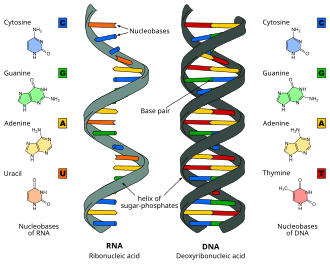
While both are nucleic acids, they differ in their sugar components and the bases they use. DNA contains deoxyribose sugar, while RNA contains ribose. The primary difference between these sugars is the presence of a hydroxyl group in ribose.
The nitrogenous bases are categorized into purines and pyrimidines. Both DNA and RNA share adenine, cytosine, and guanine. However, DNA exclusively uses thymine, whereas RNA uses uracil.
| Feature | DNA (Deoxyribonucleic Acid) | RNA (Ribonucleic Acid) |
|---|---|---|
| Sugar | Deoxyribose | Ribose |
| Bases | Adenine, Guanine, Cytosine, Thymine | Adenine, Guanine, Cytosine, Uracil |
| Structure | Typically double-stranded helix | Typically single-stranded |
| Primary Function | Long-term genetic storage | Protein synthesis and regulation |
Topology and Sequencing
The physical shape, or topology, of nucleic acids varies by type. Double-stranded DNA forms a uniform helix with a diameter of approximately 20 Å. In contrast, single-stranded RNA is more flexible and can fold into complex three-dimensional shapes through intramolecular base pairing.
While most eukaryotic chromosomes are linear, some forms of DNA—such as bacterial chromosomes, plasmids, and mitochondrial DNA—are circular. The true biological power of these molecules lies in their sequence. The specific order of nucleotides encodes the instructions for every biological molecule and cellular structure in an organism.
Functional Types of Nucleic Acids
Deoxyribonucleic Acid (DNA)
DNA serves as the permanent archive of genetic instructions. These instructions are organized into genes. In eukaryotes, DNA is stored in the nucleus and organelles (mitochondria/chloroplasts) and is compacted by proteins called histones. In prokaryotes, DNA is located in the cytoplasm.
Ribonucleic Acid (RNA)
RNA acts as the bridge between the genetic code in DNA and the production of proteins. There are three universal types:
- Messenger RNA (mRNA): Carries genetic sequences from the DNA in the nucleus to the ribosomes.
- Ribosomal RNA (rRNA): Catalyzes the formation of peptide bonds during protein synthesis.
- Transfer RNA (tRNA): Decodes mRNA and carries the corresponding amino acids to the ribosome.
Artificial Nucleic Acids
Beyond nature, scientists have synthesized artificial analogues. These include peptide nucleic acids, morpholino, locked nucleic acids, glycol nucleic acids, and threose nucleic acids, all of which feature modifications to the molecular backbone.
Frequently Asked Questions
What is the difference between a nucleotide and a nucleoside?
A nucleoside consists only of a nitrogenous base and a sugar. A nucleotide is a nucleoside that has an additional phosphate group attached, which makes the molecule acidic.
Why is DNA double-stranded and RNA usually single-stranded?
DNA's double-stranded helix provides stability and a mechanism for accurate replication and repair, which is essential for long-term genetic storage. RNA's single-stranded nature allows it to fold into various shapes to perform catalytic and transport functions.
What are the five primary nucleobases?
The five canonical nucleobases are adenine, cytosine, guanine, thymine (found only in DNA), and uracil (found only in RNA).
How large can a nucleic acid molecule be?
They vary wildly in size. Small interfering RNA can be as short as 21 nucleotides, while human chromosome 1 is a single molecule containing 247 million base pairs.
What is the role of histones in DNA?
Histones are chromatin proteins that help compact and organize DNA into a denser structure, which helps control which parts of the DNA are accessible for transcription.