geneticsheredityDNAGregor Mendelmolecular biology

Genetics: The Science of Heredity and Biological Variation

Genetics: The Science of Heredity and Biological Variation Genetics is the scientific study of genes, genetic variation, and heredity in living organisms. As a cornerstone of modern biolo...

Genetics: The Science of Heredity and Biological Variation

Genetics is the scientific study of genes, genetic variation, and heredity in living organisms. As a cornerstone of modern biology, it explains how biological information is passed from one generation to the next, providing the essential mechanism for evolution. From the simple traits of a pea plant to the complex architecture of the human genome, genetics reveals the blueprints that define life.

The field began with the scientific observations of Gregor Mendel, a 19th-century Moravian Augustinian friar. By studying pea plants, Mendel discovered that traits are not simply blended but are inherited through discrete units of inheritance—what we now recognize as genes.
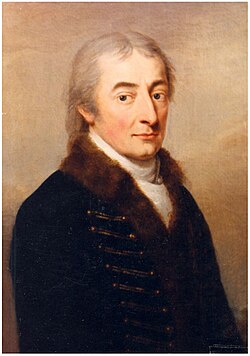
Portrait of Imre Festetics, the first geneticist and ethologist. His concepts of selection and evolution were later formulated in Charles Darwin's theory of evolution.

Key Facts

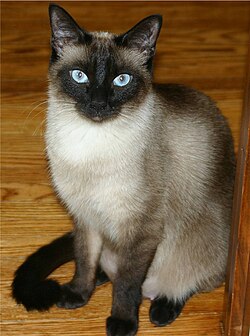
Siamese cats have a temperature-sensitive pigment-production mutation.
  • Gregor Mendel established the scientific foundation of genetics through his study of trait inheritance in pea plants.
  • DNA (deoxyribonucleic acid) serves as the molecular basis for biological inheritance.
  • Genes are segments of DNA located on chromosomes that specify the production of proteins.
  • Mutations are changes in the genetic sequence that can lead to variation and drive evolution.
  • Natural Selection acts on genetic variation to allow organisms to adapt to their environments.

The Evolution of Genetic Theory

From Blending to Discrete Inheritance

Before the acceptance of Mendelian genetics, many believed in "blending inheritance," the idea that parental traits mixed like paint. However, as engineer Fleeming Jenkin noted, this would lead to an averaging out of characteristics, making evolution by natural selection impossible.
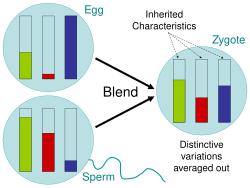
Blending inheritance leads to the averaging out of every characteristic, which as the engineer Fleeming Jenkin pointed out, makes evolution by natural selection impossible.

The Chromosomal Theory

The transition to molecular understanding accelerated with Thomas Hunt Morgan's work on Drosophila melanogaster (the common fruit fly). By observing sex-linked inheritance—specifically a mutation causing white eyes—Morgan hypothesized that genes are physically located on chromosomes.
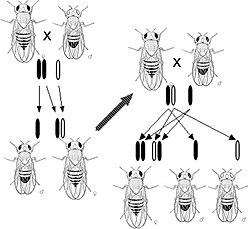
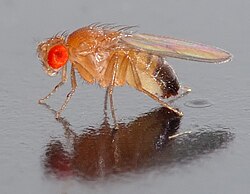
Morgan's observation of sex-linked inheritance of a mutation causing white eyes in Drosophila led him to the hypothesis that genes are located upon chromosomes.

The common fruit fly (Drosophila melanogaster) is a popular model organism in genetics research.

The Molecular Basis of Inheritance

DNA and Chromosomes

The molecular foundation of genetics is DNA, a double-helix structure composed of nucleotide chains. These strands match in the center, forming rungs on a twisted ladder, and are organized into chromosomes within the cell nucleus.
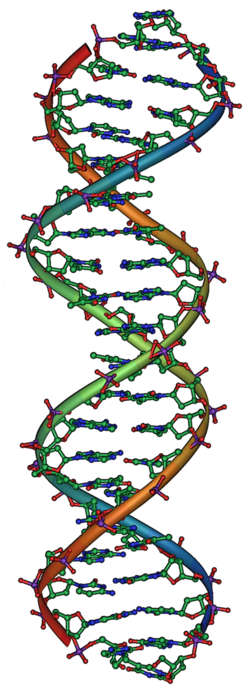
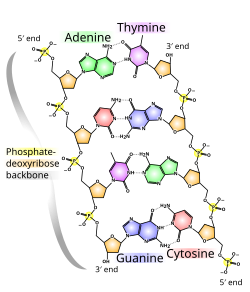
DNA, the molecular basis for biological inheritance. Each strand of DNA is a chain of nucleotides, matching each other in the center to form what look like rungs on a twisted ladder.

The molecular structure of DNA. Bases pair through the arrangement of hydrogen bonding between the strands.

In humans, a karyogram reveals 22 pairs of homologous chromosomes and one pair of sex chromosomes (XX for females, XY for males), along with a separate mitochondrial genome.
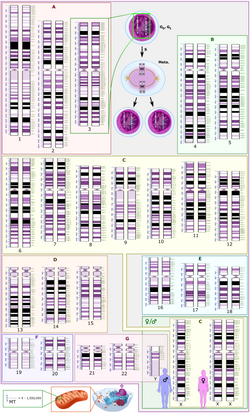
Schematic karyogram of a human, showing 22 homologous chromosome pairs, both the female (XX) and male (XY) versions of the sex chromosome (bottom right), as well as the mitochondrial genome (at bottom left)

Cell Division and Recombination

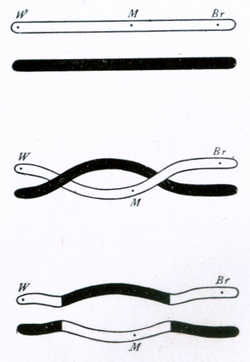
During eukaryotic cell division, chromosomes are copied and condensed before separating into daughter cells. This process ensures genetic continuity, while crossing-over (double crossovers) allows for genetic recombination, increasing diversity within a species.
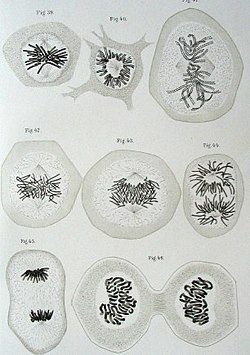
Walther Flemming's 1882 diagram of eukaryotic cell division. Chromosomes are copied, condensed, and organized. Then, as the cell divides, chromosome copies separate into the daughter cells.

Thomas Hunt Morgan's 1916 illustration of a double crossover between chromosomes

Gene Expression and Regulation

The Genetic Code

The flow of genetic information follows a specific path: DNA is transcribed into messenger RNA (mRNA), which is then translated into a protein using a triplet code. This process is the fundamental mechanism by which a genotype manifests as a phenotype.
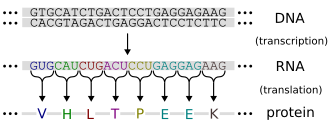
The genetic code: Using a triplet code, DNA, through a messenger RNA intermediary, specifies a protein.

Regulation and Epigenetics

Not all genes are active at all times. Transcription factors bind to DNA to influence whether a gene is expressed. Additionally, environmental factors and epigenetic signals can modify gene activity without changing the underlying DNA sequence.
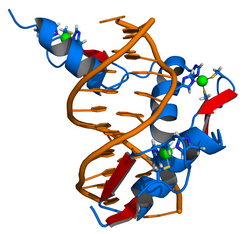
Transcription factors bind to DNA, influencing the transcription of associated genes.

Genetic Variation and Change

Mutations

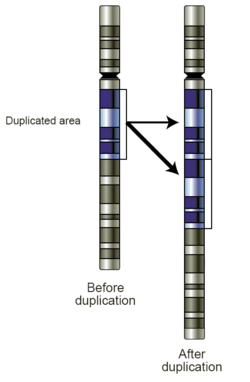
Mutations are alterations in the DNA sequence. These can range from single point mutations (missense) to frameshift mutations (insertions or deletions) and repeat expansions. While some mutations are harmful, others provide the redundancy needed for diversification through gene duplication.
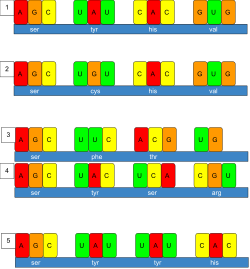
This is a diagram showing mutations in an RNA sequence. Figure (1) is a normal RNA sequence, consisting of 4 codons. Figure (2) shows a missense, single point, non silent mutation. Figures (3 and 4) both show frameshift mutations, which is why they are grouped together. Figure 3 shows a deletion of the second base pair in the second codon. Figure 4 shows an insertion in the third base pair of the second codon. Figure (5) shows a repeat expansion, where an entire codon is duplicated.

Gene duplication allows diversification by providing redundancy: one gene can mutate and lose its original function without harming the organism.

Nature, Nurture, and Evolution

Traits can be simple or complex. While some follow strict Mendelian patterns, others, such as human height, are polygenic and influenced by both genetic predisposition and environmental factors (nature vs. nurture).
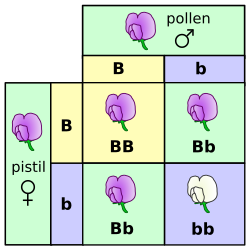
A Punnett square depicting a cross between two pea plants heterozygous for purple (B) and white (b) blossoms

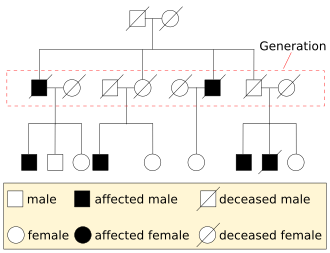
Genetic pedigree charts help track the inheritance patterns of traits.

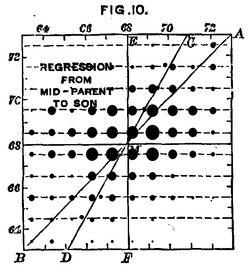
Human height is a trait with complex genetic causes. Francis Galton's data from 1889 shows the relationship between offspring height as a function of mean parent height.

These variations are the raw material for natural selection. Over time, the comparison of orthologous gene sequences allows scientists to construct evolutionary trees of eukaryotic organisms.
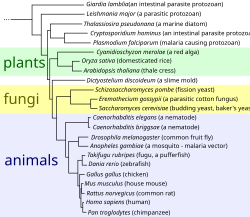
An evolutionary tree of eukaryotic organisms, constructed by the comparison of several orthologous gene sequences

Research and Technology

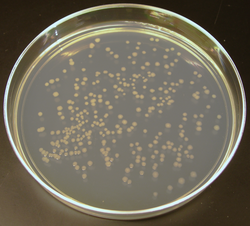
Modern genetics utilizes a variety of tools to study and manipulate DNA. Molecular cloning and cellular cloning using E. coli allow researchers to isolate and study specific genes. Advanced techniques like DNA sequencing and CRISPR/Cas9 gene editing have revolutionized medicine and agriculture.
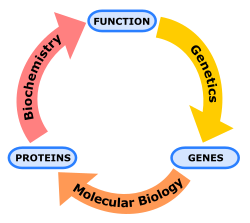
Schematic relationship between biochemistry, genetics and molecular biology

Colonies of E. coli produced by cellular cloning. A similar methodology is often used in molecular cloning.

Concept Definition Biological Role
Gene A discrete unit of inheritance Encodes specific proteins/traits
Allele A variant form of a gene Creates phenotypic variation
Chromosome Condensed DNA structure Organizes and transports genetic data
Mutation Change in DNA sequence Source of new genetic traits
Genotype The genetic makeup of an organism The internal blueprint
Phenotype The observable characteristics The physical expression of genes

Frequently Asked Questions

What is the difference between a genotype and a phenotype?

The genotype is the actual genetic sequence of an organism, while the phenotype is the set of observable characteristics resulting from the interaction of that genotype with the environment.

How do mutations contribute to evolution?

Mutations introduce new genetic variations. If a mutation provides a survival advantage, it is more likely to be passed to offspring through natural selection, gradually changing the species over generations.

What are model organisms in genetics?

Model organisms, such as Drosophila melanogaster (fruit flies) or E. coli, are species that are easy to maintain in a lab and have well-understood genetics, making them ideal for studying biological processes applicable to other species.

What is the role of mRNA in gene expression?

Messenger RNA (mRNA) acts as an intermediary. It carries the genetic code from the DNA in the nucleus to the ribosomes in the cytoplasm, where it is translated into a functional protein.

How does gene duplication allow for diversification?

Gene duplication provides redundancy. When a gene is duplicated, one copy can continue to perform the original essential function, while the second copy is free to mutate and potentially develop a new, beneficial function without harming the organism.

References

  1. Griffiths AJ, Miller JH, Suzuki DT, Lewontin RC, Gelbart, eds. (2000). "Genetics and the Organism: Introduction". An Introduction to Genetic Analysis (7th ed.). New York: W.H. Freeman. ISBN 978-0-7167-3520-5.
  2. Hartl D, Jones E (2005)
  3. "the definition of genetics". www.dictionary.com. Retrieved 25 October 2018.
  4. "Genetikos (γενετ-ικός)". Henry George Liddell, Robert Scott, A Greek-English Lexicon. Perseus Digital Library, Tufts University. Archived from the original on 15 June 2010. Retrieved 20 February 2012.
  5. "Genesis (γένεσις)". Henry George Liddell, Robert Scott, A Greek-English Lexicon. Perseus Digital Library, Tufts University. Archived from the original on 15 June 2010. Retrieved 20 February 2012.