American Occupation Zone in Germany (1945–1949)
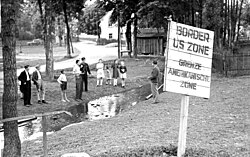
Following the surrender of Nazi Germany on May 8, 1945, the Allied powers divided the nation into four distinct administrative regions. Among these was the American occupation zone (also known as the US-Zone or Southwest zone), established in July 1945. This region served as a critical laboratory for the transition from military rule to a democratic civilian government, eventually contributing to the birth of the Federal Republic of Germany.
The zone was managed by the Office of Military Government, United States (OMGUS), and remained in effect until September 21, 1949. While the formal occupation ended with the establishment of West Germany, the United States maintained a strategic military presence in the region for decades to follow.
Key Facts
- Duration: 1945 to 1949.
- Administrative Body: Office of Military Government, United States (OMGUS).
- Capital: Frankfurt.
- Area: Over 40,000 square miles (approximately the size of Pennsylvania).
- Population: Over 16 million Germans and 500,000 displaced persons.
- Key Figures: Dwight D. Eisenhower (first governor) and Lucius D. Clay.
Geography and Demographics
The American zone encompassed a vast portion of south-eastern and central Germany, covering more than 40,000 square miles with nearly 1,400 miles of boundaries. Its largest urban centers were Frankfurt and Munich.
The zone's territory included several key regions:
- Bavaria: Including the Thuringian exclave of Ostheim.
- Prussian Provinces: Kurhessen and Nassau.
- Greater Hesse: Portions of the People's State of Hesse east of the Rhine.
- Württemberg-Baden: Areas of Württemberg and the Republic of Baden north of the Karlsruhe-Ulm Reichsautobahn.
- Bremen and Bremerhaven: These served as vital ports for supplying the occupation zone.
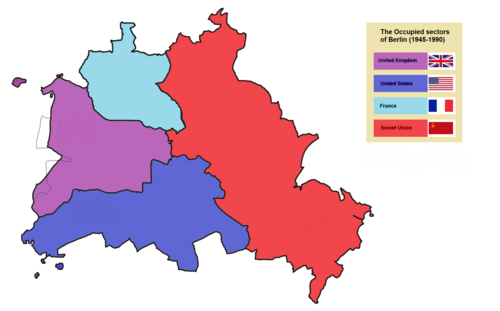
Berlin was handled differently; it was divided among the four occupying powers. The American sector—comprising Zehlendorf, Steglitz, Schöneberg, Kreuzberg, Tempelhof, and Neukölln—was under US military administration but remained formally separate from the main occupation zone.
Military Government and Administration
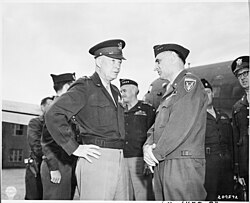
The OMGUS headquarters were located in the former IG Farben Building in Frankfurt. The administration was led by a series of military governors, beginning with Dwight D. Eisenhower. He was succeeded by George S. Patton (acting), Joseph T. McNarney, Lucius D. Clay, and finally Clarence R. Huebner (acting).
Coordination between the four Allied powers was handled by the Allied Control Council, though this body ceased operations in March 1948 after the Soviet Union withdrew. Security within the zone was maintained by the United States Constabulary, a specialized force of soldiers retrained as military police.
Political Reorganization and Denazification
The United States aimed to organize the territory based on a federal model. Between 1945 and 1946, four states were established: Bavaria, Bremen, Greater Hesse, and Württemberg-Baden. These states collaborated through the Länderrat (State Council).
A primary goal of the administration was Denazification—the process of removing Nazi influence from society. On March 5, 1946, the Law for Liberation from National Socialism and Militarism (Befreiungsgesetz) required all Germans over 18 to complete a questionnaire detailing their involvement with the Nazi regime.
Democratic transitions began with local council elections in January 1946, where Nazis were barred from participating. This was followed by state Constituent Assembly elections in June 1946. These political shifts eventually led to the merger of the American and British zones into the Bizone on January 1, 1947. By August 1948, the French zone joined to create the Trizone, which officially became the Federal Republic of Germany (West Germany) on May 23, 1949.
Media and Infrastructure
To rebuild a free press, OMGUS licensed publishers who had not been involved in Nazi propaganda. This led to the creation of influential newspapers such as the Frankfurter Rundschau, Der Tagesspiegel, and Süddeutsche Zeitung.
Radio broadcasting followed the American model of local stations rather than a single national channel. This resulted in the establishment of Bayerischer Rundfunk (BR), Radio Bremen, Hessischer Rundfunk (HR), and Süddeutscher Rundfunk (SDR). Additionally, the RIAS in West Berlin remained under direct U.S. control.
Transport was slowly restored, with three long-distance, third-class train services resuming from Frankfurt to Munich and Hof by September 1945.
Summary of the American Occupation Zone
| Category | Details |
|---|---|
| Administrative Capital | Frankfurt |
| Governing Body | OMGUS |
| Key States | Bavaria, Bremen, Greater Hesse, Württemberg-Baden |
| Population | ~16.5 million (including displaced persons) |
| Successor State | Federal Republic of Germany (West Germany) |
Frequently Asked Questions
What was OMGUS?
OMGUS stands for the Office of Military Government, United States. It was the administrative body responsible for governing the American occupation zone in Germany between 1945 and 1949.
How did the US handle Denazification?
The US implemented the Law for Liberation from National Socialism and Militarism, which required all citizens over 18 to fill out a detailed questionnaire about their roles in the Nazi regime to determine their eligibility for public office and other rights.
What was the Bizone and Trizone?
The Bizone was the administrative merger of the American and British zones in 1947. The Trizone was formed in 1948 when the French zone joined, creating the foundation for the Federal Republic of Germany.
Was Berlin part of the American occupation zone?
No. While the US administered a specific sector of Berlin (including districts like Tempelhof and Neukölln), the city was formally separate from the main American occupation zone and was divided among all four Allied powers.
Who were the primary military governors of the zone?
The first governor was Dwight D. Eisenhower. Other notable leaders included Joseph T. McNarney and Lucius D. Clay.