Algiers: The Historic West Bank Heart of New Orleans
Algiers is a storied neighborhood of New Orleans, distinguished as the only community in Orleans Parish located on the West Bank of the Mississippi River. Known formally as the 15th Ward, Algiers is a place where deep historical roots meet a vibrant cultural legacy. From its origins as a colonial outpost to its role as a cradle for jazz legends, Algiers offers a unique perspective on the evolution of the Crescent City.
Key Facts
- Established: 1719 as a plantation.
- Location: The only part of Orleans Parish on the West Bank of the Mississippi River.
- Nickname: Once called the "Brooklyn of the South" by jazz musicians.
- Demographics: Predominantly African American (89.4% as of the 2000 Census).
- Police Jurisdiction: NOPD District 4.
- Area: Approximately 0.62 square miles.
A Complex History: From Plantation to Ward
Algiers began in 1719 not as a residential neighborhood, but as a plantation. In its earliest days, it served as a French colonial encampment managed by Le Page du Pratz. The site functioned as a warehouse, lumber mill, and workshop, but its most somber role was as a powder magazine and a depository for enslaved Africans arriving from the Bight of Benin, Congo, and Senegambia regions. By the 1720s, the "Company Plantation" featured over 30 cabins used to shelter enslaved people before they were sold to colonists.
The area eventually evolved into a town under the development of Barthelemy Duverjé. Growth was driven by the shipbuilding and repair industries, specifically the dry docks and extensive railroad yards. A significant portion of the town near the Courthouse was lost to a devastating fire in 1895.
In 1870, Algiers was officially annexed into the city of New Orleans as the 15th Ward. For decades, the Southern Pacific yard served as a major freight hub, utilizing steam-powered train ferries to move railroad cars across the river until the construction of the Huey P. Long Bridge in Bridge City shifted the logistics of the region.
Social Evolution and the 20th Century
The early 20th century in Algiers was marked by the strict segregation of the Jim Crow era. Algiers Point was largely reserved for white residents and Creoles of color who passed as white. Meanwhile, the area downriver, known as McDonoghville (or "Over the Hump"), became the center for the Black community. This area grew from "Freetown," a settlement established by John McDonogh for formerly enslaved people.
By 1870, Algiers had become the most populous Black community on the West Bank. This environment fostered a rich musical heritage; many jazz pioneers, including Kid Thomas Valentine and Red Allen, grew up in McDonoghville during the 1910s. Newton Street became the cultural heartbeat of the community, hosting juke joints and ballrooms like the Greystone Voter's League, where legends such as Ray Charles, B.B. King, and Son House performed.
Mid-century shifts saw the rise of suburban developments along Gen. Meyer and Gen. De Gaulle. While white middle-class families moved into subdivisions like Aurora and Huntlee Village, the later construction of public housing, such as Christopher Park Homes, triggered a period of "white flight" and a subsequent decline in local businesses as they migrated toward Jefferson Parish.
Cultural Legacy and the "Brooklyn of the South"
Because of its proximity to the main city—separated only by the river—jazz musicians of the 1920s dubbed Algiers the "Brooklyn of the South." The neighborhood was a powerhouse of musical innovation, home to the Algiers Brass Band, one of the city's oldest active traditional brass bands. Early jazz flourished in social halls such as the Algiers Masonic Hall and the Ladies of Hope Benevolent Hall.
Notable Figures from Algiers
The neighborhood has produced an extraordinary array of talent across music, sports, and politics, including:
- Music: Red Allen, George Lewis, Papa Celestin, and Memphis Minnie.
- Sports: NFL players like Keenan Lewis, Rich Jackson, and Anthony Johnson.
- Arts & Public Life: Actress Patricia Clarkson and WWII General J. Lawton Collins.
Community Profile and Infrastructure
Today, Algiers is a diverse area with several distinct neighborhoods, including Algiers Point, Whitney, Behrman, and the Fischer Housing Development. Education is managed through the Orleans Parish School Board (OPSB), with the district headquarters located within Algiers. Local schools include L.B. Landry High School—named after the physician and activist Dr. Lord Beaconsfield Landry—and O. Perry Walker Senior High School.
Regarding public safety, the 4th District has faced challenges since the crack epidemic of the 1980s. Law enforcement has implemented modern surveillance measures, including license-plate readers and crime cameras, to address violent crime and neighborhood conflicts.
| Category | Detail |
|---|---|
| Official Designation | 15th Ward of New Orleans |
| Primary Demographics | Predominantly African American (89.4%) |
| Key Industries (Historic) | Shipbuilding, Railroads, Oil |
| Cultural Identity | Jazz and Brass Band Hub |
| Land Area | 0.62 sq mi |
Frequently Asked Questions
Why is Algiers called the 15th Ward?
Algiers is one of the 17 administrative wards of New Orleans. It was annexed to the city in 1870 and designated as the 15th Ward.
What is the significance of Algiers Point?
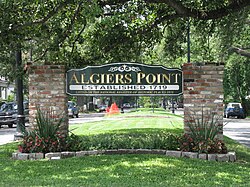
Algiers Point is a historic section of the neighborhood. Historically, it was a segregated area for white residents and Creoles of color, and it remains a distinct residential area today.
What does "Over the Hump" refer to?
"Over the Hump" is the local term for McDonoghville, the historic Black community located downriver from Algiers Point.
Who were some of the jazz musicians from Algiers?
Algiers was home to many pioneers, including trumpeters Red Allen and Kid Thomas Valentine, clarinetist George Lewis, and trombonist Papa Celestin.
How did the railroad impact the growth of Algiers?
The shipbuilding industry and the Southern Pacific railroad yards drove significant economic expansion and population growth until the construction of the Huey P. Long Bridge shifted rail traffic.