Albert Einstein's Thought Experiments: The Mental Models That Reshaped Physics
Throughout his legendary career, Albert Einstein relied on a unique intellectual tool: the Gedankenexperiment, or thought experiment. Rather than relying solely on laboratory data, Einstein constructed vivid, imaginary scenarios to test the logical limits of physical laws. These mental models allowed him to visualize complex interactions—from chasing beams of light to imagining falling elevators—ultimately leading to the most profound shifts in our understanding of space, time, and matter.
A scientific thought experiment is a logical argument cast as a hypothetical scenario. By using idealized environments—such as frictionless surfaces or massless trapdoors—physicists can isolate specific variables to examine the implications of a theory. While these scenarios are imaginary, they are designed to be conceivably performable in the real world, provided the necessary idealizations are met.
Key Facts
- Gedankenexperiment is the German term for "thought experiment," a cornerstone of Einstein's methodology.
- Einstein used these models to develop both Special Relativity (focused on speed and light) and General Relativity (focused on gravity and spacetime).
- His work on quantum mechanics often involved statistical arguments and paradoxes to challenge the prevailing views of reality.
- Many of his most famous conclusions, including the equivalence of mass and energy, originated as mental visualizations before becoming mathematical proofs.
Special Relativity and the Nature of Light
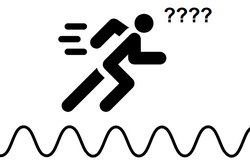
Einstein's early explorations into the nature of light set the stage for his revolution in physics. As a teenager, he famously imagined what it would be like to pursue a beam of light, a mental exercise that challenged the classical understanding of electromagnetism.
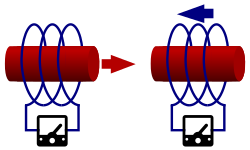
To further refine his theories, Einstein examined the relationship between magnets and conductors, questioning how different observers perceive the same physical event. This led to his groundbreaking work on the relativity of simultaneity, which he illustrated using the imagery of moving trains and flashes of lightning.

Mass-Energy Equivalence
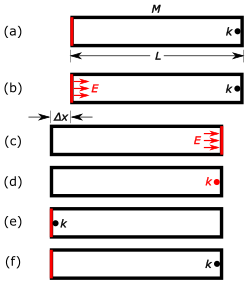
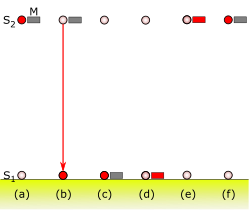
One of Einstein's most enduring legacies is the equivalence of mass and energy. He explored this through a center-of-mass theorem, imagining a cylinder emitting light. While modern analysis suggests the original 1905 derivation had flaws—specifically regarding the assumption of a completely rigid body—the core concept was later definitively proven by Max von Laue in 1911.
The Speed of Light Limit
Einstein also used thought experiments to demonstrate why signaling faster than light (FTL) is impossible. He argued that if FTL communication were possible, it would allow for the violation of causality, effectively allowing an effect to occur before its cause.

General Relativity and Gravity
While special relativity dealt with constant speeds, general relativity addressed acceleration and gravity. Einstein's "happiest thought" was the realization of the equivalence principle: the idea that the force felt by someone accelerating is indistinguishable from the force of gravity.
He visualized this by imagining a person falling off a roof or an observer in an accelerating elevator. If a person falls freely, they feel weightless, suggesting that gravity can be "canceled out" by acceleration.

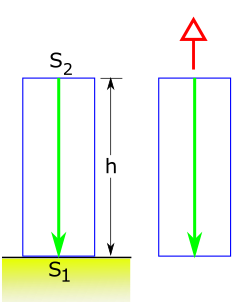
This principle led to several critical insights, including the discovery that light falling into a gravitational field acquires energy and that gravity actually curves the fabric of spacetime.
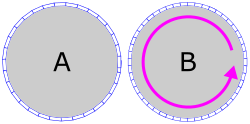
Einstein further explored these concepts using the Ehrenfest paradox, which involved a rotating disk. This led him to conclude that the geometry of the universe is non-Euclidean, meaning it is curved rather than flat.
Quantum Mechanics and the Nature of Reality
Einstein's relationship with quantum mechanics was complex. While he pioneered the concept of wave-particle duality—the idea that light behaves as both a wave and a particle—he remained skeptical of the inherent randomness of the quantum world.
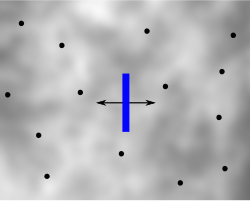
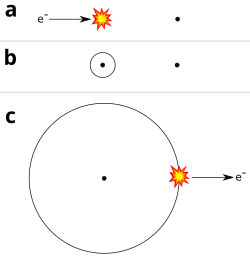
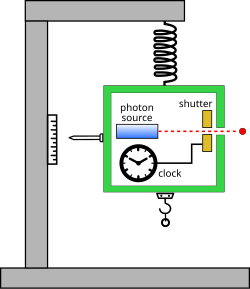
He engaged in famous debates with Niels Bohr, proposing imaginary devices to try and evade the Heisenberg uncertainty principle. These included the "light box" and the "bubble paradox," attempting to show that quantum mechanics was an incomplete description of reality.
The EPR Paradox and Entanglement
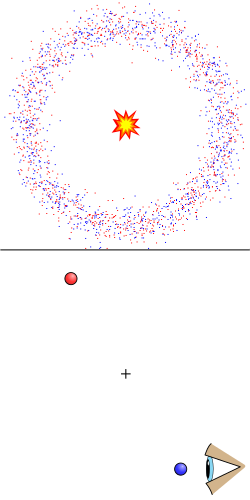
In 1935, Einstein, Boris Podolsky, and Nathan Rosen proposed the EPR paradox. They imagined two particles that interact and then fly apart, remaining correlated regardless of the distance between them. This anticipated the phenomenon of quantum entanglement, which Einstein famously found unsettling.
Summary of Einstein's Major Thought Experiments
| Theory | Scenario | Key Insight |
|---|---|---|
| Special Relativity | Chasing a light beam / Moving trains | Relativity of simultaneity and the constant speed of light. |
| Special Relativity | Center-of-mass cylinder | Equivalence of mass and energy (E=mc²). |
| General Relativity | Accelerating elevators / Falling person | The Equivalence Principle (gravity vs. acceleration). |
| General Relativity | Rotating disk | Spacetime is curved (non-Euclidean geometry). |
| Quantum Mechanics | EPR Particle Pair | Quantum entanglement and the incompleteness of quantum theory. |
Frequently Asked Questions
What is a Gedankenexperiment?
A Gedankenexperiment is a "thought experiment." It is a mental model used to explore the logical consequences of a hypothesis or theory in an idealized scenario where real-world frictions or limitations are removed.
How did Einstein use elevators to explain gravity?
Einstein used the elevator scenario to illustrate the equivalence principle, arguing that an observer inside a closed elevator cannot distinguish between the pull of gravity and the force of acceleration.
What was the purpose of the EPR paradox?
The EPR paradox was designed to argue that quantum mechanics was an incomplete theory because it suggested that particles could remain instantaneously connected (entangled) over vast distances, which seemed to violate the speed of light limit.
Did Einstein's thought experiments always lead to correct proofs?
Not always. For example, his original 1905 derivation of mass-energy equivalence using a rigid cylinder is now considered flawed because it ignored the fact that impulses cannot travel faster than light. However, these experiments often pointed the way toward the correct mathematical proofs provided by others, such as Max von Laue.
Why was the physics community skeptical of his light-quanta hypothesis?
The community relied heavily on the established success of wave theory in explaining optics. Einstein's early proposals were presented as "heuristic viewpoints" and based on statistical arguments, which many contemporaries viewed as theoretical exercises rather than definitive proofs.