Albert Einstein's Scientific Legacy: A Chronological Analysis of His Publications
Albert Einstein remains one of the most influential figures in the history of science, fundamentally altering our perception of space, time, and energy. His intellectual journey is meticulously documented through a vast array of publications, spanning from his early breakthroughs in the early 20th century to his later reflections on the nature of the universe.
Einstein's work is generally categorized into two primary eras: the first period, spanning from 1901 to 1933, and the second period, from 1933 to 1955. While the first period was characterized by the revolutionary foundations of modern physics, the second period saw him continuing to refine his theories and engage with the broader mathematical community.
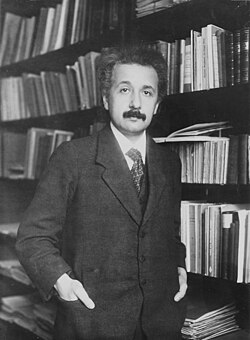
Key Facts
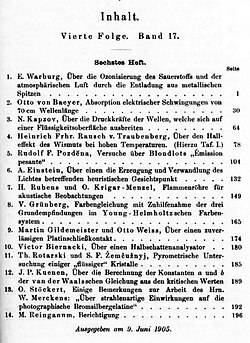
- Annus Mirabilis: 1905 was a pivotal year, with multiple groundbreaking papers published in Annalen der Physik.
- Core Theories: His work established the photoelectric effect and the General Theory of Relativity.
- Mathematical Evolution: His later career saw a shift toward publications in the Annals of Mathematics and the Canadian Journal of Mathematics.
- Global Reach: Einstein published in diverse journals across Germany, France, the United States, and the Netherlands.
The First Period (1901–1933): The Foundation of Modern Physics
The early part of Einstein's career was marked by an extraordinary output of theoretical work. Much of this was published in Annalen der Physik, a leading scientific journal of the time. During this era, he addressed the fundamental nature of light and the relationship between mass and energy.
One of his most significant early contributions was the paper on the photoelectric effect, which proposed that light consists of discrete packets of energy. This work was essential for the development of quantum mechanics.
Academic Beginnings and Doctoral Work
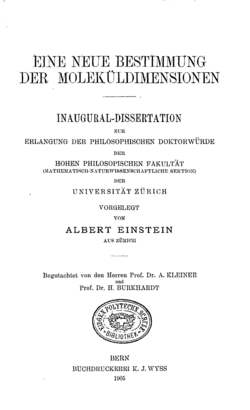
Einstein's formal academic journey included a doctoral dissertation on molecular dimensions, submitted to the University of Zurich under the supervision of Alfred Kleiner in 1905.
The Evolution of Relativity
Einstein's work on the mass-energy equivalence is perhaps his most famous contribution. In his early manuscripts, he used different notation than the modern standard, utilizing different symbols for energy and the speed of light (the Latin celer, meaning fast).
![Einstein's mass–energy equation in a 1912 manuscript. He originally used to represent energy instead of , and for the speed of light instead of ,[25]: 139 as is now standard (from the Latin celer, meaning fast.)[26]: 47](/images/32/5a/325a10cae9fc45becd9736520d7ffa93db275133d1c764eb2bebd04060258d2a.jpg)
By November 1915, Einstein had determined the correct gravitational field equations. This culminated in the 1916 publication, "The Foundation of the General Theory of Relativity," which presented the theory in a comprehensive, self-contained form.
![Cover of the reprint of Einstein's paper "The Foundation of the General Theory of Relativity" (1916). Einstein had found the correct gravitational field equations by November 1915. This 1916 paper presented the theory in a self-contained form for the first time.[34]](/images/a7/ec/a7ecc1453e57a81351abb631453b7ec605a31026850e8e2bd02bf6189b1705c9.jpg)
The Second Period (1933–1955): Later Works and Cosmology
In his later years, Einstein's focus expanded toward cosmology—the study of the origin and evolution of the universe. He continued to lecture and publish, often utilizing blackboards to derive complex estimates, including the estimated age of the Universe.
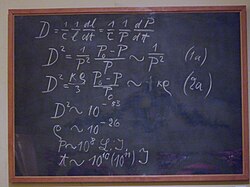
During this period, his publications shifted toward high-level mathematical journals, reflecting his pursuit of a unified field theory. He contributed frequently to the Annals of Mathematics and the Physical Review, maintaining his status as a global intellectual leader until his death in 1955.
Publication Summary
The following table summarizes the primary journals and publications that defined Einstein's scientific output across his career.
| Period | Primary Journals/Sources | Key Focus Areas |
|---|---|---|
| 1901–1933 | Annalen der Physik, Physikalische Zeitschrift, Nature | Photoelectric effect, Special and General Relativity, Molecular dimensions |
| 1933–1955 | Annals of Mathematics, Physical Review, Canadian Journal of Mathematics | Unified field theory, Cosmology, Advanced Mathematics |
| General | Encyclopædia Britannica, Science, Scientific American | Public outreach and comprehensive scientific reviews |
Frequently Asked Questions
In which journal did Einstein publish most of his early work?
Einstein published a significant portion of his early revolutionary papers in Annalen der Physik, particularly during his "miracle year" of 1905.
When did Einstein finalize the General Theory of Relativity?
Einstein found the correct gravitational field equations by November 1915, and he presented the theory in a self-contained form in his 1916 paper, "The Foundation of the General Theory of Relativity."
How did Einstein's notation for the speed of light change?
In early manuscripts, such as those from 1912, Einstein used different symbols for energy and the speed of light before the current standard (using c from the Latin celer) became universal.
What was the focus of Einstein's second period of work?
The second period (1933–1955) was characterized by a deeper focus on cosmology and the pursuit of a unified field theory, with many publications appearing in mathematical journals.
Where was Einstein's doctoral dissertation submitted?
His doctoral dissertation on molecular dimensions was submitted to the University of Zurich in 1905 under the supervision of Alfred Kleiner.