Albanian Language: History, Dialects, and Linguistic Structure
The Albanian language (known natively as shqip or gjuha shqipe) is a unique branch of the Indo-European language family. Spoken by approximately 7.5 million people as of 2017, it serves as a primary cultural pillar for Albanians across the Balkans and beyond. While it shares a distant ancestry with most European languages, Albanian occupies its own distinct branch, making it a subject of great interest for linguists studying the evolution of human speech.
From its roots in Proto-Albanian to its modern standardized form, the language has evolved through centuries of contact with Greek, Latin, Slavic, and Turkish influences, reflecting the complex history of the region.
![Albanian within Indo-European language family tree based on "Ancestry-constrained phylogenetic analysis of Indo-European languages" by Chang et al. (January 2015).[81]](/images/a3/78/a378e02148efe39272a146b688e861c5c3365f6482d205f4cfbf6b4f1992894d.jpg)
Key Facts
- Family: A distinct branch of the Indo-European family.
- Native Speakers: Approximately 7.5 million.
- Official Status: Official in Albania and Kosovo; co-official in North Macedonia and Montenegro.
- Primary Dialects: Gheg (North) and Tosk (South).
- Writing System: Latin-based Albanian alphabet.
- Regulating Bodies: Academy of Sciences of Albania and Academy of Sciences and Arts of Kosovo.
Geographic Distribution and Speakers
Albanian is most densely spoken in Albania and Kosovo, but significant populations exist in neighboring countries and across the global diaspora. In Albania, it is the native tongue for 97.7% of the population, while in Kosovo, it is spoken by 92.7%.
Beyond the Balkans, notable communities exist in Italy, Greece, and the United States, as well as in Germany and Switzerland, often as a result of historical migration and modern economic movement.
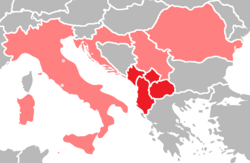
| Country | Speakers | Percentage/Note |
|---|---|---|
| Albania | 2,347,700 | 97.7% (Adult literacy rate) |
| Kosovo | 1,485,170 | 92.7% (Mother tongue) |
| North Macedonia | 481,800 | 26.23% (Mother tongue) |
| Italy | 420,955 | 0.71% (Mother tongue) |
| Greece | 374,926 | 3.57% (Citizenship) |
| Switzerland | 306,507 | 3.39% (Main language) |
| Germany | 601,000 | 0.73% (Spoken at home) |
Dialects and Classification
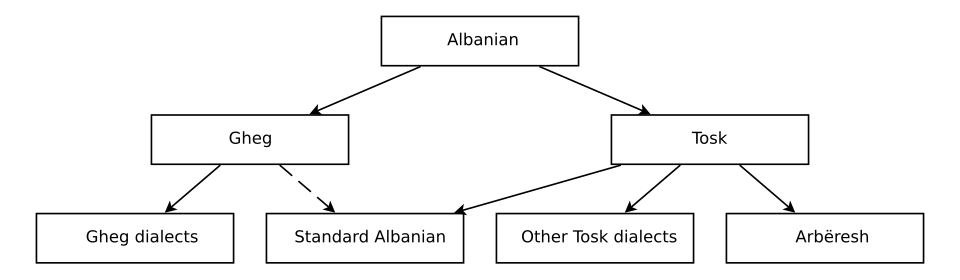
The Albanian language is primarily divided into two main dialect groups: Gheg and Tosk. These dialects differ in phonology and morphology, reflecting the geographic and historical split between the northern and southern regions.
Gheg (Northern Dialect)
Gheg is spoken predominantly in northern Albania, Kosovo, Montenegro, and North Macedonia. It includes sub-varieties such as Arbanasi, Upper Reka, and Malsia e Madhe.
Tosk (Southern Dialect)
Tosk is spoken in southern Albania and is the basis for the modern standard language. Its variants include Arbëresh (spoken in Italy) and Arvanitika (spoken in Greece), as well as Cham and Lab dialects.
Historical Development and Literary Tradition
The origins of Albanian are traced back to Proto-Albanian, with some scholars conjecturing a direct descent from the ancient Illyrian language. This is supported by cognates—words that share a common etymological origin—between Illyrian terms and modern Albanian, such as mal (mountain) and bardhë (white).
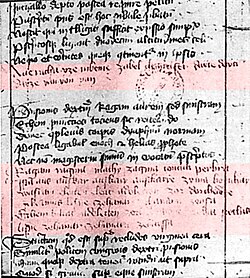
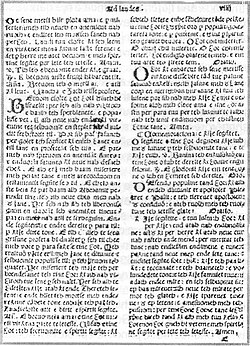
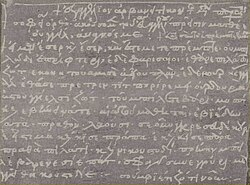
The earliest undisputed texts date back to the 16th century, such as the Meshari of Gjon Buzuku (1554–1555). However, some disputed fragments, such as those in the Bellifortis manuscript (c. 1402–1405), suggest an even earlier written presence.
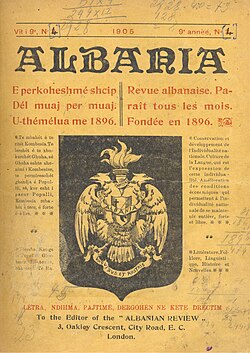
During the Ottoman period, the language persisted despite external pressures, eventually leading to the development of a standardized literary form in the early 20th century, exemplified by periodicals like the magazine Albania (1905).
Linguistic Structure and Phonology
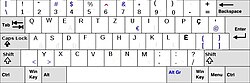
Modern Albanian uses a Latin-based alphabet. Its phonology is characterized by a diverse set of consonants and a specific set of vowels, including the schwa (written as ë), a mid-central vowel common in many languages but central to Albanian's sound profile.
Grammar and Syntax
Albanian grammar is complex, featuring a system of definite and indefinite nouns. Unlike English, where "the" is a separate word, Albanian attaches the definite article as a suffix to the end of the noun. For example, mal (a mountain) becomes mali (the mountain).
The language also employs an admirative mood, used to express surprise or a newly discovered fact. For instance, while Rruga është e mbyllur means "The street is closed," changing the verb to qenka (Rruga qenka e mbyllur) implies "(Apparently,) the street is closed."
Loanwords and Influences
Due to its location, Albanian has absorbed vocabulary from various sources:
- Greek: Early loans include terms for agriculture and nature, such as mollë (apple) and lakër (cabbage).
- Latin: Significant influence on administrative and daily life vocabulary.
- Slavic and Turkish: Extensive loans resulting from centuries of regional interaction and Ottoman rule.
- Gothic: Some sources attribute words like shkumë (foam) to Gothic origins.
Frequently Asked Questions
Is Albanian related to any other living languages?
Albanian is an Indo-European language, meaning it shares a very distant common ancestor with English, Spanish, Hindi, and Russian. However, it is the sole surviving member of its own specific branch, making it an "isolate" within the broader family.
What is the difference between Gheg and Tosk?
Gheg is the northern dialect, while Tosk is the southern dialect. They differ in pronunciation and some grammatical features. The modern standard Albanian language is primarily based on the Tosk dialect.
How does the definite article work in Albanian?
Instead of using a separate word like "the," Albanian adds a suffix to the noun. For example, the word for book is libër (indefinite), and libri (definite/the book).
What is the "admirative mood"?
The admirative mood is a unique grammatical feature used to express surprise or to indicate that the speaker has just realized a piece of information that was previously unknown to them.
Where is Albanian spoken officially?
It is the official language of Albania and Kosovo, and it holds co-official status in North Macedonia and Montenegro.