Al-Shibani Building: A Cultural Landmark of Ancient Aleppo
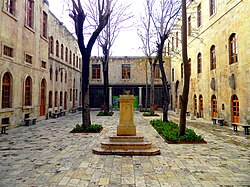
Located in the heart of the al-Jalloum district within the Ancient City of Aleppo, Syria, the Al-Shibani Building (also known as the Al-Shibani Church or School) stands as a testament to the city's layered history. Positioned south of Souq Khan al-Nahhaseen and west of the al-Saffahiyah Mosque, this 12th-century complex has evolved through numerous religious and cultural identities, reflecting the diverse heritage of the region.
The site's significance begins long before the current structure. In the pre-Islamic era, the area housed one of the four primary churches of ancient Aleppo. Following the transition to Islamic rule, a portion of that original church was repurposed as a madrasah (an Islamic school), specifically known as the "Glassy School" (al-Madrasa al-Zujajiyya).
Key Facts
- Location: Al-Jalloum district, Ancient City of Aleppo, Syria.
- Origin: Current building dates back to the 12th century.
- Former Use: Served as a church, an Islamic school, and the Collège de Terre-Sainte.
- Modern Function: A cultural venue hosting exhibitions and offices for international organizations.
- Restoration: Fully rehabilitated in 2006 through Syrian-German cooperation.
A History of Transformation
The Al-Shibani Building has undergone several ownership changes and functional shifts over the centuries. By the late 16th century, it was owned by Ahmet Pasha Matyab Zadeh, the Ottoman Wāli (governor) of Aleppo. In the 17th century, the site was acquired by the al-Shibani family, leading the area to be known as Khan al-Shibani.
The Era of the Holy Land College
In the 19th century, the Franciscan Missionaries of Mary took possession of the Khan. They established the Collège de Terre-Sainte (The Holy Land College) and a neighboring church. Rehabilitation began in 1853, the college opened in 1859, and the entire complex was completed by 1879. This institution became a cornerstone of Syrian intellectual life, educating many of the region's most prominent writers and politicians during the turn of the 20th century.
Mid-20th Century Shifts
The complex saw significant changes in the 1930s. In 1934, the Latin Catholic church was demolished so its stones could be used to construct the new Cathedral of Saint Francis of Assisi in the al-Aziziyah quarter. By 1937, the Terre-Sainte College moved to the al-Furqan district, where it operated until 1967, when it was converted into the "Partisans Enrollment Institute" of the Arab Socialist Ba'ath Party.
Revival and Modern Use
For over 50 years, the Al-Shibani Building served as a state-owned tobacco warehouse, during which time it suffered from a total lack of maintenance. This period of neglect ended in 2001 when a revival plan was launched through Syrian-German cooperation, funded by the German Federal Ministry of Economic Cooperation and Development.
The rehabilitation was completed in December 2006 by the Aleppo City Council and the German Technical Cooperation (GTZ). Today, the building is a vibrant cultural hub. It houses the main offices of the Goethe-Institut and Aga Khan Cultural Services, as well as the Heritage Archive Centre of the Aleppo Archeological Society.
Architectural Layout and Exhibits
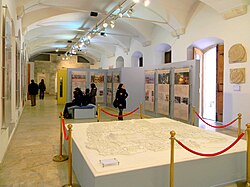
The building features a traditional design consisting of two floors centered around a large courtyard. It now hosts various exhibition halls, including the "Old Aleppo Revival Hall," which uses figures and photographs to commemorate the city's ancient districts, mosques, khans, and the Citadel of Aleppo. Additionally, the ground floor features a permanent exhibition detailing the building's own rehabilitation process.
| Period | Primary Use/Identity | Key Entity/Owner |
|---|---|---|
| Pre-Islamic | Main City Church | Ancient Aleppo Community |
| Early Islamic | Islamic School (Madrasah) | "Glassy School" |
| 16th-17th Century | Private Property/Khan | Ahmet Pasha / Al-Shibani Family |
| 19th Century | Educational College & Church | Franciscan Missionaries of Mary |
| Mid-20th Century | Tobacco Warehouse | Syrian Government |
| 2006-Present | Cultural Center & Offices | Aleppo City Council / GTZ |
Frequently Asked Questions
What is the Al-Shibani Building?
It is a 12th-century religious and cultural complex in the al-Jalloum district of Aleppo, Syria, that has served as a church, a madrasah, a college, and a warehouse before becoming a modern cultural center.
Who funded the restoration of the building?
The rehabilitation was funded by the Federal Ministry of Economic Cooperation and Development of Germany and implemented by the Aleppo City Council with assistance from the German Technical Cooperation (GTZ).
What happened to the church that was part of the complex?
The Latin Catholic church was demolished in 1934. Its stones were transported to the al-Aziziyah quarter to build the Cathedral of Saint Francis of Assisi, completed in 1937.
What can visitors see inside the building today?
Visitors can explore the "Old Aleppo Revival Hall," which showcases the city's heritage, and a ground-floor exhibition detailing the building's restoration process.
Which organizations are currently based in the building?
The building houses the main offices of the Goethe-Institut, Aga Khan Cultural Services, and the Heritage Archive Centre of the Aleppo Archeological Society.