Al-Halawiyah Madrasa: A Layered History of Faith in Aleppo
Located in the al-Jalloum district of the Ancient city of Aleppo, Syria, the Al-Halawiyah Madrasa stands as a profound testament to the architectural and religious evolution of the region. This complex is not merely a school, but a site where multiple eras of civilization overlap, reflecting the transition from Roman and Byzantine influences to Islamic scholarship.
A Legacy of Sacred Spaces
The site of the Al-Halawiyah Madrasa has been a center of spiritual significance for centuries. According to tradition, a Roman temple originally occupied the land. By the 5th century, Saint Helena, the mother of Constantine the Great, established a great Byzantine cathedral on this site, dedicated to Saint Helena herself.
The transition of the site began during a period of conflict. In 1124, while Crusaders were pillaging the surrounding countryside during the siege of Aleppo, the city's chief judge, Ibn al-Khashshab, initiated the conversion of the cathedral into a mosque. This transformation occurred during the reign of Belek Ghazi.
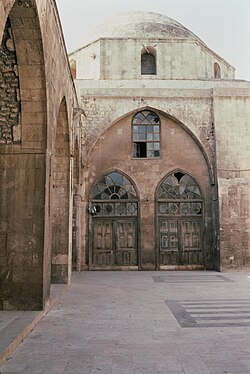
The Establishment of the Madrasa
The building underwent another significant transformation in 1149 under the direction of Nur al-Din. He converted the structure into a madrasa—an Islamic religious school. Specifically, the institution was dedicated to the followers of the Hanafi madhab, one of the four primary schools of jurisprudence in Sunni Islam.
Architecturally, the complex is a hybrid of styles. Portions of the original 5th-century Christian construction were integrated into the Islamic school. Among its most noted architectural features is its fine mihrab, the semicircular niche in the wall of a mosque that indicates the qibla (the direction of the Kaaba in Mecca).
Key Facts
- Location: al-Jalloum district, Ancient city of Aleppo, Syria.
- Established as Madrasa: 1149.
- Original Site: A Roman temple, followed by a 5th-century Byzantine cathedral.
- Affiliation: Islamic (Hanafi madhab).
- Key Figures: Saint Helena, Ibn al-Khashshab, Belek Ghazi, and Nur al-Din.
Summary of Site Evolution
| Period/Date | Structure Type | Key Figure/Influence |
|---|---|---|
| Ancient Era | Roman Temple | Roman Empire |
| 5th Century | Byzantine Cathedral | Saint Helena |
| 1124 | Mosque | Ibn al-Khashshab / Belek Ghazi |
| 1149 | Madrasa | Nur al-Din |
Frequently Asked Questions
Where is the Al-Halawiyah Madrasa located?
It is located in the al-Jalloum district within the Ancient city of Aleppo, Syria.
What was built on the site before the madrasa?
Before becoming a madrasa, the site housed a Byzantine cathedral built by Saint Helena in the 5th century, which itself was built where a Roman temple once stood.
Who converted the cathedral into a mosque?
The conversion was started by Ibn al-Khashshab, the chief judge of Aleppo, in 1124 during the reign of Belek Ghazi.
Which school of Islamic law is associated with this madrasa?
The Al-Halawiyah Madrasa was established for the followers of the Hanafi madhab.
What is a notable architectural feature of the complex?
The complex is well-known for its fine mihrab and the preservation of parts of the 5th-century Christian construction.