Admiral Sir Philip Jones: A Distinguished Career in the Royal Navy
Admiral Sir Philip Jones is a retired senior officer of the United Kingdom's Royal Navy whose career spanned four decades of service, from the front lines of the South Atlantic to the highest echelons of naval command. Over his tenure from 1980 to 2020, Jones demonstrated a steady ascent through the ranks, culminating in his appointment as the First Sea Lord, the professional head of the Royal Navy.
Key Facts
- Full Name: Admiral Sir Philip Andrew Jones, GCB, DL.
- Highest Rank: Admiral.
- Primary Role: First Sea Lord (April 2016 – June 2019).
- Combat Experience: Served in the Falklands War (1982).
- Notable Commands: HMS Beaver, HMS Coventry, and the Amphibious Task Group.
- Education: Birkenhead School, Mansfield College (Oxford), and the Royal Naval College, Dartmouth.
Early Life and Naval Foundations
Born on 14 February 1960 in Bebington, Wirral, Philip Jones is the son of Edgar and Lilian Jones. His academic journey took him through Birkenhead School and Mansfield College, Oxford, before he entered professional military training at the Royal Naval College, Dartmouth.
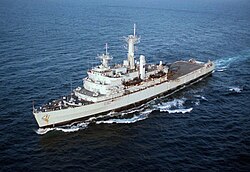
Jones officially joined the Royal Navy as a sub-lieutenant on 1 May 1980. His early career was marked by immediate immersion in active conflict; in 1982, he served aboard the amphibious assault ship (a vessel designed to land forces on a hostile shore) HMS Fearless during the Falklands War. Following this service, he was promoted to lieutenant on 1 September 1982.
Developing Expertise
Between 1983 and 1988, Jones honed his skills as a watch keeping and navigation officer across various frigates and aboard the Royal Yacht Britannia. He later transitioned into the role of principal warfare officer, serving with the maritime battle staff and additional frigate assignments.
Rise Through the Command Ranks
By 1994, Jones was promoted to commander and given command of the frigate HMS Beaver. His expertise was further utilized within the Ministry of Defence, where he served as a member of the Directorate of Navy Plans in 1997.
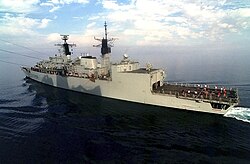
Upon his promotion to captain on 31 December 1999, Jones assumed command of the frigate HMS Coventry and served as Captain of the 1st Frigate Squadron. This period marked a transition toward higher-level strategic management, including roles as Military Assistant to the Chief of Defence Logistics (2002) and Director of the Joint Maritime Operational Training Staff (2003).
Strategic Leadership and International Operations
Promoted to commodore in December 2004, Jones took command of the Amphibious Task Group in August 2006. His leadership expanded to regional and international scales when he was appointed Rear Admiral in February 2008, serving as Flag Officer, Scotland, Northern England and Northern Ireland.
In December 2008, while serving as Commander United Kingdom Maritime Forces, Jones led the European Union's first naval task force. This mission was specifically assembled to protect international shipping from piracy in the waters off Somalia.
The Path to First Sea Lord
The final decade of Jones's career saw him occupy the most senior positions in the Navy. After serving as Assistant Chief of the Naval Staff in 2009, he was promoted to vice admiral in December 2011. He eventually became Fleet Commander and Deputy Chief of the Naval Staff on 30 November 2012.
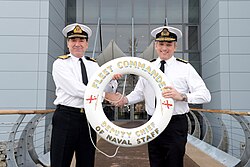
The pinnacle of his career arrived on 8 April 2016, when he assumed the role of First Sea Lord. He held this prestigious position until 19 June 2019, when he was succeeded by Admiral Tony Radakin. Sir Philip officially retired from the Royal Navy on 3 January 2020.
Career Summary and Honors
Throughout his service, Admiral Jones was recognized with numerous high-level honors for his dedication to the Crown and international security.
| Category | Details |
|---|---|
| Major Commands | HMS Beaver, HMS Coventry, Amphibious Task Group, First Sea Lord |
| Key Conflicts | Falklands War (1982) |
| British Honors | Knight Grand Cross of the Order of the Bath (GCB), Deputy Lieutenant of Hampshire |
| International Awards | Commander of the Legion of Merit (United States) |
| Academic Honors | Honorary Doctorates from Heriot-Watt University (1993) and University of Liverpool (2017) |
Personal Life
Outside of his military duties, Sir Philip married Elizabeth Collins in 1987, and they have one son and two daughters. He is an enthusiast of reading, sports, and hill walking.
Frequently Asked Questions
What was Admiral Sir Philip Jones's highest rank?
His highest rank was Admiral, and he served as the First Sea Lord from 2016 to 2019.
Which ships did Admiral Jones command?
He served as the commanding officer of the frigates HMS Beaver and HMS Coventry.
Did Admiral Jones serve in any active conflicts?
Yes, he saw active service during the Falklands War in 1982 while serving aboard the amphibious assault ship HMS Fearless.
What international mission did he lead for the European Union?
In December 2008, he commanded the first EU naval task force created to protect international shipping in the waters off Somalia.
When did Admiral Sir Philip Jones retire?
He retired from the Royal Navy on 3 January 2020.