Academy Library: A Legacy of Medicine and Public Health
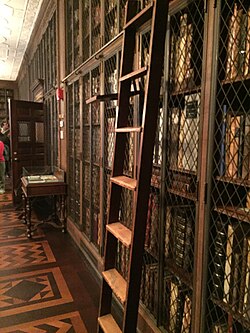
The Academy Library stands as one of the most significant repositories of medicine and public health knowledge in the world. Operating as part of the New York Academy of Medicine's Center for the History of Medicine and Public Health, this institution serves as a bridge between the ancient origins of healing and modern medical practice. While the library first opened its doors in 1847, it transitioned into a resource for the general public in 1878, ensuring that critical health information remained accessible beyond a closed circle of professionals.
Today, the library houses approximately 550,000 volumes and maintains a rigorous standard of preservation. Its historical materials are meticulously cared for in the Gladys Brooks Book and Paper Conservation Laboratory, ensuring that fragile documents survive for future generations of researchers.
Key Facts
- Collection Size: Approximately 550,000 volumes.
- Public Access: Open to the general public since 1878.
- Rare Artifacts: Home to the Edwin Smith Papyrus and original writings by Sigmund Freud.
- Historical Standing: By 1947, it was the second-largest medical library in the U.S.
- Specialized Facilities: Includes the Coller Rare Book Reading Room and the Gladys Brooks Book and Paper Conservation Laboratory.
Institutional Growth and Evolution
The library's physical and organizational structure evolved significantly during the early 20th century. Under the leadership of President Walter Belknap James (1915–1918), the Library Council made the strategic decision in May 1918 to expand the facility at 15 West 43rd Street, which necessitated the sale of the property at 10 West 44th Street.
During this era of expansion, the academy also refined its membership standards. The number of fellows increased from 1,200 to 1,300, and the professional requirement for fellows was raised from three years of practice to five years.
Wartime Contributions
During World War I, the library transformed into a hub for wartime support. It opened its doors to all citizens, including soldiers, and repurposed its prime spaces for the national effort. Hosack Hall was utilized for war-related events, while other rooms were dedicated to Medical Reserve Corps examinations.
The Golden Age of Medical Bibliography
By 1947, the library had reached a milestone of 252,000 volumes, ranking it as the second-largest medical library in the United States, surpassed only by the Surgeon General's Library (now known as the National Library of Medicine). While the library remained open to the public, borrowing privileges were reserved for fellows and specific paid subscribers.
The library's prestige was bolstered by a succession of expert librarians. Archibald Malloch, who served from 1935 to 1949, doubled the size of the collection. He was succeeded by Janet Doe and Gertrude L. Annan, both of whom were regarded by their peers as "giants in their field."
A pivotal moment occurred in 1949 when the New York Public Library, having ceased the expansion of its own medical collection, donated approximately 22,000 medical works to the Academy. This acquisition briefly established the Academy Library as the sole public medical source in the New York metropolitan area.
Notable Holdings and Rare Collections
The library is renowned for its collection of rare bibliographic works and medical artifacts, including an eclectic collection of cookbooks. Among its most prized possessions is the Edwin Smith Papyrus, an ancient Egyptian medical text recognized as the oldest known surgical treatise on trauma.
In 1928, the library expanded its historical reach by purchasing the incunable manuscripts of E.C. Streeter. Incunables are books printed before 1501; this collection included at least 130 volumes that profoundly influenced the history of medicine. These works were exhibited in December 1928 during the History of Science Society's meeting, with selections primarily curated by Arnold C. Klebs.
Archives and Modern Resources
Beyond books, the library houses the archives of numerous health-related organizations, providing primary source material for the history of medical education and practice in New York. To support modern research, the academy publishes a bimonthly Grey Literature Report—a resource dedicated to providing context and searchability for grey literature (research that is produced outside of traditional commercial or academic publishing). These resources are indexed using Medical Subject Headings (MeSH) for standardized searching.
| Category | Details |
|---|---|
| Total Volumes | ~550,000 |
| Founded / Public Access | 1847 / 1878 |
| Key Rare Item | Edwin Smith Papyrus |
| Conservation Lab | Gladys Brooks Book and Paper Conservation Laboratory |
| Specialized Room | Coller Rare Book Reading Room |
Frequently Asked Questions
Is the Academy Library open to the general public?
Yes, the library has been open to the general public since 1878, although borrowing privileges may be restricted to fellows and certain paid subscribers.
What is the Edwin Smith Papyrus?
The Edwin Smith Papyrus is an ancient Egyptian medical text held by the library and is the oldest known surgical treatise focusing on trauma.
What are incunables in the context of the library's collection?
Incunables refer to books printed before the year 1501. The library acquired a significant collection of these from E.C. Streeter in 1928.
What is the Grey Literature Report?
The Grey Literature Report is a bimonthly publication by the academy that provides search capabilities and context for research produced outside of traditional publishing channels, indexed via Medical Subject Headings.
What unique medical artifacts are found in the library?
In addition to rare manuscripts and the Edwin Smith Papyrus, the library holds original writings by Sigmund Freud and a prototype of George Washington's dentures made from donated teeth.