A Man for All Seasons: Themes of Conscience, Law, and Power
Robert Bolt's A Man for All Seasons is a profound exploration of the tension between individual integrity and the demands of the state. Centered on the life of Sir Thomas More, the play examines the precarious position of a man who refuses to compromise his internal moral compass, even when faced with the absolute power of the monarchy.
At its core, the narrative is not merely a historical retelling but a philosophical study of what defines a human being. Through More's struggle, Bolt presents a world where political expediency often triumphs over truth, and where the law is used both as a shield and a weapon.
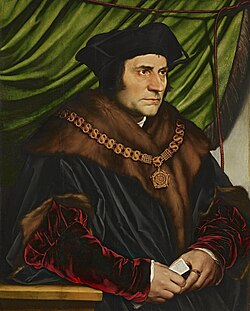
Key Facts
- Central Conflict: The struggle between personal conscience and state-mandated loyalty.
- Historical Context: Set during the reign of King Henry VIII and the implementation of the Succession to the Crown Act 1534.
- Core Philosophy: The belief that a person is defined by their conscience and that the rule of law must be upheld regardless of the individual.
- Narrative Device: The use of the "Common Man" to provide a Brechtian perspective on history.
- Antagonists: Figures like Thomas Cromwell and Richard Rich represent political ambition and corruption.
The Primacy of Conscience and Identity
The play posits that identity is inextricably linked to conscience—the internal sense of right and wrong. More argues that to betray one's conscience is to lose one's self. This commitment is depicted as absolute; More is less concerned with the objective truth of his beliefs than with the fact that he holds them sincerely.
This steadfastness puts him at odds with his peers. While associates like the Duke of Norfolk urge More to sign the Succession to the Crown Act 1534 for the sake of "fellowship" and survival, More views such compromises as spiritual suicide. He believes that while temporal power is fleeting, the consequences of betraying one's soul are eternal.
The Rule of Law vs. Political Ambition
A recurring theme is the importance of the rule of law. More views the law as a protective barrier that prevents the arbitrary exercise of power. This is most evident in his refusal to arrest Richard Rich despite Rich's obvious dishonesty.
More argues that granting the "benefit of law" even to the most malevolent individuals is the only way to ensure safety for everyone. He warns that if the law is dismantled to target an enemy, there will be no protection left when the state eventually turns its sights on the innocent.
Corruption and Anti-Authoritarianism
Bolt utilizes the play to critique authoritarianism. Almost every figure of authority—including King Henry VIII, Cardinal Wolsey, and Thomas Cromwell—is portrayed as corrupt, power-hungry, or driven by expediency. This is further emphasized by the anachronistic portrayal of Henry VIII as a younger, athletic man, contrasting the historical reality of his physical decline by 1530.
The contrast between More's loyalty and Cromwell's spite is highlighted by More's interaction with Eustace Chapuys, the Imperial ambassador. Despite his religious differences with the state, More proves his patriotism by reporting a planned Catholic rebellion to Norfolk, demonstrating that his refusal to sign the Act is a matter of conscience, not treason.
The Role of the Common Man
The character of the Common Man serves as a narrator and a framing device. He is a Brechtian character—a reference to Bertolt Brecht's theory of alienation, designed to prevent the audience from becoming too emotionally absorbed in the plot and instead encourage critical reflection.
The Common Man shifts roles throughout the play, appearing as a servant, a boatman, a jailer, and eventually the executioner. By breaking the fourth wall, he reminds the audience that the "average person" is a constant presence in history, often overlooked but always impacted by the actions of the powerful.
| Character | Primary Motivation | Relationship to Law/Conscience |
|---|---|---|
| Sir Thomas More | Integrity and Salvation | Absolute adherence to conscience and the letter of the law. |
| Thomas Cromwell | Political Power | Uses the law as a tool for manipulation and elimination. |
| Richard Rich | Social Advancement | Willing to commit perjury for personal gain. |
| The Common Man | Survival/Observation | Represents the pragmatic, often complicit, general public. |
| Duke of Norfolk | Fellowship and Status | Values social loyalty over moral conviction. |
Frequently Asked Questions
What is the significance of the Succession to the Crown Act 1534?
The Act was the legal mechanism used by Henry VIII to solidify his break from the Catholic Church. More's refusal to sign it became the legal basis for his charge of treason.
Why does More give the "Devil" the benefit of the law?
More believes that the law is the only thing protecting individuals from the arbitrary whims of those in power. If the law is ignored to punish a "devil," the legal protections for everyone are destroyed.
What is "Brechtian alienation" in the context of the Common Man?
It is a theatrical technique used to distance the audience from the characters. By having the Common Man comment on the action and break the fourth wall, Bolt prevents the audience from simply sympathizing with More and instead forces them to consider their own role in history.
How does the play portray King Henry VIII?
The play portrays Henry as an athletic, younger man, which is an anachronism. This choice emphasizes his vitality and the imposing, unpredictable nature of his power.
Is Sir Thomas More depicted as a perfect character?
While More is the moral center, the play acknowledges that his position is almost indefensible in a practical sense, and it notes that the Pope he defends was viewed by some as corrupt or a puppet of Emperor Charles V.