1980 United States Census: Population Trends and Demographic Shifts
The 1980 United States census, conducted by the Census Bureau, serves as a critical snapshot of the nation's demographic landscape at the start of a new decade. By enumerating the resident population on April 1, 1980, the survey captured a period of significant growth and evolving social identities, providing a foundation for urban planning and political representation.
The results revealed a total population of 226,545,805, marking an 11.4% increase from the 203,184,772 people counted during the 1970 census. This era saw the United States continue its upward trajectory in population, with a subsequent increase of approximately 22,164,837 (9.8%) leading into the 1990 census.
Key Facts
- Total Population: 226,545,805 (an 11.4% increase since 1970).
- Most Populous State: California, the first state to exceed 20 million residents.
- Least Populous State: Alaska, with 401,851 residents.
- Historic Milestone: The first census to count Hispanic and Latino Americans as an ethnicity.
- State Minimums: The first census where every state recorded a population over 400,000.
Census Methodology and Questions
The 1980 census introduced several changes to how data was collected. Notably, it was the first census to omit the question regarding the "head of household," reflecting a shift in how the Bureau viewed family structures.
All respondents were asked to provide basic information, including:
- Name and Address
- Age and Gender
- Race and Marital status
- Household relationship
- Whether they were of Spanish/Hispanic origin or descent
While most received a short form, approximately 16 percent of households were given a "long form," which contained over 100 detailed questions to provide deeper sociological insights.
State Population Dynamics
The 1980 data highlighted dramatic shifts in where Americans lived. While California remained the most populous state, the Sun Belt saw explosive growth. For instance, Nevada experienced a staggering 63.8% increase, and Arizona grew by 55.7%.
Conversely, some areas saw declines. New York's population dropped by 3.7%, and the District of Columbia saw a significant decrease of 15.6%.
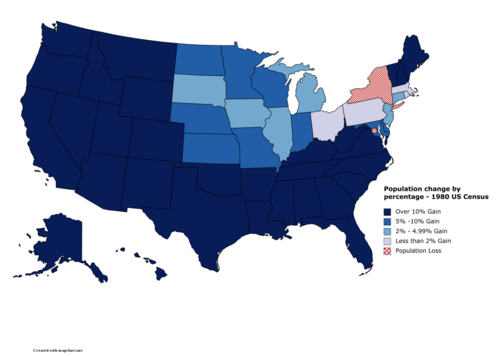
The following table summarizes the population data for the top 10 most populous states in 1980:
| Rank | State | 1980 Population | 1970 Population | Percent Change |
|---|---|---|---|---|
| 1 | California | 23,667,902 | 19,953,134 | 18.6% |
| 2 | New York | 17,558,072 | 18,236,967 | -3.7% |
| 3 | Texas | 14,229,191 | 11,196,730 | 27.1% |
| 4 | Pennsylvania | 11,863,895 | 11,793,909 | 0.6% |
| 5 | Illinois | 11,426,518 | 11,113,976 | 2.8% |
| 6 | Ohio | 10,797,630 | 10,652,017 | 1.4% |
| 7 | Florida | 9,746,324 | 6,789,443 | 43.6% |
| 8 | Michigan | 9,262,078 | 8,875,083 | 4.4% |
| 9 | New Jersey | 7,364,823 | 7,168,164 | 2.7% |
| 10 | North Carolina | 5,881,766 | 5,082,059 | 15.7% |
Urban Centers and City Rankings
At the city level, New York remained the dominant metropolis with over 7 million residents. Chicago and Los Angeles followed, both hovering around the 3 million mark. The data also showed the rise of Texas cities, with Houston ranking 5th and Dallas 7th in total population.
The distribution of the 100 largest cities showed a strong presence in the Northeast and Midwest, though the West and South were rapidly expanding, as evidenced by the high growth rates in states like Arizona and Florida.
Data Availability and Privacy
For researchers and historians, microdata from the 1980 census is freely available through the Integrated Public Use Microdata Series (IPUMS). Additionally, aggregate data for small areas and electronic boundary files are hosted by the National Historical Geographic Information System.
To protect individual privacy, the U.S. government adheres to a strict confidentiality rule. Personally identifiable information from the 1980 census will not be released to the public until the year 2052.
Frequently Asked Questions
What was the total population of the U.S. in 1980?
The total resident population was determined to be 226,545,805, which represented an 11.4% increase over the 1970 census.
Which state had the highest population growth in 1980?
Among the states, Nevada saw the highest percentage increase at 63.8%, followed closely by Arizona at 55.7%.
What was unique about the 1980 census regarding ethnicity?
The 1980 census was the first to officially count Hispanic and Latino Americans as an ethnicity.
When will the private records of the 1980 census be released?
Personally identifiable information from the 1980 census is scheduled to become available in 2052.
Which city was the most populous in 1980?
New York City was the most populous, with a population of 7,071,639.