1960 United States Census: Population Trends and Demographic Shifts
The 1960 United States census, conducted by the Census Bureau, provides a critical snapshot of the nation during a period of significant growth and transition. By determining the resident population of the country, this decennial survey served as the foundation for political representation and social planning for the following decade.
The results revealed a total population of 179,323,175, marking a 19 percent increase over the 151,325,798 people counted during the 1950 census. A notable milestone of this specific survey was that it marked the first time in U.S. history that every single state recorded a population exceeding 200,000 residents.
Beyond simple counting, the data from the 1960 census was instrumental in determining the allocation of electoral votes for the 1964 and 1968 presidential elections.
Key Facts
- Total Population: 179,323,175 (a 19% increase from 1950).
- Most Populous State: New York (16,782,304).
- Least Populous State: Alaska (226,167).
- Historical Milestone: The last census where New York held the title of the most populous state.
- Urban Decline: Detroit experienced a loss of 220,000 residents, the largest population drop between two censuses on record.
Census Methodology and Data Collection
To capture a comprehensive view of the American public, the Census Bureau collected several core data points from every respondent. These included the respondent's address, name, sex, race, age, marital status, and their relationship to the head of the household.
While most received a basic form, approximately 25% of households were issued a long form. This extended questionnaire contained over 100 detailed questions to provide deeper demographic insights.
Data Availability and Privacy
Today, researchers can access microdata from the 1960 census through the Integrated Public Use Microdata Series (IPUMS). Additionally, the National Historical Geographic Information System provides aggregate data for small areas and electronic boundary files. In accordance with privacy laws, personally identifiable information from this census will not be released until 2032.
State and City Population Analysis
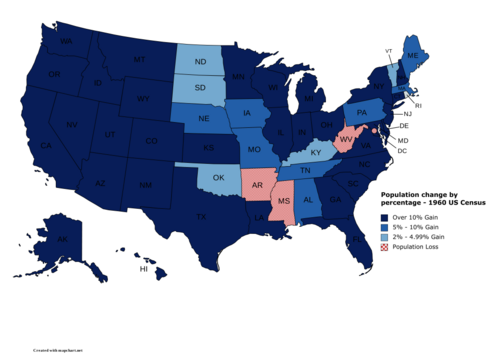
The 1960 data highlights a period of rapid expansion in the West and South. Florida, for example, saw a massive population surge of 78.7%, while Arizona grew by 73.7% and Nevada by 78.2%.
Conversely, some regions saw declines. West Virginia and Arkansas both experienced population losses, and the District of Columbia saw a decrease of 4.8%.
At the city level, New York City remained the dominant urban center with over 7.7 million residents, followed by Chicago and Los Angeles.
| Rank | State | 1960 Population | 1950 Population | Percent Change |
|---|---|---|---|---|
| 1 | New York | 16,782,304 | 14,830,192 | 13.2% |
| 2 | California | 15,717,204 | 10,586,223 | 48.5% |
| 3 | Pennsylvania | 11,319,366 | 10,498,012 | 7.8% |
| 4 | Illinois | 10,081,158 | 8,712,176 | 15.7% |
| 5 | Ohio | 9,706,397 | 7,946,627 | 22.1% |
| 6 | Texas | 9,579,677 | 7,711,194 | 24.2% |
| 7 | Michigan | 7,823,194 | 6,371,766 | 22.8% |
| 8 | New Jersey | 6,066,782 | 4,835,329 | 25.5% |
| 9 | Massachusetts | 5,148,578 | 4,690,514 | 9.8% |
| 10 | Florida | 4,951,560 | 2,771,305 | 78.7% |
Frequently Asked Questions
What was the total population of the U.S. in 1960?
The total resident population was determined to be 179,323,175.
Which state had the highest population in 1960?
New York was the most populous state with 16,782,304 residents. This was the final census in which New York held this ranking.
What was the most significant city population loss?
Detroit recorded the largest loss of population between two censuses, losing 220,000 residents during the 1950s.
How was the 1960 census used for political purposes?
The data collected was used to determine the number of electoral votes for the 1964 and 1968 presidential elections.
When will the personally identifiable information from the 1960 census be public?
Personally identifiable information from the 1960 census is scheduled to become available in 2032.