1933 FA Cup Final: Everton's Dominant Victory Over Manchester City
The 1933 FA Cup final stands as a landmark moment in English football history. Contested on 29 April 1933 at the iconic Wembley Stadium in London, this 62nd final of the Football Association Challenge Cup (the FA Cup) saw Everton face off against Manchester City. Beyond the action on the pitch, the match is remembered for a significant administrative first: it was the first time players, including goalkeepers, were issued shirt numbers for identification purposes.
Everton entered the match as the reigning league champions, while Manchester City had reached the semi-finals the previous year. Despite both teams wearing blue, the competition rules mandated alternative colors to avoid a clash. Everton players were assigned numbers 1–11, while Manchester City wore 12–22.
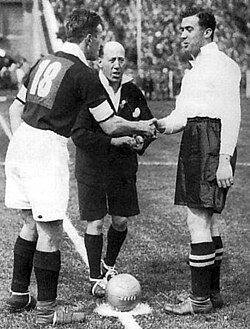
Key Facts
- Date: 29 April 1933
- Venue: Wembley Stadium, London
- Final Score: Everton 3–0 Manchester City
- Attendance: 92,950
- Everton Goalscorers: Jimmy Stein, Dixie Dean, and James Dunn
- Historical First: First FA Cup final to feature numbered shirts
- Guest of Honour: The Duke of York
The Road to Wembley
Everton's Path
Everton's journey to the final was marked by consistent scoring and defensive resilience. They began their campaign with a 3–2 win over Leicester City, followed by a 2–0 victory against Bury. In the fifth round, they overcame Leeds United 4–2, with goalkeeper Ted Sagar making critical saves to maintain the lead. A dominant 6–0 win against Third Division Luton Town in the quarter-finals established them as favorites. They secured their place in the final by defeating West Ham United 2–1 at Molineux, with Edward Critchley scoring the decisive goal.
Manchester City's Path
Manchester City's route was equally determined. After a 1–1 draw with Gateshead, they delivered a crushing 9–0 win in the replay. They proceeded to defeat Walsall 2–0 and Bolton Wanderers 4–2, the latter being the highest-attended match of that round with 69,920 spectators. A 1–0 win over Burnley in the quarter-finals and a hard-fought 3–2 victory against Derby County in the semi-final at Leeds Road completed their journey to London.
Match Analysis: A One-Sided Affair
Both teams utilized the standard formation of the era: two full-backs, three half-backs, and five forwards. Manchester City suffered a blow with the absence of Fred Tilson due to a leg injury, leading Alec Herd to move to center-forward. Everton, meanwhile, welcomed back Albert Geldard at outside right.
Everton dominated the tempo from the start. The breakthrough came in the 41st minute when Manchester City goalkeeper Len Langford dropped a cross from Cliff Britton, allowing Jimmy Stein to slot the ball into the empty net. The lead was doubled seven minutes into the second half when Langford again failed to secure a Britton cross, and Dixie Dean charged the ball and the goalkeeper into the net.
The Everton defense, led by Warney Cresswell, remained impenetrable throughout the match. The victory was sealed ten minutes from time when James Dunn headed in a goal from a corner, resulting in a final score of 3–0.
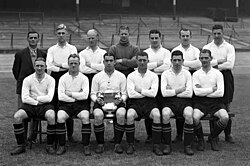
Summary of the 1933 Final
| Detail | Everton | Manchester City |
|---|---|---|
| Final Score | 3 | 0 |
| Goalscorers | Stein, Dean, Dunn | None |
| Captain | Dixie Dean | Sam Cowan |
| Manager | Thomas H. McIntosh | Wilf Wild |
| Shirt Numbers | 1–11 | 12–22 |
Post-Match Celebrations and Legacy
Captain Dixie Dean received the trophy from the Duke of York. Upon returning to Liverpool, the team paraded the city in the same horse-drawn carriage used during their 1906 victory. In a notable post-match exchange, Dean toasted to the cup staying in Lancashire; Sam Cowan replied that he hoped the next Lancashire club to win it would be Manchester City. This proved prophetic, as Manchester City returned to Wembley the following year to win the 1934 FA Cup.
Frequently Asked Questions
Who scored the goals for Everton in the 1933 final?
The goals were scored by Jimmy Stein in the 41st minute, Dixie Dean in the 52nd minute, and James Dunn in the 80th minute.
Why was the 1933 FA Cup final historically significant for player kits?
It was the first FA Cup final where players were issued numbers on their shirts for identification; Everton wore 1–11 and Manchester City wore 12–22.
Who was the guest of honour at the match?
Due to inclement weather, King George V was unable to attend, and the Duke of York served as the guest of honour.
How many people attended the match at Wembley?
The official attendance for the final was 92,950.
Did Manchester City find success shortly after this defeat?
Yes, Manchester City returned to the final the following year and won the 1934 FA Cup by defeating Portsmouth 2–1.