Zuqaq al-Blat: A Historic Quarter of Beirut
Located at the coordinates 33°53′32″N 35°29′54″E, Zuqaq al-Blat is one of the twelve traditional quarters of Beirut. Known for its rich architectural heritage and deep historical roots, this neighborhood serves as a testament to the city's expansion from a medieval walled port into a modern metropolitan center.
The quarter is often referred to by two names. Literally meaning "the cobbled alley," Zuqaq al-Blat takes its name from the 19th-century street covered in cobblestones that connected the old city to the Qantari hill. It is also commonly called al-Batrakieh (the Patriarchate), as it houses the seat of the Greek Catholic Patriarchate of Beirut.
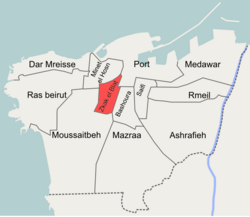
The History and Urban Evolution of Zuqaq al-Blat
For centuries, Beirut existed as a medieval walled port town. However, the second half of the 19th century marked a period of rapid growth. As the city became overcrowded, affluent citizens began building villas on the slopes of surrounding hills, including Musaytbeh, Qnatari, and Ashrafieh.
A pivotal shift occurred in 1832 when the troops of Ibrahim Pasha occupied Beirut. Under Egyptian authority, the city underwent significant urban planning and sanitation improvements. Mahmoud Na'ami Bey, the Egyptian-Circassian governor of Beirut, commissioned the cobbling of streets that extended beyond the city's original walls. The specific street stretching from the south-western wall into the new neighborhoods of Qantari hill became known as Zuqaq al-Blat, eventually giving the entire quarter its name.
Demographics and Community
The demographic composition of Zuqaq al-Blat reflects the diverse religious fabric of Beirut. Based on registered voter data from 2014, the population is predominantly Muslim, accounting for 90.23% of the electorate, while Christians make up 8.96%.
| Religion | Percentage |
|---|---|
| Sunni Islam | 50.89% |
| Shia Islam | 39.32% |
| Christian | 8.96% |
| Others | 0.83% |
Key Facts
- Meaning: The name Zuqaq al-Blat translates to "the cobbled alley."
- Alternative Name: It is also known as al-Batrakieh due to the Greek Catholic Patriarchate.
- Urban Origin: The quarter developed as Beirut expanded beyond its medieval walls in the 19th century.
- Key Figure: Governor Mahmoud Na'ami Bey was responsible for the street cobbling that defined the area.
- Demographics: As of 2014, Sunni Muslims (50.89%) and Shia Muslims (39.32%) are the largest religious groups.
Notable Residents
Throughout its history, Zuqaq al-Blat has been home to a variety of influential figures from the worlds of art, politics, and academia, including:
- Fairuz (Legendary singer)
- Charles de Gaulle (Former French President)
- Butrus Bustani (Scholar and educator)
- Abd el-Qader Qabbani
- Hussein Beyhum
- Khalil Sarkis
- Omar Zaani
Frequently Asked Questions
What does the name Zuqaq al-Blat mean?
The name literally translates to "the cobbled alley," referring to the 19th-century cobblestone street that led from the old city to Qantari hill.
Why is the quarter also called al-Batrakieh?
It is called al-Batrakieh (the Patriarchate) because the seat of the Greek Catholic Patriarchate of Beirut is located within the quarter.
How did the quarter form?
It formed during the 19th century when Beirut grew beyond its medieval walls. Under the administration of Mahmoud Na'ami Bey, new cobbled roads were built leading to the hills, creating new extramural neighborhoods.
What is the religious makeup of the area?
According to 2014 voter registration, the area is approximately 50.89% Sunni Muslim, 39.32% Shia Muslim, and 8.96% Christian.
Who are some of the famous people associated with Zuqaq al-Blat?
Notable residents have included the iconic singer Fairuz, French leader Charles de Gaulle, and the scholar Butrus Bustani.