Ras Beirut: A Hub of Culture, History, and Prehistoric Discovery
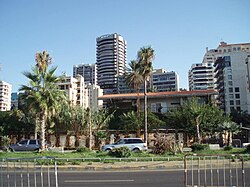
Located at the tip of the Lebanese capital, Ras Beirut is an upscale residential neighborhood known for its cosmopolitan atmosphere and rich historical layers. Defined by its diverse population of Christians, Muslims, and Druze, the area is celebrated for its nonsectarian relations and serves as a center for education and the arts.
The neighborhood is home to several of Beirut's most prominent historical families, including the Bekhazi, Rebeiz, Daouk, Itani, Sinno, Sidani, and Beyhum families. It is also a primary educational hub, hosting prestigious institutions such as the American University of Beirut (AUB) and the International College Beirut (IC).
Key Facts
- Location: An upscale coastal neighborhood in Beirut, Lebanon (33°54′N 35°29′E).
- Demographics: A mixed community of Sunni Muslims, Christians, Shia Muslims, and Druze.
- Archaeological Significance: A critical site for Quaternary studies (the study of the last 2.6 million years of Earth's history), featuring sites from the Lower Paleolithic to the Chalcolithic.
- Cultural Hub: Home to the "Ras Beirut artists," a circle largely composed of displaced Palestinians.
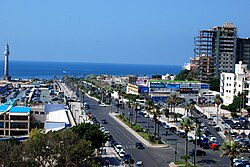
- Key Landmarks: Bliss Street, Hamra Street, and the Corniche Beirut.
Prehistoric Archaeology of Ras Beirut
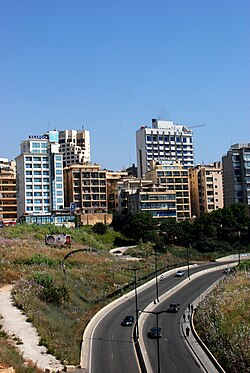
The archaeological landscape of Ras Beirut is vast, characterized by marine terraces and fossil beaches. Much of the early research was conducted by Father Henri Fleisch of Saint Joseph University, who performed extensive surveys starting in 1946. While many sites have been lost to urban development, the remaining findings provide a chronological map of human activity in the region.
Paleolithic and Neolithic Sites
The area contains a sequence of stratified sites (sites where artifacts are found in distinct layers). The first four sites date back to the Lower Paleolithic, found at the 45-meter beach level. Subsequent sites represent the Middle Paleolithic, with a notable gap leading to the Chalcolithic period.
Notable sites include:
- Ras Beirut I (The Slope Breccia): Located on a limestone cliff, this site yielded an Early Acheulean rolled biface, the oldest tool found in the area.
- Ras Beirut II (The Offshore Bar): A fossil bar of flint and gravel containing Tayacian tools with Levallois influence.
- Ras Beirut IV (Bergy's Trench): Located near Pigeon Rock, this site revealed Early Levalloisian industries and bifacial picks.
- Ras Beirut XIII (Field south of Pigeon Rock): Known for the "Golden Mousterian" industry, characterized by flint tools with a distinct yellow sheen.
The Significance of Minet ed Dhalia
Ras Beirut XI, known as Minet ed Dhalia, is regarded as one of the richest factory sites in Lebanon. Originally thought to be Solutrean, it was later reclassified as Chalcolithic (the transition period between the Neolithic Stone Age and the Bronze Age), dating between 3800 and 3650 BCE.
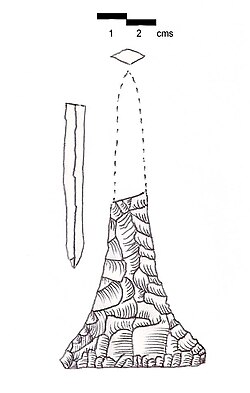
The site is famous for the Minet ed Dhalia point, a white patinated flint stylet ranging from 2 to 8 inches in length. While their exact purpose is debated, they may have served as fleshing tools. The collection includes javelins, borers, and picks, many of which are now housed in the National Museum of Beirut.
Demographics and Social Fabric
Ras Beirut is a microcosm of Lebanon's religious diversity. Based on 2014 registered voter data, the population is predominantly Muslim (67.83%), with Sunni Muslims making up 63.69% and Shia Muslims 4.09%. Christians represent 28.55% of the population, including a significant Greek Orthodox community (11.69%).
The Ras Beirut Art Circle
The neighborhood has fostered a unique artistic community known as the "Ras Beirut artists," a term coined by historian Kamal Boullata. This circle consists largely of Palestinian artists displaced from urban centers, including figures such as Paul Guiragossian, Jumana al-Husseini, and Juliana Seraphim. Their work often catered to international and wealthy elites.
Summary of Archaeological Sites
| Site Name | Period/Industry | Key Findings |
|---|---|---|
| Ras Beirut I | Early Acheulean | Rolled biface (oldest in area) |
| Ras Beirut II | Tayacian | Flint and gravel fossil bar |
| Ras Beirut IV | Early Levalloisian | Bifacial Bir Hassan picks |
| Ras Beirut XI | Chalcolithic | Minet ed Dhalia points (stylets) |
| Ras Beirut XIII | Mousterian | "Golden Mousterian" yellow flint |
Frequently Asked Questions
What is the Minet ed Dhalia point?
The Minet ed Dhalia point is a specific type of flint stylet, ranging from 2 to 8 inches in length, discovered at the Minet ed Dhalia site. It is believed to have been used as a fleshing tool, though its exact function remains uncertain.
Which educational institutions are located in Ras Beirut?
The neighborhood is home to the American University of Beirut (AUB) and the International College Beirut (IC).
What is the "Golden Mousterian"?
The Golden Mousterian is a nickname for the Levallois industry found at Ras Beirut XIII, so named because the flint tools possess a characteristic yellow or gold color and sheen.
Who are the Ras Beirut artists?
The Ras Beirut artists are a group of creators, many of whom were Palestinians displaced from their urban centers. Notable members include Paul Guiragossian, Jumana al-Husseini, and Juliana Seraphim.
How has urbanization affected the archaeology of the area?
Urbanization has had a significant impact, with many prehistoric sites being built over and completely destroyed. Some sites, such as Ras Beirut VII, have disappeared entirely, while others are now located beneath roads or playing fields.