The Essential World of Zostera: Exploring Marine Eelgrass
While many people are familiar with the lush greenery of terrestrial forests, some of the most vital ecosystems on Earth exist beneath the waves. Among these, the genus Zostera—commonly known as marine eelgrass—plays a critical role in maintaining the health of our oceans. Unlike freshwater seagrasses, such as Vallisneria, Zostera is a specialized group of saltwater plants that has adapted to life in the shifting tides of the sea.
What is Zostera?
Zostera is a small genus of widely distributed seagrasses consisting of 15 different species. These plants are typically perennial, meaning they live for more than two years, and are often found in estuaries or on sandy substrates. They can exist either fully submerged or partially floating on the water's surface.
Physical Characteristics
Eelgrass is easily recognized by its long, bright green, ribbon-like leaves, which generally measure about 1 centimetre (0.4 in) in width. These leaves grow from short stems that emerge from extensive, white branching rhizomes (underground stems). The plant's reproductive structures are also unique; its flowers are tucked away within the sheaths of the leaf bases, and it produces bladdery fruits that are capable of floating.
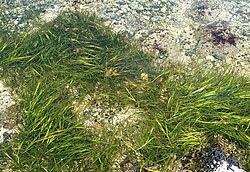
To survive in a marine environment, Zostera has developed remarkable biological adaptations. It must maintain its turgor (the internal water pressure that keeps the plant upright) despite the changing salt levels in the ocean. It achieves this by adjusting its osmolarity—the concentration of solutes within its cells—by losing solutes as the tide recedes and gaining them as the tide comes in.
Ecological Importance and Survival
Zostera beds, often forming in the mud of estuarine settings, act as much more than just underwater gardens. They are foundational to marine life, serving several vital functions:
- Sediment Stabilization: The root systems help hold the seabed in place and encourage sediment deposition.
- Habitat Creation: The beds provide a substrate for micro-invertebrates and epiphytic algae.
- Nursery Grounds: Many important species of fish and shellfish rely on these meadows as safe places to grow.
- Food Source: Eelgrass is a primary food source for animals such as wigeons, brant geese, and even the caterpillars of the grass moth Dolicharthria punctalis.
However, these ecosystems are not without threats. A slime mold known as Labyrinthula zosterae can cause wasting disease in Zostera. This disease is particularly dangerous for Zostera marina, and an outbreak can lead to a significant decline in the various marine fauna that depend on the grass for survival.
Global Distribution
The genus Zostera is found across much of the Northern Hemisphere's seashores. Its reach also extends to Australia, New Zealand, Southeast Asia, and southern Africa. Recent discoveries have expanded our understanding of its range, such as the 2005 identification of Z. chilensis on the Pacific coast of South America. Additionally, one specific species, Z. noltii, can be found in the land-locked Caspian Sea.
Human Uses: From Ancient Traditions to Modern Innovation
Throughout history, humans have found numerous ways to utilize eelgrass, ranging from dietary staples to industrial materials.
Historical and Cultural Applications
The Seri tribe of Native Americans, located on the coast of Sonora, Mexico, has a deep cultural connection to eelgrass. They have historically used the rhizomes and leaf-bases for food, eating them fresh or drying them into cakes for winter consumption. They also used the plant for smoking deer meat. The Seri language even features specific terminology for eelgrass and its harvest, including a name for the month of April that translates to "the month when the eelgrass seed is mature."
In Europe, eelgrass has served practical construction purposes. On the Danish island of Læsø, it has been used for thatched roofing. While eelgrass roofs are heavy, they are noted for being easier to maintain and much longer-lasting than traditional materials. In the United States, the Samuel Cabot Co. of Boston even marketed eelgrass insulation as "Cabot's Quilt" in the early 1900s. However, this industry collapsed due to a combination of the Great Depression and outbreaks of wasting disease, eventually leading to the widespread use of fiberglass insulation.
Modern Potential
Today, researchers are looking at Zostera through the lens of sustainability. There is significant promise in using eelgrass meadows to sequester (capture and store) atmospheric carbon, which could help mitigate anthropogenic climate change. Furthermore, Zostera can be utilized to produce biomass energy through the Jean Pain method.
Key Facts
- Genus Size: Contains 15 recognized species.
- Primary Habitat: Sandy substrates and estuaries.
- Key Threat: Wasting disease caused by the slime mold Labyrinthula zosterae.
- Climate Role: Potential for atmospheric carbon sequestration.
- Adaptation: Regulates internal pressure by adjusting solutes with the tides.
Species Overview
| Species | Primary Geographic Range |
|---|---|
| Zostera asiatica | Russian Far East, Japan, Korea, NE China |
| Zostera capensis | Madagascar, Kenya to Cape Province |
| Zostera chilensis | Chile |
| Zostera japonica | Russian Far East, Japan, China, Vietnam |
| Zostera marina | North Pacific, North Atlantic, Mediterranean, Black Sea |
| Zostera noltii | Northeastern Atlantic, Mediterranean, Black Sea, Caspian Sea |
| Zostera novazelandica | New Zealand |
Frequently Asked Questions
How does eelgrass differ from freshwater seagrass?
While they may look similar, Zostera refers specifically to saltwater marine eelgrasses. Freshwater varieties, such as Vallisneria, are different plants adapted to non-saline environments.
How does the plant survive the changing tides?
Zostera manages the changing salt concentrations of the tides by adjusting its internal solutes. This allows the plant to maintain constant internal pressure, or turgor, regardless of the surrounding water's osmolarity.
What is the "wasting disease" mentioned in studies?
Wasting disease is caused by a slime mold called Labyrinthula zosterae. It can devastate Zostera populations, particularly Z. marina, which in turn impacts the fish and shellfish that rely on the grass for habitat.
Can eelgrass help fight climate change?
Yes, scientific studies suggest that eelgrass meadows have the potential to sequester atmospheric carbon, meaning they can capture and store carbon dioxide, helping to reduce the impacts of climate change.
What were the historical uses of eelgrass in construction?
Eelgrass has been used for thatching roofs in Denmark and was even used as a commercial insulation material in the United States during the early 20th century.