Zionism and the Settler Colonial Framework in Palestine
The analysis of the Palestinian struggle through the lens of settler colonialism—a system where colonists seek to replace the indigenous population of a land with a new society of their own—emerged as a significant scholarly framework in the 1960s. This perspective gained momentum during the broader decolonization movements across Africa and the Middle East, eventually re-emerging in Israeli academia during the 1990s. Led by the "New Historians," these scholars began challenging foundational national myths and viewing the Nakba (the 1948 displacement of Palestinians) as an ongoing process rather than a single historical event.
This shift in academic thought has coincided with a political transition among some scholars and activists, moving away from the traditional two-state solution toward a one-state solution. Such a model proposes a single state where all citizens hold equal rights, a concept that fundamentally challenges the specific Jewish identity of the State of Israel.
Key Facts
- Origins: The framework emerged in the 1960s and was revitalized in the 1990s by Israeli and Palestinian scholars.
- Core Argument: Proponents argue that Zionism functioned as a settler-colonial movement aimed at establishing a home-base for the Jewish nation.
- Key Scholars: Prominent figures include Edward Said, Rashid Khalidi, Noam Chomsky, and Ilan Pappé.
- Distinctions: Early analysts like Fayez Sayegh argued that unlike European colonialism, Zionism sought nationhood rather than just economic exploitation.
- Modern Application: The paradigm is used to link diverse practices—such as home demolitions, the Gaza siege, and land theft—under a single colonial logic.
The Evolution of Colonial Analysis (1960s–1980s)
One of the earliest formal analyses was provided by Palestinian writer Fayez Sayegh in 1965. Sayegh posited that Zionists formed a "settler-community" between 1882 and 1897 with the ultimate goal of creating a "settler-state." He argued that Zionism utilized colonization as an instrument for nation-building, imitating the methods of European powers to establish a sovereign home-base.
Sayegh identified three distinct characteristics that separated Zionist colonization from European ventures: first, it was driven by a desire for nationhood rather than economic gain; second, it was viewed as incompatible with the continued existence of the native population; and third, it lacked a protecting imperial metropole, leading to an alliance with British imperialism.
By 1967, French historian Maxime Rodinson expanded this view, suggesting that Europe as a whole served as the metropole for Israeli settler colonialism. Following the 1967 war, these analyses became increasingly prominent among Palestinian intellectuals.
![Upon Israel's occupation of the Old City of Jerusalem in the 1967 Arab-Israeli War, Israeli bulldozers cleared [he] what had been the Mughrabi Quarter, creating the Western Wall Plaza.[43] Scholars have discussed such moves as examples of Israel's Judaization of Jerusalem and Israeli settler colonialism.[43][44]](/images/89/1f/891f701aabf81d58391b58ae4b0e783fac64ca2e61c035f1b8f5815a4e681acb.jpg)
The Rise of the New Historians
In the 1980s, the "colonization perspective" entered mainstream Israeli historical scholarship via the New Historians. This movement shifted the focus from purely Jewish history to the dynamics of Israeli-Palestinian relations. Scholars like Abdo and Yuval-Davis argued that the Zionist national project was predicated on the destruction of the Palestinian one, while Isma'il Raji al-Faruqi described the movement as a project to empty Palestine of its native inhabitants through force.
Contemporary Scholarly Perspectives (2000s–Present)
Modern scholars continue to refine the settler-colonial definition. Rashid Khalidi argues that Zionism is simultaneously a national movement and a settler-colonial project, asserting that one identity does not negate the other. Similarly, John Collins suggests that the architects of Zionism were conscious of their status as colonizers whose claims to the land superseded those of the Arab inhabitants.
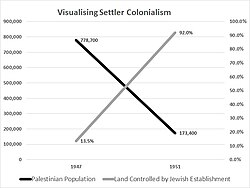
Patrick Wolfe highlighted how this colonialism manifests in immigration policies, noting the promotion of unlimited Jewish immigration while denying family reunification for Palestinian citizens. Meanwhile, sociologist Uri Ram notes that the characterization of Zionism as colonial is likely as old as the movement itself.
Regional Variations and Biopolitics
Academics Neve Gordon and Moriel Ram have noted that the application of settler colonialism varies by territory. In the Golan Heights, the state imposed unitary Israeli law and offered citizenship to some Syrian Druze to facilitate annexation. In contrast, the West Bank is governed by a dual legal structure, with no intention of incorporating Palestinians into the Israeli demos.

More recently, sociologist Elia Zureik has applied Michel Foucault's theories of biopolitics—the administration of human life and populations—to argue that racism and surveillance are central tools of governance in the Zionist project.
Comparative Frameworks and Conclusions
Historian Nur Masalha draws parallels between the Palestinian experience and other indigenous peoples globally, citing the erasure of material culture and the reinvention of history by settlers. Some scholars, such as Rosaura Sánchez and Beatrice Pita, argue that the effects on Palestinians have been more severe than those experienced by Spanish and Mexican populations in the American Southwest following the Treaty of Guadalupe Hidalgo.
While the settler-colonial framework is an empirical tool, it is frequently associated with the advocacy for a one-state solution. Sociologist Rachel Busbridge suggests this frame provides a more accurate portrayal of the conflict than narratives of "Palestinian criminality," though she notes limitations regarding the practical application of decolonization.
| Scholar/Group | Key Contribution/Perspective | Core Argument |
|---|---|---|
| Fayez Sayegh | Early Analysis (1965) | Colonization as an instrument for nation-building. |
| New Historians | Israeli Academic Shift (1980s-90s) | Refuted foundational myths; viewed Nakba as ongoing. |
| Rashid Khalidi | Dual-Nature Theory | Zionism is both a national movement and settler colonialism. |
| Patrick Wolfe | Policy Analysis | Colonialism seen in immigration and population control. |
| Elia Zureik | Biopolitical Approach | Racism and surveillance as tools of colonial governance. |
Frequently Asked Questions
What is the settler colonial framework?
It is an analytical lens that views the conflict not as a clash between two equal national movements, but as a process where a settler group seeks to replace the indigenous population of a territory to establish their own sovereign state.
How does Zionist colonialism differ from European colonialism?
According to Fayez Sayegh, European colonialism was primarily driven by economic exploitation or imperial expansion. In contrast, Zionist colonization was driven by the desire to achieve nationhood and establish a permanent home-base.
Who are the New Historians?
The New Historians are a group of Israeli scholars who emerged in the 1980s. They utilized previously classified archives to challenge traditional Israeli narratives and examine the colonial aspects of Zionist settlement.
What is the relationship between this framework and the one-state solution?
Because the settler-colonial paradigm views the state's foundation as an act of displacement, many proponents argue that the only just resolution is a single state with equal rights for all citizens, rather than dividing the land into two separate states.
How does the framework explain the difference between the West Bank and the Golan Heights?
Scholars argue that the "completeness" of ethnic cleansing differs; in the Golan Heights, the state used citizenship to facilitate annexation, whereas in the West Bank, a dual legal system maintains a separation between the settlers and the indigenous population.