Zambo Ancestry: The History and Culture of African-Amerindian Mixed Heritage
The term Zambo (or Sambu) refers to individuals of mixed sub-Saharan African and Amerindian ancestry. Emerging from the complex social and racial dynamics of colonial Latin America and the Caribbean, this identity represents a unique intersection of two continents' histories. While the term is most common in Spanish-speaking regions, similar identities exist across the Americas, reflecting the diverse ways African and Indigenous peoples interacted, survived, and built new communities.
Key Facts
- Definition: A person of mixed African and Amerindian descent.
- Regional Terms: Known as cafuzo in Brazil and lobo (wolf) in colonial Mexico.
- Geographic Presence: Significant populations in Colombia, Brazil, Venezuela, Guyana, Ecuador, and Panama.
- Notable Groups: Includes the Garifuna and the Miskito people.
- Genetic Insight: Afro-Ecuadorians show a high average of Amerindian heritage (35.86%).
Terminology and the Casta System
The word Zambo is believed to have roots in Romance languages or Latin. In the gendered language of Spanish, the feminine form is zamba. In Brazil, the equivalent term is cafuzo, though in Portugal and Portuguese-speaking Africa, cafuzo specifically refers to someone born of an African parent and a person of mixed African and European ancestry.
During the colonial era, the Spanish implemented a rigid racial hierarchy known as the Casta system. In New Spain (modern-day Mexico), those of mixed African and indigenous ancestry were often officially documented as lobo, meaning "wolf." Other specific terms existed to describe varying ratios of ancestry, such as cambujo for a mixture of Zambo and Amerindian.
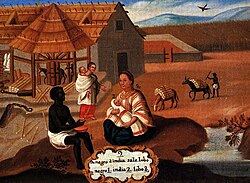
These classifications were not merely social but were recorded in official marriage registers and government documentation to maintain social order.

Historical Origins and Development
The mixing of African and Amerindian populations began in the early 16th century on the island of Hispaniola, following the arrival of enslaved Africans. These two groups often found common ground while working in mines or on sugar cane plantations. In many instances, Africans escaped slavery and sought refuge within indigenous communities.
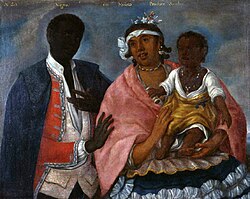
Over time, some Zambo groups established their own autonomous power structures. In Esmeraldas, Ecuador, shipwrecked former slaves took control of indigenous communities and eventually acted as representatives before Spanish authorities in the late 16th and early 17th centuries.
Another prominent example is the Misquito Zambos. Following a slave ship revolt in 1640, survivors wrecked their vessel at Cape Gracias a Dios (on the border of Honduras and Nicaragua) and merged with the indigenous Miskito people. By the 18th century, the Afro-Miskito people dominated the region, engaging in slave raids and forming an alliance with English merchants, which facilitated the establishment of British Honduras (now Belize).
Contemporary Populations and Cultural Identity
Today, Zambo populations remain significant minorities in several northwestern South American and Central American countries. In Ecuador, recent unions between Amerindian men and Afro-Ecuadorian women are common in coastal cities and the Imbabura province. A 2021 study published in Human Genetics and Genomic Advances revealed that Afro-Ecuadorians possess an average of 35.86% Amerindian heritage, which is significantly higher than other Afro-latino groups to the north.
In Central America, two distinct mixed groups have flourished:
- The Miskito: Descendants of the 1640 revolt and indigenous Miskito people.
- The Garifuna: Formed from Africans who fled or were shipwrecked on St. Vincent. After being deported by the British in 1797 for supporting France, they settled along the coasts of Honduras, Nicaragua, and Belize.
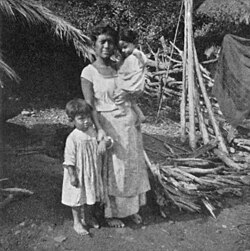
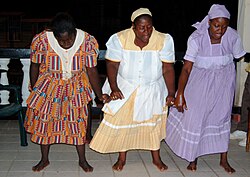
In Mexico, where the term lobo was historically used, many people of this ancestry have been absorbed into the broader mestizo (mixed European and Indigenous) population. However, the 2015 Intercensus Estimate found that 896,829 people identified as both Afro-Mexican and Indigenous Mexican, with concentrations in southern coastal states like Oaxaca, Guerrero, and Veracruz.
Culturally, these groups often leaned toward Amerindian traditions. In Mexico, lobos were frequently raised by Amerindian mothers, adopting their culture. Similarly, Afro-Bolivians in the Yungas region of La Paz have retained Amerindian influences, including traditional dress and the use of the Aymara language.
Summary of Regional Terms and Groups
| Region | Primary Term | Notable Groups/Details |
|---|---|---|
| Spanish America | Zambo / Zamba | General term for mixed African-Amerindian |
| Colonial Mexico | Lobo | Literally "wolf"; used in official registers |
| Brazil | Cafuzo | Equivalent to Zambo |
| Central America | Garifuna / Miskito | Distinct ethnic groups with autonomous histories |
| Bolivia | Afro-Bolivian | Strong Aymara cultural influence in Yungas |
Racism and Discrimination
Despite their rich cultural contributions, populations of African and Amerindian ancestry have historically faced systemic marginalization and discrimination across the Americas, often occupying the lower tiers of colonial social hierarchies.
Frequently Asked Questions
What is the difference between a Zambo and a Mulatto?
A Zambo refers to a person of mixed African and Amerindian ancestry, whereas a Mulatto refers to a person of mixed African and European ancestry.
Why were Zambo people in Mexico called "lobos"?
In the colonial Casta system of New Spain, lobo (meaning wolf) was the official classification used in marriage registers and documentation to denote those of mixed African and indigenous descent.
Who are the Garifuna people?
The Garifuna are a mixed-race group of African and Amerindian descent who originated on St. Vincent and later settled along the coasts of Central America, specifically from Nicaragua to Belize.
How much Amerindian ancestry do Afro-Ecuadorians typically have?
According to a 2021 genetic study, the average Afro-Ecuadorian carries approximately 35.86% Amerindian heritage, which is higher than many other Afro-latino groups in the region.
What is a cafuzo?
A cafuzo is the Portuguese term used in Brazil to describe a person of mixed African and Amerindian ancestry, serving as the equivalent to the Spanish term Zambo.