Unlocking the Secrets of the Yixian Formation: A Window into the Early Cretaceous
Deep within the Liaoning province of China lies one of the world's most significant geological treasures: the Yixian Formation. Part of the larger Jehol Group, this formation acts as a prehistoric time capsule, preserving an incredibly detailed record of life during the Early Cretaceous period. Known for its "exquisitely preserved fossils," the Yixian Formation provides scientists with unparalleled insights into the evolution of birds, feathered dinosaurs, and ancient ecosystems.
The formation is characterized by a complex landscape of lacustrine deposits (sediments formed in lakes) interspersed with volcanic material. This suggests a dynamic environment where long-lived lake systems were frequently interrupted by catastrophic volcanic activity, a process that helped seal and preserve biological remains in extraordinary detail.
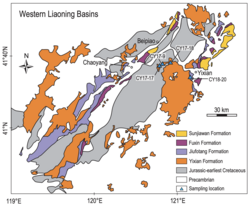
Key Facts
- Location: Jinzhou, Liaoning, China.
- Geological Age: Barremian stage of the Early Cretaceous (approx. 125.75–124.12 Ma).
- Primary Composition: Basalt and siliciclastic sediments.
- Famous For: The Jehol Biota, including feathered non-avian dinosaurs and early birds.
- Climate: Temperate with humid periods and seasonal aridity.
Geological History and Age Refinement
The study of the Yixian Formation has evolved significantly since it was first defined by Amadeus William Grabau in 1923. Early research was conducted by Japanese scientists during the occupation of Rehe Province, but much of that early data was lost following World War II. Since the 1990s, however, a new era of excavation has revolutionized our understanding of dinosaur evolution, particularly through the discovery of the first known non-avian theropods (carnivorous dinosaurs) with feathers.
Determining the exact age of the formation has historically been a challenge. While older studies suggested a Jurassic origin, modern biostratigraphic correlation—the process of matching fossils with known age markers—places the formation firmly in the Early Cretaceous. Scientists have used various radiometric dating methods, such as potassium-argon and uranium-lead, to pinpoint its age. Recent high-precision argon-argon dating of basalts has narrowed the deposition window significantly, suggesting the entire formation was deposited over a relatively short period of approximately 1.633 million years.
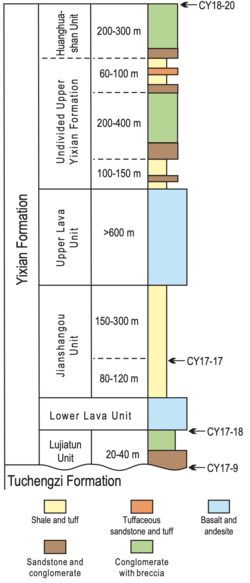
The Layers of the Yixian: Stratigraphy and Subunits
The Yixian Formation is the middle unit of the Jehol Group, sitting between the older Dabeigou Formation and the younger Jiufotang Formation. Geologists divide the formation into several distinct subunits based on their composition and thickness:
- Lujiatun Unit: 20–40 metres thick, composed of sandstone, conglomerate, and breccia.
- Lower Lava Unit: Composed of basalt and andesite.
- Jianshangou Unit: 230–420 metres thick, composed of shale and tuff.
- Upper Lava Unit: Over 600 metres thick, composed of basalt and andesite.
- Upper Yixian: 360–650 metres thick, primarily conglomerate with breccia.
- Huanghuanshan Unit: 200–300 metres thick, primarily conglomerate with breccia.
While the composition of these layers is well-understood, their exact chronological order remains a subject of scientific debate. For instance, recent measurements suggest that the Lujiatun and Jianshangou units may have been deposited at the same time rather than in a strict sequence.
Paleoclimate: A Temperate World
Contrary to the popular image of a universally hot Mesozoic era, the Yixian Formation reveals a much cooler reality. Chemical analysis of oxygen isotopes suggests an average yearly temperature of approximately 10 degrees Celsius (50 degrees Fahrenheit). This indicates a temperate climate with unusually cold winters, likely due to the high latitude of northern China at the time.
The environment was characterized by a humid climate, evidenced by the abundance of ferns, cycads, and horsetails. However, growth rings in petrified wood show that this humidity was not constant; the region experienced regular dry seasons. Scientists believe these climate fluctuations may have been driven by orbital forcing—changes in the Earth's tilt and orbit.
The Jehol Biota: A Burst of Life
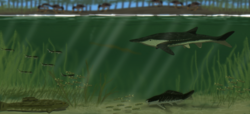
The Yixian Formation is a cornerstone of the Jehol Biota, a fossil assemblage known for its incredible diversity. The ecosystem was built around freshwater lakes that were enriched by volcanic minerals. This nutrient-rich environment, combined with frequent disturbances like wildfires and volcanic gases, may have spurred rapid biological diversification.
Vertebrate Diversity
The formation preserves a massive radiation of life, including:
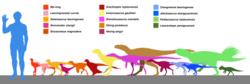
- Dinosaurs: Famous specimens include the large tyrannosauroid Yutyrannus, the feathered Beipiaosaurus, and the ceratopsian Psittacosaurus.
- Birds: The Yixian marks the first major radiation of birds in the Jehol Group.
- Mammals: It contains the largest mammal radiation known from the Jehol Group.
- Fish and Reptiles: The dominant fish species was Lycoptera, and many vertebrates show evidence of being arboreal (tree-dwelling).
Invertebrates and Plant Life
Invertebrates such as insects experienced their largest diversification of the entire Mesozoic era within the Yixian. Insects, ostracods (seed shrimp), and clam shrimp are common. The flora was equally diverse, featuring extensive forests of ginkgoes, conifers, and cycads, alongside primitive flowering plants like Archaefructus.
Summary of Geological Data
| Feature | Details |
|---|---|
| Geological Age | Barremian (Early Cretaceous) |
| Location | Liaoning, China |
| Primary Lithology | Basalt and Siliciclastic sediments |
| Key Biota | Jehol Biota (Feathered dinosaurs, early birds, diverse insects) |
| Climate | Temperate, humid with seasonal dry periods |
Frequently Asked Questions
What makes the Yixian Formation so famous?
It is world-renowned for its Lagerstätte quality, meaning it preserves fossils with extraordinary detail. Most notably, it has provided the first evidence of many non-avian dinosaurs possessing feathers.
How old is the Yixian Formation?
Recent high-precision dating places the formation in the Barremian stage of the Early Cretaceous, with an estimated age between 125.75 and 124.12 million years ago.
What kind of environment existed in the Yixian?
The region consisted of a dynamic system of freshwater lakes surrounded by forests of conifers, ginkgoes, and ferns. The climate was temperate, with an average temperature of about 10°C, and featured distinct wet and dry seasons.
Why are the fossils so well-preserved?
The combination of lacustrine (lake) environments and frequent volcanic activity played a key role. Volcanic ash and gases likely helped to rapidly cover and preserve organisms, sometimes through events like limnic eruptions.
Which dinosaurs are found in the Yixian Formation?
The formation is home to a wide variety of dinosaurs, including the feathered Yutyrannus, Beipiaosaurus, Sinosauropteryx, and the ceratopsian Psittacosaurus.