Yazan Halwani: Redefining Beirut Through Calligraffiti and Public Art
In the heart of Beirut, the city's walls serve as more than just boundaries; they are canvases for social commentary and cultural reclamation. Yazan Halwani, a prominent Lebanese artist, has transformed the urban landscape of his hometown through a sophisticated blend of graffiti, murals, and sculptures. By merging traditional Middle Eastern aesthetics with modern street art, Halwani seeks to foster a unified national identity rooted in secularism, moving beyond the sectarian divisions that have historically fragmented Lebanon.
Halwani's academic background is as diverse as his art, holding degrees from the American University of Beirut and Harvard Business School. His journey into public art began as a form of protest against the legacy of the Lebanese Civil War (1975-1990) and the prevailing sectarian political climate. For Halwani, art is a tool for construction in a city that has seen significant destruction.
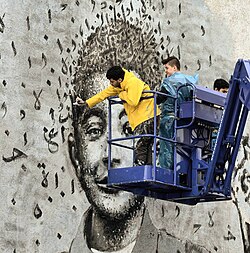
Key Facts
- Artist: Yazan Halwani, based in Beirut, Lebanon.
- Style: A unique fusion of Arabic calligraphy and street art known as "calligraffiti."
- Core Theme: Celebrating Lebanese cultural heritage and promoting a secular, unified national identity.
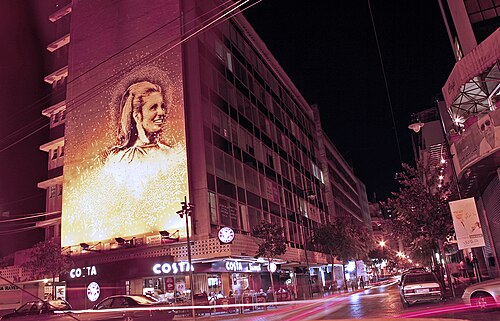
- Most Famous Work: The Eternal Sabah mural in the Hamra neighborhood of Beirut.
- Education: Graduate of the American University of Beirut and Harvard Business School.
The Evolution of a Style: From Graffiti to Calligraffiti
Halwani began experimenting with graffiti in 2007, taking advantage of the loose regulations regarding street art in Beirut. While initially influenced by the hip-hop and graffiti scenes of the United States and Europe, he soon felt the need to create a visual language independent of Western influence. This shift occurred around 2011, spurred by a book on Arabic calligraphy shared with him by his uncle.
Redefining Calligraphy
Halwani developed a style he calls calligraffiti. Unlike traditional Arabic calligraphy, which typically focuses on the meaning of sacred texts, poems, or sayings, Halwani's approach prioritizes form over meaning. He treats Arabic letters as visual elements—essentially "pixels"—to create movement, note music, or build the structure of a portrait.
This departure from tradition allows the calligraphy to serve as a modern compositional tool. By stripping away the literal meaning of the words, Halwani focuses on the shape and movement of the script, transforming the act of calligraphy into a purely artistic expression of the city's energy.
Art as a Constructive Force
Halwani views his work as a direct response to the "vandalism" of war and political corruption. While graffiti is often associated with destruction, he intends his murals to be constructive additions to the urban environment, celebrating the faces and icons that bring people together.
Major Works and Global Reach
Halwani's work is characterized by large-scale portraits of Arab and Lebanese cultural icons. His most iconic piece is the Eternal Sabah mural in Beirut's Hamra neighborhood. This massive portrait of the legendary Lebanese singer Sabah is painted on a building that once housed the Horseshoe cafe, a historic gathering place for intellectuals and artists such as Mahmoud Darwish, Nizar Qabbani, and Paul Guiragossian.
Beyond Lebanon, Halwani's work has gained international recognition. In Germany, he created "The Flower Salesman," a poignant mural depicting Fares, a Syrian child who sold flowers in Beirut before passing away during the Syrian Civil War.
Summary of Global Exhibitions
| Year | Exhibition/Venue | Location |
|---|---|---|
| 2014 | Djerbahood Open Air Museum | Djerba, Tunisia |
| 2014 | Singapore Art Fair | Singapore |
| 2014 | Liquid Art House | Boston, USA |
| 2015 | Horouf Art Exhibition | Dubai, UAE |
| 2015 | Institut du Monde Arabe | Paris, France |
| 2015 | UrbanArt Biennale | Saarbrücken, Germany |
Frequently Asked Questions
What is the primary goal of Yazan Halwani's art?
Halwani aims to celebrate Lebanon's unique cultural heritage and promote a unified, secular national identity as a way to move past the country's history of sectarian politics and civil war.
How does Halwani's use of calligraphy differ from traditional methods?
Traditional calligraphy focuses on the meaning of the words (such as religious texts). Halwani removes the meaning to focus solely on the shape, movement, and composition, using letters as visual building blocks or "pixels" for his portraits.
Who is the subject of the Eternal Sabah mural?
The mural portrays Sabah, a famous Lebanese singer and artist, and is located in the Hamra neighborhood of Beirut.
What inspired Yazan Halwani to move away from Western graffiti styles?
While initially influenced by US and European hip-hop culture, Halwani wanted a style independent of the West. He turned to Middle Eastern art and Arabic calligraphy after being inspired by a book provided by his uncle.
Does Yazan Halwani create art other than murals?
Yes, in addition to his large-scale murals and graffiti, Halwani has recently begun installing cement sculptures on the streets.