Yanbian Korean Autonomous Prefecture
Located in the northeast of China within Jilin Province, the Yanbian Korean Autonomous Prefecture serves as a unique cultural and administrative bridge between China, North Korea, and Russia. With its prefectural seat in Yanji, this region is the primary home of the Joseonjok (ethnic Koreans in China), blending distinct Korean traditions with Chinese governance and economic systems.
The prefecture is characterized by its diverse landscape, ranging from the rugged peaks of the Changbai Mountains to the strategic river borders that define its international boundaries. It is a region where bilingualism is common and history is etched into the landscape, from ancient Balhae archaeological sites to the modern urban centers of the 21st century.
Key Facts
- Prefectural Seat: Yanji
- Total Area: 43,329.3 km²
- Population: 2,015,500 (2022)
- Ethnic Composition: 65.79% Han, 30.77% Korean, 3.44% other (2020 Census)
- GDP: Approximately CN¥ 100 billion (US$ 14.49 billion)
- Bordering Countries: North Korea (522.5 km) and Russia (232.7 km)
History and Administrative Evolution
During the Ming dynasty, the region was governed by the Jianzhou Guard. By the late Qing dynasty, it was divided into the Yanji and Hunchun subprefectures. For centuries, the Manchurian Qing state restricted Han Chinese immigration to prevent the assimilation of the Manchu people. However, these rules were eventually relaxed during the Chuang Guandong movement to counter Russian encroachment, leading to a mass migration of Han Chinese into the region during the 19th century.
The Yanbian Autonomous Region was officially established on September 3, 1952. Due to population size, it was administratively downgraded to an Autonomous Prefecture in December 1955. While ethnic Koreans once composed roughly 60% of the population in 1952, this figure shifted to 32% by 2000, reflecting broader demographic changes in the province.
Geography and Environment
Yanbian occupies a strategic position with a total border length of 755.2 kilometers. The terrain is dominated by several significant mountain ranges and river systems that support the local ecosystem and economy.
Mountains and Peaks
- Changbai Mountains (central range)
- Zhangguangcai Range
- Harba Peak, Peony Peak, and Old Master Peak
- Nangang Mountain Range
Major Waterways
The region is drained by several vital rivers, including the Songhua River, the Mudan River (also known as the Peony River), and the Tumen River, along with its branch, the Gaya River, and the Hunchun River.
The natural environment is rich in biodiversity, hosting approximately 1,460 species of native animals.
Demographics and Society
As of 2022, the total registered population was 2.015 million, with a high urbanization rate of 69.6%. The ethnic landscape is diverse, though predominantly Han. According to the 2020 census, the population consists of 65.79% Han, 30.77% Korean, and 2.80% Manchu.
A notable demographic trend is the sex ratio among ethnic Koreans. While the overall ratio is balanced at 99.1, there is a distinct split between urban and rural areas: urban centers like Yanji have more women (ratio of 95.3), while rural counties have more men (ratio of 105.7).
Economy and Infrastructure
Yanbian's economy has undergone a significant transformation since the 1990s. Following the normalization of diplomatic relations between China and South Korea in 1992, the region saw an influx of South Korean investment and culture. This sparked a trend known as Hanggukbaram (the "Korean dream"), where many Joseonjok migrated to South Korea for work.
By 2011, annual remittances from these migrants reached $1 billion USD, accounting for one-third of the prefecture's GDP. The economy has since shifted from a reliance on farming and industry toward services and tourism.
Transportation Networks
The region is well-connected via several railway lines, including the Chang-Tu, Mu-Tu, and Chao-Kai lines, as well as the Jilin–Hunchun intercity railway.
Education and Culture
Education in Yanbian has historically been a site of political struggle. During the Japanese occupation of Manchuria, Korean-run schools were often linked to anti-Japanese resistance, leading to crackdowns and the banning of the Korean language in the 1930s. After the occupation ended, there was a surge in enrollment and the establishment of new primary and middle schools.
In recent decades, however, enrollment in Korean-language schools has declined as more students attend Han schools to improve their Mandarin Chinese fluency, which is seen as essential for socioeconomic mobility. Despite this, the region maintains a high level of academic achievement; as of 2017, the rate of university degree holders was 2.13 times the national average.
Cultural Preservation
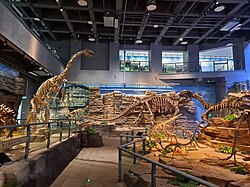
The Yanbian Museum, constructed in 1982, preserves the region's heritage with over 10,000 exhibits. To maintain accessibility for the local population, all labels, explanations, and tour guides are provided bilingually in Korean and Chinese.
Regional Summary
| Category | Detail |
|---|---|
| Administrative Seat | Yanji |
| Total Area | 43,329.3 km² |
| Primary Languages | Mandarin Chinese, Korean |
| Key Industries | Services, Tourism, Secondary Industry |
| Major Landmarks | Changbai Mountains, Yanbian Museum, Paektu Mountain |
Frequently Asked Questions
What is the ethnic composition of Yanbian?
According to the 2020 census, the population is 65.79% Han, 30.77% Korean, and 2.80% Manchu, with smaller percentages of other ethnic groups such as the Hui and Mongol.
What is the "Hanggukbaram" phenomenon?
Hanggukbaram, meaning "Korean dream" or "Korean wind," refers to the trend of Joseonjok (ethnic Koreans in China) migrating to South Korea for employment and economic opportunities, particularly after 1992.
Which cities are located within the Yanbian Prefecture?
The prefecture includes six county-level cities: Yanji, Tumen, Dunhua, Hunchun, Longjing, and Helong, as well as Wangqing and Antu counties.
How has education changed for ethnic Koreans in the region?
While there was a rapid expansion of Korean schools in the late 1970s, the 21st century has seen a decline in Korean-language school enrollment as more students opt for Han schools to gain fluency in Mandarin Chinese.
What are the main geographical borders of Yanbian?
Yanbian shares an international border with North Korea (522.5 km) and Russia (232.7 km).