Xul Solar: The Visionary Artist of Light and Language
Oscar Agustín Alejandro Schulz Solari, known to the world as Xul Solar, was far more than a painter. He was a polymath—a sculptor, writer, and inventor who spent his life constructing an intricate bridge between the physical world and the metaphysical. From the streets of Buenos Aires to the avant-garde hubs of Europe, Xul Solar blended mysticism, mathematics, and art to create a unique visual and linguistic universe.
Key Facts
- Real Name: Oscar Agustín Alejandro Schulz Solari.
- Artistic Style: A blend of Expressionism, Surrealism, Symbolism, and Modernism.
- Primary Medium: Watercolor and tempera on small-format paper.
- Major Inventions: Two imaginary languages (Neo Criollo and Pan Lingua) and a version of "non-chess."
- Key Association: A lifelong close friendship with the legendary writer Jorge Luis Borges.
- Legacy: The Fundación Pan Klub and the Museo Xul Solar in Tigre, Argentina.
The Journey of a Cosmopolitan Soul
Born in San Fernando, Argentina, in 1887, Xul Solar grew up in a multicultural environment. His father was of Baltic German origin from Riga, and his mother was Italian. This cosmopolitan upbringing fostered a lifelong curiosity that led him to study music and architecture in Buenos Aires before embarking on a transformative journey to Europe in 1912.
During his travels through London, Paris, Turin, and Florence, he immersed himself in the epicenter of the avant-garde. He encountered Cubism, Futurism, and German Expressionism, all of which influenced his evolving style. It was during this period that he adopted the pseudonym Xul Solar. The name was a deliberate construction: "Xul" is "lux" (Latin for light) spelled backward, and "Solar" refers to the sun, symbolizing his affinity for the universal source of energy.
Artistic Style and Philosophical Interests
Xul Solar's work is characterized by bright colors, striking contrasts, and a small scale. His style is often described as a middle ground between the abstract geometry of Wassily Kandinsky and Paul Klee and the dreamlike narratives of Marc Chagall. Beyond traditional painting, he experimented with unorthodox media, including modifying pianos to include three rows of keys.
His art was deeply intertwined with his spiritual and intellectual pursuits. He was a student of astrology (the study of the movements and relative positions of celestial bodies), Buddhism, and the belief in reincarnation. These interests manifested in his paintings through recurring symbols such as stairs, roads, and representations of the divine.
The Invention of Languages and Games
Xul Solar believed that existing languages were insufficient to express the complexities of the universe. To solve this, he created two imaginary languages:
- Neo Criollo: A poetic fusion of Spanish and Portuguese used in daily conversation.
- Pan Lingua: A universal language designed to link mathematics, music, astrology, and visual arts.
His passion for systems extended to gaming, where he developed his own version of chess, which he termed "non-chess."
Analysis of Major Works
Entierro (Burial), 1915
One of his early signature works, Entierro, is a watercolor that depicts a celestial funeral procession. Led by a floating angel, the figures feature profiles reminiscent of Pre-Columbian and Ancient Egyptian art. The painting replaces traditional halos with luminous peaks, suggesting a reimagined afterlife that diverges from standard Christian iconography.
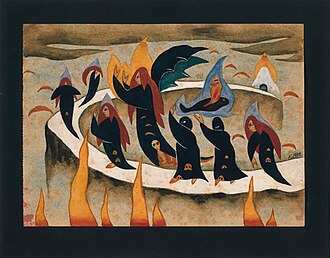
This piece reflects Xul's break from the official Argentine art institutions of the time, which favored rural gaucho culture and pampas landscapes. Instead, Xul focused on internal, imaginative landscapes, utilizing flat shapes and bold colors influenced by Cubism.
Fiordo (Fiord), 1943
In contrast to his earlier vibrant works, Fiordo was created during the Second World War. This period saw Xul move toward a more ascetic style, reflecting the anguish and inhumanity of the global conflict. These later works are considered some of his most emotionally expressive pieces.
The Borges Connection and Legacy
Xul Solar maintained a profound intellectual bond with Jorge Luis Borges. They shared interests in Eastern philosophy, the I Ching, and the works of William Blake and Emanuel Swedenborg. Xul even appeared as a character in Borges's semi-fictional story "Tlön, Uqbar, Orbis Tertius" and illustrated the limited edition of Un modelo para la muerte.
In 1939, Xul founded the Pan Klub, a salon for intellectuals. This vision was later formalized by his widow, Micaela Cadenas, through the Fundación Pan Klub, which established the Museo Xul Solar in 1993. The museum serves as a repository for his paintings, sculptures, and extensive personal archive.
| Category | Key Contribution / Detail |
|---|---|
| Visual Arts | Watercolor and tempera; blend of Surrealism and Modernism. |
| Linguistics | Created Neo Criollo and Pan Lingua. |
| Spirituality | Astrology, Buddhism, and custom Tarot cards. |
| Mathematics | Exponent of duodecimal (base-12) mathematics. |
| Key Works | Entierro (1915), Fiordo (1943). |
Frequently Asked Questions
What does the name Xul Solar mean?
The name is a symbolic construction. "Xul" is the word "lux" (Latin for light) spelled backward, and "Solar" refers to the sun. Together, they represent "the light of the sun," reflecting the artist's obsession with energy and light.
What was the "Florida group"?
The Florida group (also known as the Martín Fierro group) was an Argentine avant-garde circle that included Xul Solar and Jorge Luis Borges. They sought to bring aesthetic modernity to Argentina, moving away from traditional nationalistic art.
What are Neo Criollo and Pan Lingua?
Neo Criollo was a spoken poetic fusion of Spanish and Portuguese. Pan Lingua was a more ambitious project: a world language intended to unify mathematics, music, astrology, and the visual arts.
How did World War II affect his art?
The horrors of the Second World War led Xul Solar to create more ascetic and anguished works, such as Fiordo, marking a shift from his earlier, more whimsical and colorful explorations.
Where can his work be seen today?
Much of his work, along with his personal library and archives, is housed at the Museo Xul Solar in Tigre, Argentina, which was established by the Fundación Pan Klub.