Xpuhil: The Architectural Legacy of the Río Bec Maya
Deep within the jungles of Mexico lies Xpuhil, an ancient Maya settlement renowned for its distinctive architectural style. Characterized by towering facades and intricate designs, the site serves as a primary example of the Río Bec style—a regional architectural tradition known for its non-functional towers that mimic the appearance of larger palaces.
The Timeline of Xpuhil
Determining the exact chronology of Xpuhil is a complex task for archaeologists. While evidence suggests the site may have been settled as early as the Early Classic period, the bulk of the surviving architecture and artifacts date back to the end of the Classic period. The National Institute of Anthropology and History (INAH) estimates that the site was occupied between 300 and 1200 AD.
Precise dating remains elusive because Xpuhil exhibits significant architectural variations when compared to other Río Bec style settlements, making it difficult to synchronize its timeline with neighboring sites.
Rediscovery and Documentation
After centuries of being reclaimed by the forest, Xpuhil was rediscovered in 1938 by Karl Ruppert and John Denison. Shortly after its discovery, the site was visited by Tatiana Proskouriakoff, a distinguished archaeologist and architectural draftswoman. In 1943, Proskouriakoff produced a detailed reconstruction drawing of Structure I.
These historical drawings are now invaluable to researchers. Because the structures have suffered significant deterioration since the 1940s, a reconstruction of this accuracy would be nearly impossible to achieve today.
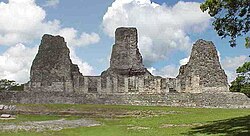
Despite its historical importance, the site has faced modern challenges. Since its rediscovery, Xpuhil has been frequently targeted by looters seeking to steal pieces of its complex and ornate facades.
Xpuhil Cuartel: The "Barracks" Site
Beyond the main complex lies an intriguing area known as Xpuhil Cuartel. Located approximately 2 km south-southeast of the three-towered Structure I, this area is situated within a Mexican army camp. The name "Xpuhil Cuartel" literally translates to "Xpuhil barracks," reflecting its proximity to the military installation.
This specific area was discovered in January 1999, with reconstruction efforts taking place between June and October of that same year.
Key Facts
- Estimated Occupation: 300 to 1200 AD.
- Architectural Style: Río Bec style, characterized by decorative towers.
- Rediscovered: 1938 by Karl Ruppert and John Denison.
- Key Documentation: Detailed 1943 drawings of Structure I by Tatiana Proskouriakoff.
- Xpuhil Cuartel: A secondary site discovered in 1999 located near a military camp.
| Feature | Details |
|---|---|
| Estimated Date Range | 300 AD – 1200 AD |
| Primary Style | Río Bec |
| Rediscovery Year | 1938 |
| Key Structure | Structure I |
| Secondary Site | Xpuhil Cuartel (discovered 1999) |
Frequently Asked Questions
When was Xpuhil occupied?
According to INAH estimates, Xpuhil was occupied between 300 and 1200 AD, though most of its architecture dates to the end of the Classic period.
Who were the people responsible for rediscovering Xpuhil?
The site was rediscovered in 1938 by Karl Ruppert and John Denison.
Why are Tatiana Proskouriakoff's drawings so important?
Her 1943 reconstruction of Structure I provides a level of detail that is no longer possible to capture because the buildings have deteriorated significantly since then.
What is Xpuhil Cuartel?
Xpuhil Cuartel is an area discovered in 1999 located about 2 km south-southeast of Structure I. It is named "barracks" because it is located within a Mexican army camp.
What is the Río Bec style?
The Río Bec style is a regional Maya architectural tradition characterized by complex facades and towers that often serve a decorative rather than functional purpose.