X-10 Graphite Reactor: The Pioneer of Continuous Nuclear Operation
Following the success of Chicago Pile-1, the X-10 Graphite Reactor emerged as the world's second artificial nuclear reactor. Unlike its predecessor, X-10 was the first facility specifically designed and built for continuous operation, serving as a critical bridge between experimental physics and industrial-scale nuclear production.
Located at the X-10 site in Oak Ridge, this facility—later known as the Clinton Laboratories—was instrumental in the development of plutonium and the refinement of nuclear engineering techniques that would define the atomic age.
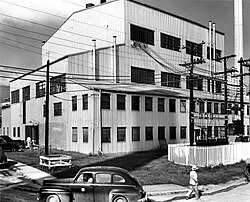
Key Facts
- First of its kind: The first nuclear reactor designed for continuous, around-the-clock operation.
- Core Composition: A 1,500 short ton block of nuclear graphite cubes used as a moderator.
- Plutonium Production: Produced the first 500 mg of plutonium by November 1943.
- Critical Mass: Initially went critical on November 4, 1943, using 30 short tons of uranium.
- Strategic Impact: Revealed the presence of plutonium-240, forcing a shift from gun-type to implosion-type weapon designs.
Reactor Design and Architecture
The heart of the X-10 reactor was a massive cube of nuclear graphite, measuring 24 feet (7.3 m) on each side. This graphite acted as a moderator, a material used to slow down fast neutrons to sustain a nuclear chain reaction. To protect operators and the environment, the core was encased in seven feet (2.1 m) of high-density concrete radiation shielding.
The overall dimensions of the structure were 38 feet wide, 47 feet deep, and 32 feet high. The internal architecture featured 36 horizontal rows of 35 holes, each leading to a metal channel. While there were many available slots, only 800 (approximately 64%) of these channels were ever utilized for fuel.
Fueling and Loading Process
The reactor utilized pure metallic natural uranium fuel slugs, each 4.1 inches (100 mm) long and 1 inch (25 mm) in diameter, sealed in air-tight aluminum cans. Each channel held between 24 and 54 of these slugs.
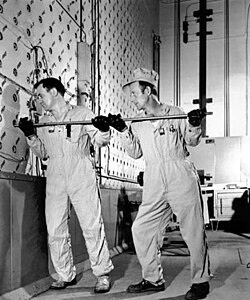
Loading was a manual process: operators removed a radiation-absorbing shield plug and inserted the slugs from the east end using long rods. To unload, the slugs were pushed through to the west end, where they fell down a chute into a 20-foot-deep (6.1 m) pool of water. This water served as a radiation shield, allowing the slugs to decay in radioactivity for several weeks before being moved to the chemical separation building.
Control Systems and Safety
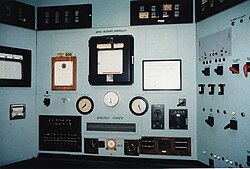
To manage the nuclear reaction, the X-10 employed control rods made of neutron-absorbing materials. These rods could either restrict or completely halt the fission process.
- The Scram System: Three 8-foot (2.4 m) cadmium-clad steel rods were suspended vertically by steel cables and electromagnetic clutches. In the event of a power loss, the clutches would release, and the rods would drop by gravity into the core to immediately stop the reaction.
- Shim and Motorized Rods: Four boron steel rods entered horizontally from the north. Two were "shim" rods controlled hydraulically (with sand-filled accumulators for backup), and two were driven by electric motors.
Cooling and Environmental Filtration
The reactor was cooled by three electric fans moving 55,000 cubic feet of air per minute. Because the system relied on ambient outside air, the reactor could actually operate at higher power levels on colder days.
To prevent the release of contaminants, the air was filtered to remove radioactive particles larger than 0.00004 inches (0.0010 mm) in diameter. This process captured over 99 percent of radioactive particles before the air was vented through a 200-foot (61 m) chimney.
Operational History and Evolution
Under the supervision of physicists Compton, Whitaker, and Fermi, the reactor went critical on November 4, 1943. By the end of that month, the first 500 mg of plutonium had been created. The facility operated nearly 24/7, with only 10-hour weekly shutdowns for refueling.
Over time, the facility's efficiency grew. By February 1944, it irradiated one ton of uranium every three days. The plutonium recovery rate improved from 40 percent to 90 percent over five months, and power output was increased from 500 kW to 4,000 kW by July 1944.
| Feature | Specification |
|---|---|
| Moderator Material | Nuclear Graphite |
| Core Dimensions | 24 ft x 24 ft x 24 ft |
| Radiation Shield | 7 ft High-Density Concrete |
| Initial Power Output | 500 kW |
| Peak Power Output | 4,000 kW |
| Total Construction Cost | $13,041,000 (approx. $159M in 2024) |
Scientific Legacy and Impact
The X-10 reactor provided the Los Alamos Laboratory with its first significant samples of plutonium. Analysis by Emilio G. Segrè and the P-5 Group revealed the presence of plutonium-240. Because this isotope has a high spontaneous fission rate, it was determined that a gun-type weapon would likely predetonate. This discovery forced scientists to develop the far more complex implosion-type nuclear weapon.
Furthermore, X-10 verified the bismuth-phosphate process for chemical separation, which was later implemented at the full-scale Hanford Site. The facility served as a training ground for the engineers and operators who would eventually manage the larger Hanford reactors.
By January 1945, X-10 transitioned from a production plant to a research facility. Additional structures, including a radioisotope building and steam plant, were completed by December 1946 to support peacetime educational and research missions.
Frequently Asked Questions
What was the primary purpose of the X-10 Graphite Reactor?
The X-10 was designed for the continuous production of plutonium and to serve as a pilot plant to test the chemical separation processes and reactor designs that would be used at the larger Hanford Site.
How did the "scram" system work in the X-10 reactor?
The scram system consisted of three cadmium-clad steel rods held above the reactor by electromagnetic clutches. If power was lost, the clutches released, allowing the rods to drop into the core and halt the nuclear reaction.
Why did the X-10 reactor lead to the development of implosion-type weapons?
Samples from X-10 revealed that the plutonium contained the isotope plutonium-240. Its high spontaneous fission rate meant a gun-type weapon would predetonate, necessitating the more complex implosion design.
How was the reactor cooled?
The reactor used an air-cooling system consisting of three electric fans. The air was filtered to remove 99% of radioactive particles before being released through a 200-foot chimney.
What was the role of graphite in the reactor?
Graphite served as the moderator, which is a material used to slow down neutrons to a speed that allows them to be more easily captured by uranium nuclei, thereby sustaining the chain reaction.